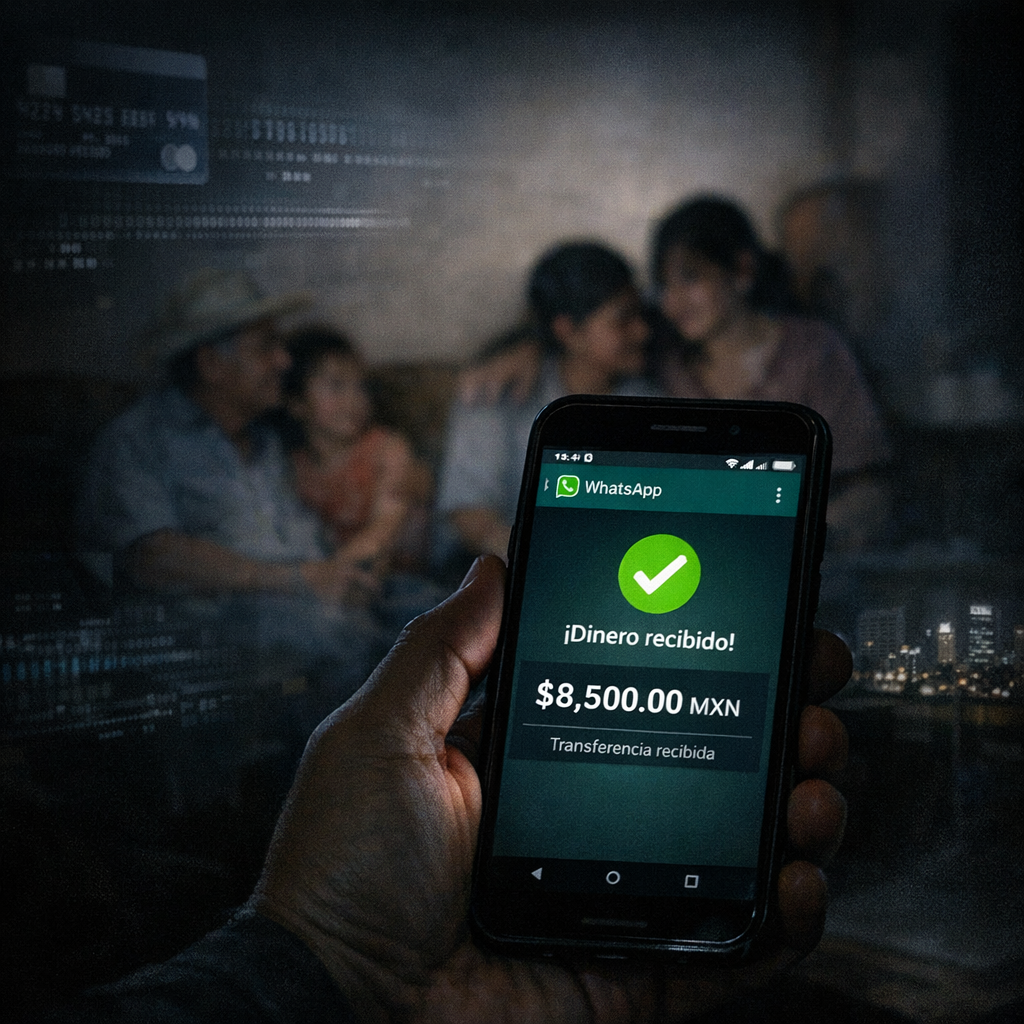
The WhatsApp Receipt: How One Small Habit Is Teaching Mexican Fintechs to Build for the World
Mexican fintech founders like to say, “If it works in Mexico, it can work anywhere.” This feature follows a small but telling behavior—the screenshot or WhatsApp receipt that migrants send back home—and uses it to map the mental blueprint behind Plata, Xepelin, Stori, and other companies that are turning the country’s financial exclusion into an exportable product laboratory.

The Hook — A Screenshot at 2:13 A.M.
At 2:13 a.m., a phone lights up in a small town in Oaxaca.
On the cracked screen: not a long bank statement, not a PDF, not a fancy app interface.
Just a screenshot.
A daughter in Chicago has taken a screenshot of her Félix Pago confirmation inside WhatsApp. “Ya quedó,” she types. It’s a three-word message and an image that proves the rent will be paid, that her younger brother can enroll this semester, that her mother can finally book that medical exam.
No one in that home will ever log in to a U.S. bank portal. They may not recognize the logo in the screenshot. What they trust is the green check mark, the time stamp, and the fact that money appears in a local account or to be picked up as cash.
For the last decade, Mexican fintech startups have been quietly building around that exact behavior: the tiny ritual of sending and receiving proof.
The screenshot. The WhatsApp message. The voice note saying, “Sí llegó.”
As a behavioral psychologist, I’m less interested in the technology stack here than in the mental stack: the beliefs, fears, and shortcuts that make that 2:13 a.m. screenshot not just a message, but a contract, a receipt, and a lifeline.
If you follow that single screenshot across Mexico—from remittance flows into Nu Mexico and Banco Azteca, to digital banks like Plata, SME lenders like Xepelin, and mass-market credit card players like Stori—you can see something subtle but radical:
Mexico is not just a “fintech hub.” It is a training ground for products designed to survive in the harshest psychological conditions of distrust, informality, and cash dependence—and then exported to the rest of Latin America and the U.S. Hispanic market.
The twist: The real export isn’t only the code. It’s the mental blueprint that says, “Design for the screenshot, not the slide deck.”
The Genesis — Before the Apps, There Was the Favor
Zoom out from that 2:13 a.m. message.
For decades, financial life in Mexico has been organized less around institutions and more around people: the trusted cousin, the neighborhood shopkeeper, the informal lender.
Three behavioral facts shaped the ground on which today’s fintechs are building:
- Thin or invisible credit histories. Millions of Mexicans work in informal jobs. The tax authority may not see them; credit bureaus barely recognize them. From a traditional bank’s perspective, they are statistical ghosts.
- Cash as a comfort object. Cash is not simply a means of payment; it’s a physical promise. You can hold it, count it, hide it. Handing over cash in person is a social ritual that communicates respect and seriousness.
- Trust lives in relationships, not logos. People trust who they know—family, employers, the lady who runs the corner store—far more than they trust institutions that have historically excluded or humiliated them.
This is why, for years, the basic financial system for many Mexicans operated like this:
- Need a loan? Ask a relative or a local lender.
- Need to send money? Give cash to a friend traveling to the city or across the border.
- Need proof? A handwritten note, a phone call, a neighbor who can vouch.
When fintech startups began to appear in Mexico—Plata’s automated digital bank, Xepelin’s AI-powered SME financing, Stori’s near-automatic credit approvals—they weren’t just competing with banks. They were competing with the favor.
So they learned an uncomfortable truth: unless their products could mimic the psychological comfort of that favor—flexible, forgiving, understandable—no amount of sleek UX would matter.
The Invisible Conflict — Why “Banking the Unbanked” Often Misses the Point
In pitch decks, you’ll see a familiar story: Mexico as a “market opportunity” with millions of unbanked adults, a booming smartphone population, and a young, tech-savvy generation.
Psychologically, that framing hides a quiet conflict in people’s minds.
When someone like Stori offers a 99% approval-rate credit card with no annual fee to a person who has never held a formal card, two movies start playing in that person’s head:
- Movie A: “I’m finally part of the formal economy. I matter. Someone is taking a bet on me.”
- Movie B: “This is how they trap you. This is how people lose their house. This is how my uncle’s life fell apart.”
Most solutions talk only to Movie A.
They talk about inclusion, modernization, and opportunity. But they rarely acknowledge Movie B—the learned fear of debt, the memory of abusive interest rates, the shame of being rejected at a bank counter.
The same split-screen plays out with SMEs and remittances:
- For SMEs, Xepelin’s AI credit model reads data signals that banks ignore, offering real-time financing. But behind every application is an owner who has survived for years by avoiding overexposure and who has been trained to assume formal lenders are predators.
- For remittances, digital channels like Nu Mexico plus Félix Pago promise low friction. Yet families have a long history of preferring physical agents, receipts, and the ability to complain to a human who “knows them.”
The invisible conflict is not between cash and digital, or between banks and startups. It’s between two mental models of safety:
- Safety through visibility and tangibility (cash, paper receipts, the familiar shop).
- Safety through systems and data (apps, credit scores, real-time risk engines).
Mexico’s fintech success stories work not because they choose one or the other, but because they quietly braid both into the product, then export that braid.
Evidence & Insights — The Screenshot as a Global Stress Test
Let’s ground this in what has actually happened.
A Country-Sized Lab of Scarcity and Stress
Between 2017 and 2023, the number of fintech startups in Mexico jumped from roughly 180 to 618—about a 243% increase. This wasn’t only because of cheap cloud infrastructure or design talent; it was also because Mexico has what behavioral scientists call “constraint-rich environments.”
People live with:
- Irregular income flows
- Thin or non-existent credit files
- High dependence on remittances
- Patchy trust in institutions
Any product that survives here has been tested under chronic uncertainty and skepticism.
Consider some anchors:
- Plata, a branchless digital bank, offers automated risk management and 24/7 personalized support. By 2024, it had over two million active credit customers, making it a Latin American reference point in digital credit.
- Xepelin uses AI for real-time risk monitoring and SME financing; by mid-2021, it had granted over $400 million in loans to more than 4,000 companies.
- Stori, launched in 2018, built credit cards specifically for people without formal histories, with 99% approval and no annual fee, reaching over two million customers in Mexico and a valuation of $1.2 billion by 2022.
These are not soft environments. They are constant stress tests.
Now layer in remittances: Mexico received a record $64.7 billion in 2024, up about 2.25% from the year before. A large share of this money now moves through or touches fintech channels—Nu Mexico partnering with Félix Pago for WhatsApp-based transfers, Banco Azteca designing accounts like “Guardadito Amigo Migrante” that build services around migrants’ lives.
When founders say, “If it works in Mexico, it can work anywhere,” they’re not bragging about complexity of code. They’re talking about the psychological pressure cooker where their products are forced to prove themselves.
The Regulatory Maze as Behavioral Filter
Mexico’s 2018 Fintech Law—overseen by the SHCP, CNBV, and Banxico—created a pioneering framework for crowdfunding, e-money, and virtual assets.
On one level, this gave startups a clearer playing field and brought in domestic and foreign capital.
On another, it acted as a filter for behavioral seriousness:
- Since 2020, only about 84 fintech firms have received authorization, with more than 30 applications rejected largely for weak or incomplete models.
- Compliance isn’t cheap: smaller firms can spend 6–12 months just to build basic compliance infrastructure. Hiring qualified compliance and security officers can cost around USD 80,000 per year.
These frictions mean that what survives tends to be:
- Better at building trust signals (since they must prove themselves to customers and regulators).
- More likely to bake compliance and risk management into the core product psychology, not just the legal fine print.
That’s visible in how larger players operate:
- Nu and Mercado Pago leverage robust legal teams and automated KYC—turning burdensome checks into almost invisible experiences.
- Other fintechs seek broader licenses (SOFIPOs or banking charters) to offer deposits, anchoring people’s sense of safety in a more regulated shell.
A regulator I once interviewed used a phrase that stuck with me: “The law forces them to design for distrust.”
Meaning: assume the customer is wary, assume the regulator is skeptical, assume the environment is hostile—and then build.
The Winners vs. Losers Scorecard (Psychological Edition)
Here’s how the mental game tends to sort players:
| Type of Player | Psychological Strategy | Outcome in Mexico | Export Potential |
|---|---|---|---|
| App-first, trust-later startups | Lead with features, bolt on compliance and human support | Short-term buzz, low retention in underbanked groups | Weak; struggles in similar high-distrust markets |
| Compliance-heavy, empathy-light incumbents | Lead with rules, treat users as risks | Regulatory comfort, but stagnant adoption | Limited; model doesn’t translate into new segments |
| Behavior-first fintechs (Plata, Stori, Xepelin, Nu Mexico) | Design around user fears, habits, and trust rituals from day one | Deep adoption, especially among excluded groups | Strong; mental model portable to rest of LatAm and U.S. Hispanics |
Mexico’s financial exclusion doesn’t just punish lazy models; it rewards those who learn to speak “trust” fluently.
One Tiny Object, Many Mental Needs
Return to that 2:13 a.m. screenshot.
Behaviorally, what needs does it satisfy?
- Proof of action — “The money really moved.”
- Time anchoring — “Here’s exactly when it happened.”
- Blame insurance — “If there’s a problem, I did my part; look at the evidence.”
- Social reassurance — “See, I keep my word.”
Plata’s customers check their app for similar visual cues. Stori’s users watch approval messages pop up almost instantly. Xepelin’s SME clients monitor dashboards that behave like business-grade screenshots: time-stamped, concrete, easy to forward to a partner or accountant.
The product surface changes; the need for immediate, shareable proof does not.
When these companies go to Colombia, Brazil, or the U.S. Hispanic market, they’re not just translating languages or integrating new payment rails. They’re porting this micro-ritual: “You act. You see proof. You can show it to someone else.”
The Strategic Shift — Designing for the Screenshot Economy
If we treat Mexico as a behavioral training ground, one design principle stands out:
Build every feature as if its main job were to generate a screenshot people feel proud to send.
That may sound flippant. It isn’t. It’s a shorthand for a deeper mental blueprint that Mexican fintechs are developing—and exporting.
Let’s unpack that blueprint.
The Mental Blueprint
From interviews and patterns in the data, you can reconstruct a recurring playbook.
-
Start where the system is most broken.
- Plata chose to build a branchless bank in a country where physical branches often signal bureaucracy rather than help.
- Xepelin focused on SMEs systematically ignored by banks despite being the backbone of employment.
- Stori designed for people who fail traditional KYC and credit scoring, not for the comfortable middle.
-
Translate formal complexity into everyday rituals.
- Credit scoring becomes: “You pay your phone bill; that should count.”
- Risk monitoring becomes: “We watch your invoices in real time, not your last three years of paperwork.”
- Remittances become: “You send a WhatsApp; your mom gets pesos in her account or as cash she can touch.”
-
Anchor every promise in a visible proof object.
- Approval notifications, transaction receipts, dashboards, chat transcripts.
- Everything must be easy to screenshot, forward, and re-check in moments of anxiety.
-
Treat regulation as a trust theater, not just a hurdle.
- Compliance is framed not as “because CNBV says so” but as “because your money deserves a serious vault.”
- Transparency around licensing (like Clara’s payment institution license in Brazil or Mexican SOFIPO licenses) becomes part of the sales story.
-
Design for export from day one.
- Clara built corporate credit and expense tools in Mexico, then adapted to Brazil and Colombia, obtaining licenses that allowed local flexibility.
- Pomelo created card-issuing infrastructure spanning Mexico, Brazil, Colombia, Peru, Chile, and the Dominican Republic, tailoring to each regulatory setting.
- Ripio adapted its crypto wallet and “crypto-as-a-service” for both Mexican users and the U.S. market, capturing the U.S. Hispanic appetite for digital assets.
Here’s how this blueprint contrasts with more traditional “build then internationalize” thinking:
| Design Dimension | Traditional Approach | Mexico-Hardened Blueprint |
|---|---|---|
| Target user | Banked middle class | Financially invisible, irregular earners |
| Trust anchor | Brand, regulation | Human rituals, receipts, chat threads |
| Primary UX metaphor | Clean, minimal app | Hybrid: app + messenger + familiar cash patterns |
| Role of regulation | Constraint, cost center | Stage where trust is publicly performed |
| Path to expansion | Copy-paste product, translate language | Rebuild rituals locally, keep mental model |
Mexican fintechs that understand this are playing a different game: they’re building ritual engines, not just apps.
What Needs to Change—Now
For founders, regulators, and investors looking at Mexico (or at exporting Mexican models), three changes are overdue.
1. Stop Designing for the Pitch Deck Persona
The fictional user in many pitch decks is smooth: regular salary, smartphone, formal job, rational decision-making.
The real user in Mexico often:
- Has volatile income and no paper trail
- Shares a phone with family members
- Makes decisions under stress, shame, or fear of being judged
Actionable shift:
- Build and test features under stress conditions: simulate poor connectivity, shared device scenarios, and “what if I’m embarrassed to ask?” moments.
- Use behavioral research to map scripts of shame (“What if the card gets declined in front of my kids?”) and design guardrails around them.
2. Treat WhatsApp and Screenshots as First-Class Citizens
Remittance flows through Nu Mexico and Félix Pago, or accounts like Guardadito Amigo Migrante, work partly because they embed themselves in tools people already use daily.
Actionable shift:
- Design confirmations, receipts, and support interactions that work inside WhatsApp, not just via SMS or email.
- Provide one-tap ways to generate shareable proof: PDF is optional; clear, image-friendly summaries are mandatory.
3. Invite Regulators Into the Product Room Early
Mexican fintech law is aging; DeFi and crypto-backed lending float in gray zones. The CNBV has been selective, authorizing 84 firms while rejecting over 30 applications.
Actionable shift:
- Don’t treat regulators as late-stage gatekeepers. Involve them in mock user journeys, show how compliance steps feel from the user’s point of view.
- Make the product’s “trust theater” explicit. For example: show where KYC happens silently, where users see reassuring friction, and where they can escalate problems.
The behavioral payoff: when regulation is integrated into flows in ways that users experience as protections, not punishments, the same product becomes far more exportable.
The Big Picture — If It Works in Mexico, Will It Break Somewhere Else?
Founders and regulators like to say: “If it works in Mexico, it can work anywhere.”
There’s truth in that. A product that survives Mexico’s mixture of:
- high financial exclusion,
- intense remittance dependence,
- a strict yet outdated regulatory framework,
- and pervasive institutional distrust
…has solved problems that richer markets only glimpse at the margins.
But there’s a question we’re not asking enough:
What if a product hardened in Mexico’s conditions becomes too good at navigating any environment—including ones where people should slow down and think twice?
A credit card that approves 99% of applicants with no annual fee can be life-changing for someone with no history. It can also normalize a constant, low-level exposure to debt.
An SME lending engine that pushes real-time credit based on invoices can smooth cash flow. It can also seduce owners into permanent short-termism.
A remittance service woven seamlessly into chat apps can reduce costs and stress. It can also make it too easy to say “yes” to every request from abroad, without time to reflect on personal financial limits.
From a behavioral lens, Mexico is not just a lab for inclusion; it’s a lab for friction removal. And not all friction is bad.
Traditional industry—banks, cash, even the awkward trip to a physical branch—imposes slowness that sometimes protects people from themselves. When fintech strips that away, we must consciously reintroduce the right kind of friction:
- Warnings framed in human terms: “If you keep paying the minimum, it will take X years and cost you Y pesos.”
- Cooling-off periods for risky decisions.
- Prompts that invite family conversations: “Share this plan with someone you trust before confirming.”
Otherwise, the phrase “if it works in Mexico, it can work anywhere” risks meaning: “if we can sell it to people with the fewest buffers, we can sell it to anyone.”
That’s not the future Mexico—or the world—needs.
The more useful vision is subtler:
If we can build tools that respect the fear, pride, and ingenuity of a Mexican street vendor, migrant family, or SME owner—and help them think better, not just move money faster—then yes, we can build for anywhere.
The screenshot at 2:13 a.m. will not disappear. But what it represents can change.
Today it says, “The money arrived; we survived another month.”
The next generation of Mexican fintech—if it leans into the hard behavioral questions—could make that same screenshot mean something else:
“I’m not just surviving. I’m building something I actually understand.”
References
- Finovate. “Finovate Global: Mexico – Plata Doubles Valuation, Revolut & SumUp Announce Expansion, and More.” (Plata’s growth and customer base).
- Wikipedia (ES). “Xepelin.” (SME lending volumes and client numbers).
- Fintech News. “6 Leading Fintech Startups from Mexico to Know.” (Stori’s approval rates, customer base, and valuation).
- U.S. Department of Commerce, International Trade Administration. “Mexico – Financial Technologies (Fintech) Industry.” (2018 Fintech Law and regulatory structure).
- PanamericanWorld. “Rise of Fintech in Mexico: Banking the Unbanked.” (Mexico’s role in remittances, fintech growth drivers, and regulatory adaptations).
- LibPA. “Fintech Law in Mexico: Navigating Cryptocurrency Regulation.” (Challenges of outdated legislation and compliance costs).
- Contxto. “Mexico’s Fintech Startups Face Stringent CNBV Regulations.” (Authorization statistics and license rejections).
- JPMorgan Payments. “Payments Without Borders.” (Growth of Mexican fintech startups 2017–2023).
- El País. “Las remesas a México cierran 2024 con un nuevo máximo histórico.” (Record $64.7 billion remittances in 2024).
- Mexico Business News. “Banks, Fintechs Adapt as Remittances Soar to Record Levels.” (Nu Mexico, Félix Pago, and Banco Azteca products for migrants).
- MSM Times. “Mexico’s Fintech Revolution: A New Era of Financial Innovation.” (AI adoption rates in Mexican fintech—around 68%).
- Capa.Fi. “Remittances in Latam: Regional Analysis and Stablecoin Solutions.” (Emerging DeFi and stablecoin opportunities).
- Wikipedia (EN). “Clara (company).” (Corporate card expansion to Brazil and Colombia, Brazilian license).
- Wikipedia (ES). “Pomelo (fintech).” (Regional card infrastructure footprint).
- Wikipedia (EN). “Ripio.” (Crypto wallet expansion to Mexico and U.S.).
Related Articles

Who Stole the Value? A Forensic Audit of Giants, Startups, and the Customer Left Out of the Deal
Treating today’s innovation economy as a crime scene, this essay investigates what quietly disappears when incumbents and startups reshape finance, health, retail, mobility, education, and climate tech. Beyond pitch decks and marble lobbies, who actually captures the value—and at what human cost?

The Year We Misread the Checkbox: How a Single UX Choice Rewired Giants and Startups
Writing from 2050, a radical futurist looks back on 2024 and argues that the true battle between traditional industries and startups in banking, retail, health, and mobility never took place in boardrooms or pitch decks, but inside a single, tiny UX artifact: the checkbox. By following that microscopic element, this manifesto rewrites the history of incumbents vs. startups as a struggle over who controls consent, data, and time.

The scene of the silent crime: where has courage been lost between giants and startups?
A monk‑analyst steps onto the “crime scene” of the digital economy—financial services, retail, healthcare, mobility, education, and manufacturing—to investigate a silent disappearance: the deeper value that customers, workers, and communities expected from the transformation between traditional industry and the startup ecosystem.