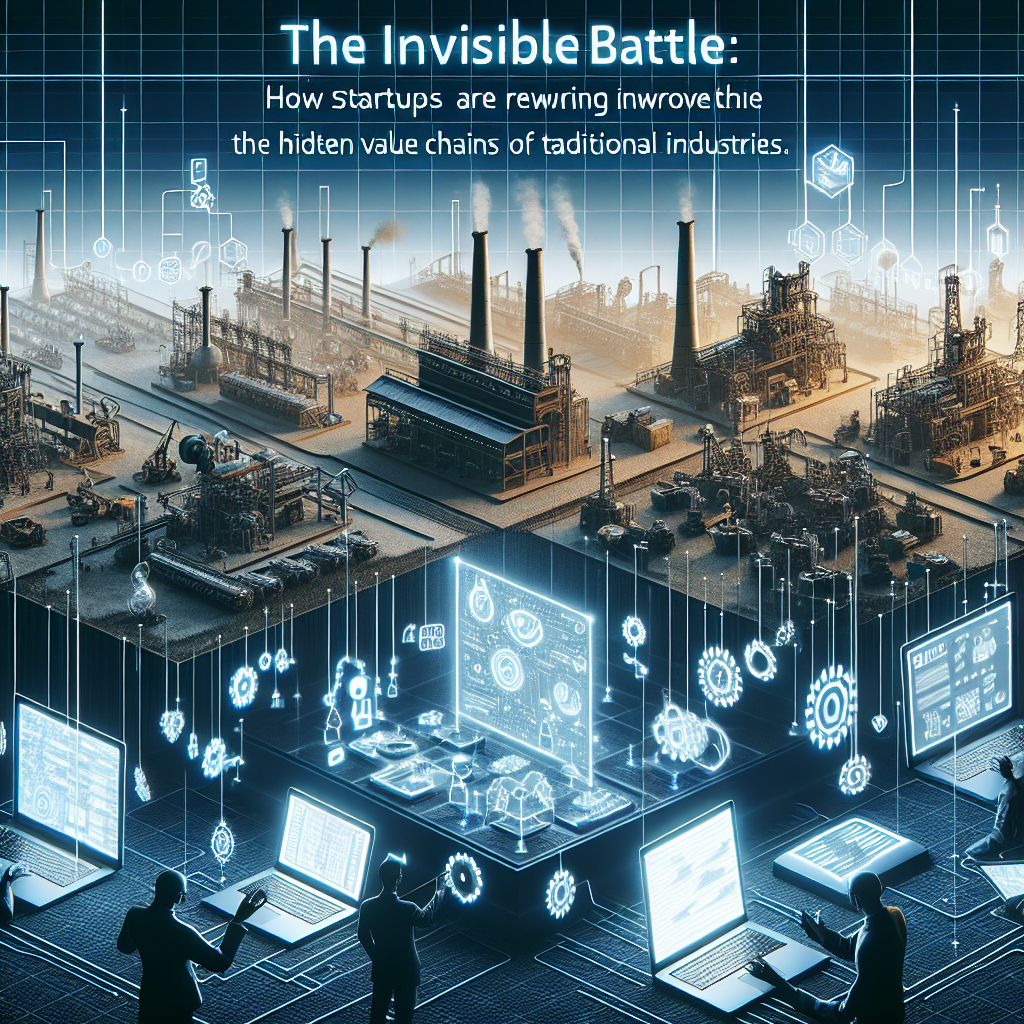
The Invisible Battle: How Startups Are Rewiring the Hidden Value Chains of Traditional Industries
A research‑grade analysis of how startups and incumbents are silently renegotiating roles, risks, and value capture in the invisible layers of fintech, retail, and energy value chains—and what this means for strategy, technology, and collaboration.

Abstract
Most debates around startup “disruption” focus on visible features: sleek apps, direct‑to‑consumer brands, and rapid user growth. Yet in sector after sector, the most consequential changes are unfolding in the hidden value chain—where infrastructure, compliance, wholesale contracts, data plumbing, and back‑office processes reside. This white paper argues that startups rarely replace incumbents outright. Instead, they rewire who does what, who takes which risks, and who captures the marginal dollar of value in the invisible layers beneath the user interface.
Drawing on examples from fintech, retail and e‑commerce, and distributed energy, the paper analyzes how orchestration platforms, API ecosystems, and third‑party infrastructure providers are reshaping business models, technological control points, and indirect user experience. We synthesize recent research on supply‑chain innovation, regulatory frameworks, data privacy, and digital scaling in traditional industries to show that the real battle is not app versus branch, but platform versus balance sheet, and data layer versus physical network [1][2][3]. The paper concludes with a typology of collaboration models, a comparative risk–data–power framework, and strategic recommendations for both incumbents and startups seeking to navigate and shape these evolving hidden value chains.
Background
Conventional disruption narratives are front‑stage stories. They contrast slow, asset‑heavy incumbents with agile startups armed with capital‑light apps, viral marketing, and superior interfaces. This framing is not wrong, but it is radically incomplete. In banking, early commentary centered on mobile apps outclassing clunky web portals. In retail, the focus fell on direct‑to‑consumer (D2C) brands that could speak to customers on Instagram instead of via store aisles. In energy, smart thermostats and EV chargers captured the imagination more than substations or grid codes.
Yet underneath these visible shifts lies an extensive backstage where real strategic bargaining occurs. Traditional firms still own banking licenses, warehouses, power plants, and regulated networks. Startups, in turn, excel at recombining these assets via software, APIs, and data analytics into new configurations of services. The outcome is less a winner‑takes‑all displacement than a complex re‑allocation of functions: KYC checks sit in one company, deposit insurance in another, orchestration logic and user interaction in a third. Understanding disruption as a re‑wiring of hidden value chains illuminates why incumbents remain systemically important even when they appear sidelined in the customer’s field of view.
At the same time, integrating innovation into traditional value chains is hard. Startups often lack established supplier relationships and bargaining power, which leads to higher input costs and weaker service levels when compared to large incumbents [1]. Coordination across multiple partners and tiers is challenging; limited resources and low attractiveness to suppliers can generate delays, quality problems, and increased operating costs [2]. Regulatory compliance adds further friction, especially where sustainability and environmental standards trigger the need for certifications like ISO 14001 [3].
Technological integration is another non‑trivial hurdle. Deploying advanced software for supply‑chain visibility or real‑time risk monitoring can be complex and expensive, particularly for young firms with constrained budgets [4]. Cultural and organizational differences between startups and traditional firms—distinct governance structures, decision‑making tempos, and risk appetites—complicate collaboration and scaling [5]. These frictions are not side notes; they shape where along the hidden value chain new entrants can realistically position themselves and how much leverage they can gain.
Seen through this lens, disruption becomes less about sleek front‑ends and more about evolving role definitions inside complex industry architectures. The key questions are: who designs the process, who carries which risks, who holds critical data, and who can walk away from a negotiation. The remainder of this paper develops a framework to answer those questions and applies it to fintech, retail/e‑commerce, and energy.
Methods
This white paper synthesizes insights from recent research and practitioner analyses on supply‑chain innovation, regulatory frameworks, digital scaling, and data privacy in traditional industries. The research context provided includes academic work on startup supply‑chain coordination challenges [2], practitioner discussions of sustainable supply‑chain compliance [3], and advisory content on the costs and complexity of implementing advanced operational software [4]. It also incorporates management research on scaling digital solutions in incumbent environments [5], sectoral analyses of fintech regulation [6], and policy reports on agile regulation in biotechnology that illustrate broader regulatory design principles [7].
To structure the argument, we first define a conceptual framework distinguishing visible and hidden value chains and highlight three analytical axes: business models, technology control points, and indirect user experience. We then apply this framework to three sectors—fintech, retail/e‑commerce, and distributed energy—chosen for their contrasting asset bases and regulatory intensity. For each sector, we draw explicit connections between the three axes and the redistribution of roles and risks.
Comparative analysis aggregates patterns across sectors, focusing on risk allocation, data ownership, and bargaining power, and relates them to broader trends such as platformization and API‑driven architectures. Case studies serve to concretize these patterns with realistic scenarios derived from the underlying literature and observed market structures. Finally, the paper develops a typology of collaboration modes and strategic recommendations, integrating evidence from sources on regulatory challenges for startups [8] and the role of data privacy in negotiations and valuation [9][10][11]. Throughout, we avoid anecdotal “hero startup” narratives in favor of system‑level causality anchored in the cited research.
Key Findings
1. Fintech vs. Traditional Banking: Orchestration atop Licensed Balance Sheets
Fintech is often portrayed as an app story: mobile‑first interfaces, real‑time notifications, and smooth onboarding. But beneath the interface, the decisive transformation has occurred in how banking capabilities are modularized and reallocated. Traditional banks historically combined licensing, balance sheets, core systems, compliance, and distribution into vertically integrated stacks. Today, many of these capabilities are being unbundled into Banking‑as‑a‑Service (BaaS) components.
In this model, licensed banks continue to own the regulatory perimeter: capital requirements, deposit insurance, and much of the operational risk of core banking. Fintech startups sit as orchestration layers, exposing banking functions via APIs and designing front‑end experiences tailored to specific niches—freelancers, gig workers, SMEs, or youth segments. KYC/AML checks, once tightly embedded inside bank operations, are increasingly externalized to specialized regtech providers that offer verification, transaction monitoring, and reporting as services [6]. Startups that successfully integrate these services can launch financial products without ever seeking a full banking license, leveraging the license and infrastructure of a partner bank.
This reconfiguration alters business models. Fee‑based account maintenance and branch‑driven cross‑selling give way to models based on interchange fees, subscription tiers, and revenue‑sharing on lending and deposits. BaaS providers can charge fintech front‑ends per‑account or per‑transaction, while neobanks monetize through interchange and premium features. Banks, in turn, can grow assets and fee income by becoming “invisible wholesalers” of regulated capabilities. However, complex revenue‑sharing agreements and compliance burden allocation must be negotiated carefully; poorly designed models can leave banks with disproportionate regulatory risk relative to economic upside [6][8].
From a technology standpoint, control of critical infrastructure and data is tilting toward those who own orchestration platforms rather than those who merely host the ledger. API gateways, consent management, and data aggregation services sit in startup or third‑party layers, enabling multi‑bank experiences that weaken the monopoly of any single institution over customer data. Yet integrating these layers is costly and complex for smaller players. Advanced risk engines, data catalogs, and model registries—tools increasingly required for regulatory readiness in AI‑driven financial services—demand governance maturity that not all fintechs possess [9]. Those that invest early in such capabilities tend to enjoy faster deployment cycles and more predictable regulatory interactions [9].
Indirectly, these changes reshape user experience. Faster onboarding and modular, personalized products are possible because identity verification, risk scoring, and transaction processing are split across specialized providers. However, the visible UX depends on the resilience, uptime, and compliance of the underlying bank and BaaS stack. Outages in core banking or failures in outsourced KYC can cascade into user‑facing disruptions and regulatory sanctions. Moreover, data privacy and security have become central negotiation items: incumbents must ensure that fintech partners’ data handling does not expose them to breaches or compliance failures, while fintechs must demonstrate robust privacy practices to be considered credible partners or acquisition targets [10][11].
2. Retail and E‑commerce: D2C Brands Riding on Old Logistics Muscles
In retail and e‑commerce, the popular story pits digital‑native D2C brands against big‑box retailers and legacy chains. Visibly, D2C brands control the narrative: design‑driven websites, influencer marketing, and community management. But the hidden value chain tells a more entangled story. Traditional retailers and logistics incumbents still own dense warehouse networks, transport fleets, sophisticated inventory systems, and long‑standing procurement relationships with global suppliers.
D2C startups typically focus on brand, UX, and digital marketing, building their storefronts on generic commerce platforms. The physical work of moving goods—from overseas factories to regional hubs to customers’ doors—rests largely with third‑party logistics providers (3PLs), parcel carriers, and original equipment manufacturers with decades of operational experience. For early‑stage brands, limited volumes weaken their bargaining power with suppliers and 3PLs, often resulting in higher unit costs, less favorable service‑level agreements, and constraints on customization [1]. These constraints directly shape what delivery promises or return policies a brand can credibly offer.
This configuration structurally shifts where margins and data advantages emerge. Incumbent retailers historically earned margins from scale efficiencies: buying power, optimized store assortments, and finely tuned replenishment. D2C players seek margin through brand premiums and direct access to customer data. Owning the customer relationship allows them to control pricing, storytelling, and retention strategies. At the same time, their heavy dependence on legacy logistics means that a portion of the value created by superior UX is captured by 3PLs and carriers, not by the brand itself.
Technology integration is the bridge between visible and hidden chains. D2C brands increasingly connect their front‑end platforms to order‑management systems that integrate with incumbents’ ERP and warehouse management systems. This integration is complex: advanced software for supply‑chain coordination and tracking can be expensive to implement, particularly for startups with limited capital [4]. Inadequate integration can lead to poor inventory visibility, stockouts, or misaligned promotional campaigns, all of which erode the promised user experience. Moreover, startups must comply with growing expectations around sustainable supply chains, including environmental certifications and traceability, which require data collection and documentation far upstream [3].
Indirectly, logistics capabilities manifest as user experience promises: same‑day shipping, precise delivery windows, frictionless returns, and personalized assortments. Legacy warehouse networks and routing algorithms, largely owned by incumbents, determine whether such promises are feasible. Where startups can negotiate favorable access to incumbents’ infrastructure, they can offer experiences comparable to or even exceeding those of large retailers. Where they cannot, they must either constrain their UX (e.g., slower shipping to certain regions) or accept margin erosion to buy higher‑priced logistics services. The “invisible” contracts and integrations thus place a hard boundary around what the “visible” brand can credibly deliver.
3. Energy: Software Platforms over Regulated Physical Networks
Energy offers a contrasting case, defined by heavy assets and tight regulation. Traditional utilities own and operate generation plants, transmission lines, and distribution networks. They manage complex regulatory relationships, ensuring grid stability, reliability standards, and tariff compliance. Historically, this asset ownership conferred both economic power and control over end‑user relationships.
The rise of distributed energy resources (DERs)—rooftop solar, home batteries, EVs, smart appliances—has opened a window for startups to insert themselves as aggregators, platform providers, and optimization layers. Unlike utilities, these startups rarely build physical networks. Instead, they build software platforms that orchestrate assets owned by households, businesses, and sometimes utilities themselves, re‑packaging access to the grid through new services: peer‑to‑peer energy trading, virtual power plants, or subscription‑based demand management.
This shifts business models away from pure volumetric tariffs toward more complex schemes: dynamic pricing that responds to real‑time grid conditions, marketplace commissions between prosumers and consumers, or subscription fees for optimization services. Startups in this space must still navigate stringent regulatory environments; compliance missteps can lead to penalties and reputational damage, particularly where environmental regulations and grid codes are strict [3][7]. Agile regulatory approaches—of the kind promoted in sectors like biotechnology to balance innovation with risk management [7]—are increasingly discussed in energy as well, with sandboxes and pilot programs allowing experimentation under supervision.
Technologically, the crucial control points sit in data and optimization algorithms. Dashboards that show real‑time consumption and production, smart contracts governing peer‑to‑peer trades, and APIs connecting to smart home devices determine how flexibly and profitably DERs can be orchestrated. Implementing such advanced software is complex and costly; integrating multiple device standards, utility IT systems, and regulatory reporting interfaces can stretch the capacities of young firms [4][5]. Utilities, meanwhile, must ensure that integrating third‑party platforms does not introduce cybersecurity vulnerabilities or data‑privacy risks.
For end users, these invisible layers translate into better insights (e.g., hourly consumption and cost forecasts), new tariff structures (e.g., time‑of‑use rates increasingly tied to behavior), and potentially lower bills. But they also create dependencies: platform outages, mis‑configured devices, or misaligned incentives between platform operators and utilities can manifest as bill shocks or service interruptions. Once again, the visible UX—an elegant consumption dashboard or a simple “optimize my bill” toggle—rests on complex coordination across incumbents and startups in the hidden value chain.
Summary Table: Hidden vs. Visible Layers by Sector
| Sector | Visible Value Chain (Startups) | Hidden Value Chain (Incumbents / Partners) |
|---|---|---|
| Fintech | Mobile apps, onboarding flows, niche‑specific features | Banking licenses, core systems, compliance, balance sheet, BaaS infrastructure |
| Retail | D2C storefronts, branding, digital marketing | Warehouses, logistics networks, OEM manufacturing, ERP/WMS systems |
| Energy | Consumption dashboards, P2P apps, smart‑home interfaces | Generation assets, grid infrastructure, regulatory relationships, metering |
Comparative Analysis
Business Model Reconfiguration: From Vertical Integration to Platform Orchestration
Across sectors, startups tend to adopt asset‑light, orchestration‑heavy models, while incumbents retain asset‑ and risk‑heavy roles. In banking, vertical integration historically meant that the same institution owned deposits, branches, IT, and customer relationships. Under BaaS, licensed banks increasingly function as regulated utilities for capital and compliance, while fintechs harvest margins on distribution and data‑driven cross‑selling. In retail, incumbents’ scale economies in procurement and logistics underpin D2C brands’ promises, yet D2C firms capture brand premiums and customer lifetime value (CLV). In energy, utilities continue to invest in long‑lived infrastructure, while startups monetize flexibility and intelligence on top.
The trade‑off is clear: incumbents shoulder regulatory, operational, and capital risks, whereas startups bear market, adoption, and partnership risks. Regulatory frameworks can enhance or reduce the attractiveness of each role. Well‑designed regulations can foster sustainable fintech growth by building trust and credibility, incentivizing responsible innovation and transparent practices [6]. Conversely, overly rigid rules can stifle experimentation and lock startups out of regulated revenue pools [8]. For energy platforms, regulatory support for dynamic pricing or DER participation in markets can determine whether orchestration models are economically viable.
Technology Control: Monoliths vs. API Ecosystems
Technological architectures differ sharply. Incumbents typically operate monolithic, legacy systems optimized for stability and compliance. Startups assemble ecosystems of APIs, microservices, and outsourced functions, enabling rapid iteration and modular experimentation. Yet this modularity comes at a cost: integration complexity, reliance on third‑party SLAs, and heightened cybersecurity exposure.
In fintech and AI‑enabled services, regulatory readiness is increasingly a differentiator. Firms with mature governance—data catalogs, model registries, explainability dashboards—can deploy models faster and engage regulators more predictably [9]. Many incumbents lag on flexibility but exceed in compliance; many startups are agile but under‑invest in formal governance, creating friction in partnerships and acquisitions. In retail and energy, advanced software for supply‑chain visibility or grid optimization is expensive and complex to integrate [4], particularly where legacy systems were never designed for open APIs. This creates an opening for specialized infrastructure‑as‑a‑service startups that sell into incumbents rather than compete head‑on.
Indirect User Experience: Promises Constrained by Invisible Bottlenecks
While startups often own the “last mile” of UX, the quality of that experience is constrained by invisible bottlenecks. In banking, instant account opening depends on fast, accurate KYC/AML checks and reliable core systems. In retail, promises of next‑day delivery or seamless returns hinge on 3PLs’ capacity and incumbents’ warehouse automation. In energy, real‑time dashboards and savings guarantees rely on accurate metering, grid reliability, and coordination with utility operations.
Failures in the hidden chain often surface as UX disappointments, even when startups are not at fault. Supply‑chain coordination issues—delays, quality problems, cost overruns—stem from startups’ limited control over suppliers and logistics partners [1][2]. Regulatory non‑compliance or data breaches at any tier can erode trust and trigger sanctions [3][8][11]. Thus, while the visible layer is where differentiation is marketed, the invisible layer is where it is operationally won or lost. Strategic advantage therefore depends as much on governance, integration, and partner selection as on interface design.
Cross‑Sector Pattern Table: Risk, Data, and Power
| Dimension | Incumbents (Typical Role) | Startups (Typical Role) |
|---|---|---|
| Risk | Regulatory, capital, long‑term operational risk | Market, adoption, integration, reputational risk |
| Data | Legacy transactional and asset data; often fragmented | High‑resolution behavioral and usage data; advanced analytics |
| Bargaining Power | Strong with regulators and suppliers; weaker at UX frontier | Strong at customer interface and in niche segments; weaker in infrastructure |
Case Studies
Case 1: A European Neobank Built on a Regional BaaS Provider
Consider a hypothetical European neobank targeting freelancers. Rather than seeking a banking license, the startup partners with a regional bank offering BaaS. The bank provides accounts, IBANs, and access to payment schemes, while a regtech vendor handles KYC and AML checks as a service [6]. The neobank’s team focuses on fast onboarding, integrated invoicing, and tax estimation features tailored to freelancers.
Economically, interchange fees on card spending and subscription tiers for premium features form the neobank’s core revenue, while the BaaS bank charges per‑account and per‑transaction fees. Regulatory capital and compliance risk remain largely with the bank, but the neobank carries reputational and market risk—customers blame the app if funds are delayed, even when the root cause lies in the bank’s systems. To credibly partner with larger enterprises or be acquired, the neobank must invest in robust data privacy and security practices, such as formal data protection policies and clear governance roles, often including a Data Protection Officer [10]. During fundraising or M&A due diligence, investors scrutinize these controls; weaknesses can lower valuations or lead to complex deal protections [9][11].
Case 2: A D2C Home Goods Brand Leaning on Legacy Logistics
A D2C brand in home goods launches via a popular e‑commerce platform and builds a loyal online following. Manufacturing is outsourced to long‑standing OEMs in Asia; freight and warehousing are handled by a global 3PL with decades of experience serving big‑box retailers. Initially, the brand’s modest order volumes and lack of track record result in higher logistics rates and limited customization of warehousing processes [1]. Service hiccups—stockouts, delayed shipments—stem from coordination issues across time zones and tiers of suppliers [2].
To deliver on promises of two‑day shipping and flexible returns, the brand must integrate its order‑management system directly with the 3PL’s warehouse management software and carriers’ tracking APIs. Implementing this integration strains its limited IT budget [4]. Meanwhile, increasing regulatory pressure around sustainable sourcing requires the brand to work with OEMs to document material origins and environmental practices, adding complexity [3]. The user only sees a refined storefront and friendly emails; behind the scenes, the brand’s bargaining power with logistics incumbents and its capacity to invest in integration software determine whether the experience matches the marketing.
Case 3: A Virtual Power Plant Aggregating Residential Batteries
In a deregulated power market, a startup builds a virtual power plant (VPP) by aggregating hundreds of residential batteries and rooftop solar systems. Its app offers users a simple promise: “Lower your energy bill and support grid stability.” The startup’s platform optimizes charging and discharging based on price signals and grid conditions, then participates in flexibility markets. Physical connections to the grid, metering infrastructure, and baseline tariffs remain under the control of incumbent utilities.
To operate, the VPP must integrate with utilities’ meter data systems and comply with grid codes and market participation rules [7]. Implementing software that ingests high‑frequency measurements, dispatches control signals securely, and reconciles financial flows requires significant investment [4][5]. Regulatory compliance around environmental claims and data privacy adds further obligations [3][11]. Any failure in coordination—misaligned incentives with utilities, communication glitches with devices, or regulatory non‑compliance—can result in financial penalties or user dissatisfaction. Yet if the orchestration works, end users experience more predictable bills and feel empowered, even though the “heavy lifting” still occurs in utility‑owned assets and markets they never see.
Limitations
The analysis in this white paper is constrained by several factors. First, it relies on secondary sources and generalized research rather than proprietary datasets or firm‑level financials. While the cited studies on supply‑chain challenges, regulatory frameworks, and data privacy provide robust qualitative insights [1][2][3][6][8][9][10][11], they do not offer comprehensive quantitative breakdowns of margin shifts or risk allocations across all sectors. Consequently, some conclusions about value capture and bargaining power remain inferential.
Second, sector coverage—fintech, retail/e‑commerce, and energy—captures important variation in asset intensity and regulation but does not exhaust the landscape. Industries such as healthcare, mobility, and industrial manufacturing exhibit similar dynamics yet may differ substantially in regulatory design, data sensitivity, and pace of digitalization. Lessons drawn here should thus be adapted, not transplanted wholesale.
Third, the discussion of regulatory regimes is necessarily high‑level. Policy environments vary widely across jurisdictions; frameworks that are enabling in one country may be restrictive in another. Studies highlighting agile regulation in biotechnology [7] or fintech [6] illustrate principles, not universal conditions. Likewise, the role of data privacy in M&A and partnership negotiations is evolving quickly; practices that are emerging today may be standard or obsolete within a few years [9][10][11].
Finally, this paper centers primarily on the perspective of startups and incumbents. It does not deeply engage with labor implications, environmental externalities beyond compliance, or broader societal impacts of shifting value chains. Future work could integrate these dimensions, drawing on interdisciplinary research to assess how invisible value‑chain rewiring affects not only firm‑level strategy but also workers, communities, and systems resilience.
Implications
For executives in traditional industries, the main implication is that defending market position cannot be reduced to improving front‑end UX or launching a “copycat app.” Strategic resilience requires explicit mapping of both visible and hidden value chains: which layers are asset‑intensive and regulated, which are data‑rich and user‑proximate, and how these layers intersect. Once mapped, incumbents can decide where to double down as infrastructure providers, where to open APIs, and where to partner with or acquire orchestration‑focused startups.
For startups, the findings underscore that choosing a position in the value chain is as important as choosing a target customer. Aspirations to control visible brands must be weighed against the costs of integrating with and depending on legacy infrastructure. Alternatively, building “invisible” infrastructure‑as‑a‑service offerings—regtech in fintech, logistics middleware in retail, grid‑edge analytics in energy—may offer more durable moats and clearer revenue models, albeit with longer sales cycles into incumbents [4][5]. In either case, early investment in compliance capabilities, data privacy governance, and integration engineering appears less a luxury than a precondition for scalable collaboration [3][6][8][9][10][11].
Regulators and policymakers also face strategic choices. Evidence from agile regulatory initiatives in sectors like biotechnology suggests that sandboxed environments and collaborative rule‑making can encourage innovation while maintaining oversight [7]. Similar approaches in fintech and energy could enable experimentation with new business models—such as platform‑based lending or VPPs—without undermining stability. However, poorly designed or overly burdensome frameworks risk pushing startups to relocate or exit markets, eroding local innovation ecosystems [8].
Ultimately, the invisible battle over roles, risks, and data in hidden value chains will shape not only competitive landscapes but also how industries absorb future shocks, from climate events to geopolitical disruptions. Firms that understand and deliberately design their backstage architectures—including who they partner with, what they outsource, and how they govern data—will be better positioned to adapt.
Conclusion
The contrast between startups and incumbents is often described in aesthetic and cultural terms: sleek interfaces versus clunky forms, fast sprints versus slow committees. This paper has argued that the deeper story lies elsewhere—in the rewiring of hidden value chains that determine who owns licenses and warehouses, who carries capital and compliance risks, who controls data flows and algorithms, and who ultimately shapes user experience from behind the scenes.
In fintech, we saw how BaaS and regtech allow neobanks to orchestrate experiences without holding full licenses, while banks reposition as invisible utilities. In retail and e‑commerce, D2C brands thrive by controlling narrative and data, yet their promises rest on logistics muscles and supplier relationships built over decades. In energy, digital platforms turn distributed assets into orchestrated capacity, but depend on utilities’ networks and regulatory goodwill. Across all three sectors, the same pattern emerged: vertical integration gives way to platform orchestration; monolithic IT yields to API ecosystems; visible UX is both enabled and constrained by invisible agreements, systems, and risks.
The future for most industries is therefore unlikely to be a binary “startup replaces incumbent” outcome. More plausibly, we will see hybrid structures in which incumbents operate as infrastructure and regulatory stewards, while startups act as experience orchestrators, data interpreters, and niche specialists. The strategic task for leaders on both sides is to map their visible and hidden value chains, identify which roles they are best positioned to play, and proactively negotiate the terms of collaboration.
For readers—whether corporate executives, founders, or advisors—the call to action is clear: look beyond the app. Inventory your invisible dependencies, understand where data and risk actually sit, and decide where you want to be indispensable in tomorrow’s value chain. The real competitive advantage will belong to those who design not just the user interface, but the entire backstage of their industry.
References
[1] FasterCapital – "The Role of Supply Chain Innovation in Startups: Key Strategies for Success" – https://fastercapital.com/content/The-Role-of-Supply-Chain-Innovation-in-Startups--Key-Strategies-for-Success.html
[2] ScienceDirect – "Challenges in Managing Startup Supply Chains" – https://www.sciencedirect.com/science/article/pii/S1478409220301291
[3] BPlan – "Challenges Implementing Sustainable Supply Chains for Startups" – https://bplan.ai/blogs/startups-questions/challenges-implementing-sustainable-supply-chain-startups-startups
[4] BPlan – "Challenges Managing Supply Chains for Startups" – https://bplan.ai/blogs/startups-questions/challenges-managing-supply-chains-startups-startups
[5] California Management Review – "Scaling Digital Solutions in Traditional Industries" – https://cmr.berkeley.edu/2023/11/scaling-digital-solutions-in-traditional-industries-a-mission-impossible-for-small-firms/
[6] Vault of Trust – "Fintech Regulatory Frameworks" – https://vaultoftrust.com/fintech-regulatory-frameworks/
[7] OECD – "Boosting Biotechnology Innovation through Agile Regulation and Finance Instruments" – https://www.oecd.org/en/publications/boosting-biotechnology-innovation-through-agile-regulation-and-finance-instruments_7cd12966-en/full-report.html
[8] BrightLaws – "Regulatory Challenges for Startups" – https://brightlaws.com/regulatory-challenges-for-startups/
[9] GuruStartups – "Cross-Sector Impact of AI Regulation" – https://www.gurustartups.com/reports/cross-sector-impact-of-ai-regulation
[10] Flevy – "Impact of Data Privacy Regulations on Tech Acquisition Strategies" – https://flevy.com/topic/acquisition-strategy/question/impact-data-privacy-regulations-tech-acquisition-strategies
[11] LegalNodes – "Global Compliance for Startups" – https://www.legalnodes.com/article/global-compliance-for-startups
[12] TechReviewer – "Data Security Essentials: How Startup Tech Businesses Can Protect Confidential Information" – https://techreviewer.co/blog/data-security-essentials-how-startup-tech-businesses-can-protect-confidential-information
Related Articles

Who Stole the Value? A Forensic Audit of Giants, Startups, and the Customer Left Out of the Deal
Treating today’s innovation economy as a crime scene, this essay investigates what quietly disappears when incumbents and startups reshape finance, health, retail, mobility, education, and climate tech. Beyond pitch decks and marble lobbies, who actually captures the value—and at what human cost?

The Year We Misread the Checkbox: How a Single UX Choice Rewired Giants and Startups
Writing from 2050, a radical futurist looks back on 2024 and argues that the true battle between traditional industries and startups in banking, retail, health, and mobility never took place in boardrooms or pitch decks, but inside a single, tiny UX artifact: the checkbox. By following that microscopic element, this manifesto rewrites the history of incumbents vs. startups as a struggle over who controls consent, data, and time.

The scene of the silent crime: where has courage been lost between giants and startups?
A monk‑analyst steps onto the “crime scene” of the digital economy—financial services, retail, healthcare, mobility, education, and manufacturing—to investigate a silent disappearance: the deeper value that customers, workers, and communities expected from the transformation between traditional industry and the startup ecosystem.