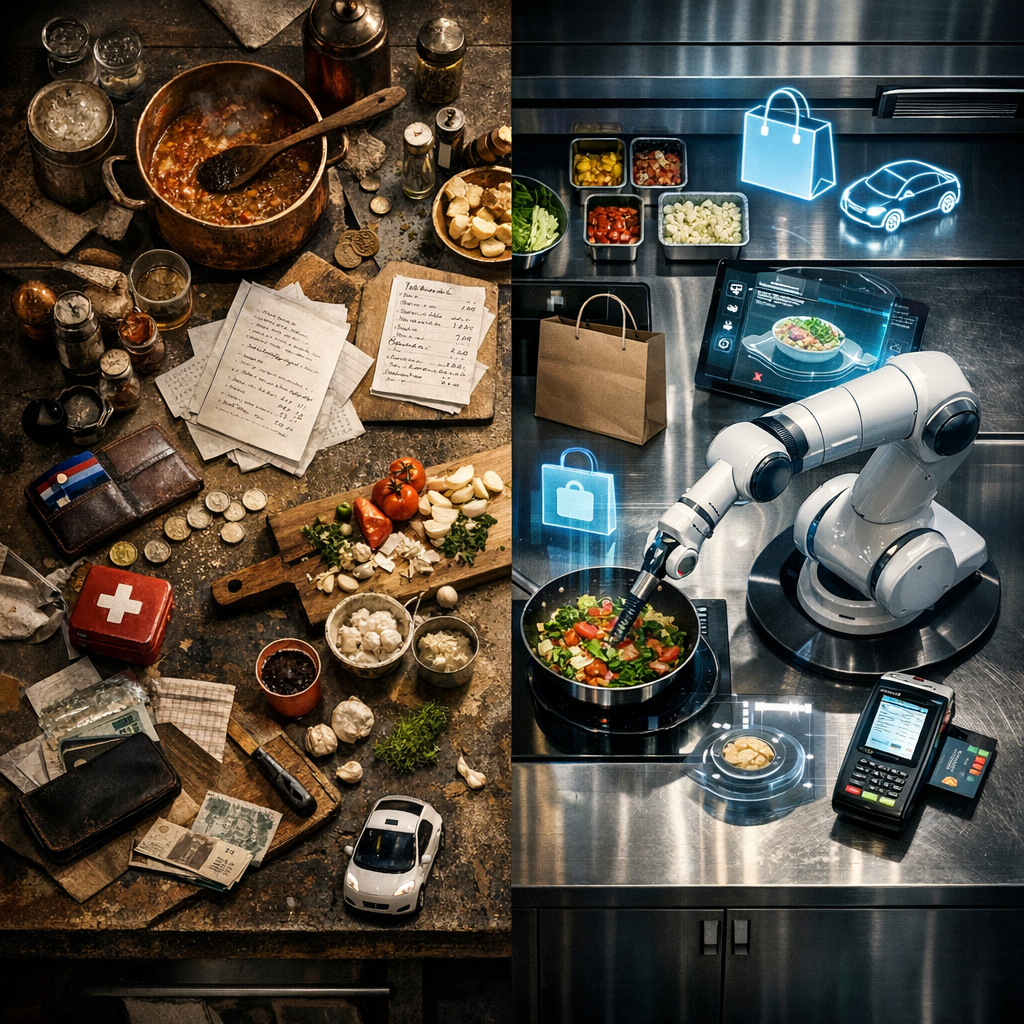
When the menu becomes impossible: hidden sacrifices between giants and startups
A head chef looks at banking, retail, mobility, and healthcare as if they were kitchens under extreme pressure. He doesn’t talk about profits, but about the real costs—in money, speed, risk, and trust—of growing in a market where traditional industry and startups are cooking over opposite flames.

La Hook: dinner service in a kitchen split in two
It’s 8:45 p.m. Rush hour.
In one half of the kitchen: heavy steel ovens, bound recipe books, laminated procedures on the wall. Every dish passes through three hands, four signatures, two thermometers. Everything is logged. Nothing is improvised.
In the other half: light griddles, tablets full of notes, young chefs with headphones. They change the menu on the fly, test new sauces during service, adjust the price of each dish depending on the neighborhood’s footfall.
What you’re seeing isn’t just a restaurant split in two: it’s banks and fintechs, supermarkets and e‑commerce, taxis and ride‑hailing platforms, hospitals and healthtech startups all working, at the same time, on the same diner: the user.
They all say the same: we want “better experience” and “more efficiency”. But in a serious kitchen, nothing improves without sacrificing something. To gain speed, you burn through your margin for error. To gain personalization, you pay in technical complexity. To chase scale, you sacrifice intimacy, or perceived quality, or resilience.
My trade has taught me a harsh rule: there is no recipe that only adds; every professional decision is a pact with what you give up. In this analysis, I’m not going to celebrate benefits. I’ll treat the market as an impossible menu and show you which dishes reach the table—but above all, which ingredients are thrown away in the process.
Genesis: how we ended up with this bipolar menu
For years, the giants served a single, heavy menu.
- Banking: accounts, cards, mortgages, insurance, all on the same plate. Interest margins and fees as the dominant sauce, branches as the visible kitchen, technology as the basement stove.
- Physical retail: aisles, paper receipts, staff who “personalize” by remembering faces and tastes. High fixed costs: rent, inventory, front‑of‑house staff.
- Traditional mobility: taxis, licenses, fleets, concessions. Fixed fares like prices printed on the menu.
- Hospital‑based healthcare: comprehensive care, lots of infrastructure, rigid protocols, IT systems isolated like walk‑in fridges with no connection.
Then startups arrived, like pop‑up chefs with cloud kitchens:
- Fintechs specialized in a single bite: fast payments, instant credit, simplified accounts. They grow on light licenses, regulatory sandboxes, and cloud‑native architectures.
- E‑commerce that turns any product into a link. AI decides what to show, to whom, and at what price. Chatbots and “digital humans” provide round‑the‑clock service: 70% of e‑commerce businesses already rely on these agents to improve customer care, especially in personalization, search, and marketing.
- Ride‑hailing platforms that coordinate other people’s cars as if they owned the fleet. Dynamic prices like a tasting menu subject to the market’s mood.
- Health startups that replace paperwork with telemedicine and voice agents: Tucuvi automates clinical calls with AI, Omniloy maintains records and multilingual communication, Maternify offers personalized maternal and child care via mobile.
Regulators and technology added their own seasoning:
- In Latin America, countries such as Brazil, Mexico, Argentina, Colombia, and Chile have designed modern frameworks for fintech. Mexico is close to 1,000 fintech companies, and 86 million people are expected to use these services in 2027. Sandboxes are opening, full licenses are being granted—like the banking license Revolut has obtained in Mexico—and financial inclusion is being pushed.
- In online retail, generative AI is becoming a key ingredient for hyper‑personalization: seidor highlights it as a central tool to tailor offers and improve customer relationships.
- In healthcare, public and private systems are slowly integrating surgical robots and remote monitoring: the HLA Hospital Group uses the Da Vinci robot and AI‑driven appointment booking; the Murcian Health Service monitors cardiac patients at home, reducing in‑person visits and hospitalizations.
It all sounds appetizing. But every innovation has a cost. Each sector, each type of player has had to decide what to burn to keep the growth fire alive.
The invisible conflict: perfect plates, exhausted kitchens
From the outside, the debate seems simple: do agile startups win, or do solid giants hold the line?
From inside the kitchen, the question is different: how much stability are we willing to sacrifice for speed, and how much humanity for automation?
Three sacrifices almost nobody talks about
-
Sacrificing control for scale
Fintechs that grow fast with flexible licenses and open APIs accept an extreme dependence on third parties: cloud providers, shifting rules in each country, fragile integrations. Banks that integrate those fintechs give up the uniformity of their recipe book. -
Sacrificing transparency for personalization
E‑commerce, powered by generative AI and hyper‑personalization, creates the feeling that “this store knows me,” but only by using massive amounts of data. Recent studies highlight serious customer concerns about privacy and algorithmic fairness. The menu looks like it was designed for you, but you don’t know which ingredients were used to decide that. -
Sacrificing human contact for efficiency
In healthcare and mobility, automation reduces friction and workload but dilutes the human relationship. Tucuvi automates calls; Omniloy manages records and communication; transport platforms turn a trip into a cold transaction. Hospitals that don’t automate overload their staff; those that over‑automate risk dehumanizing service.
The conflict isn’t “old vs new,” but what kind of sacrifices each model accepts:
- Incumbents sacrifice agility to preserve resilience, regulatory compliance, and trust built over time.
- Startups sacrifice safety margins, predictability, and often immediate profitability, to gain speed, rapid iteration, and a UX that resets expectations.
Evidence and insights: the market’s mise en place
In the kitchen, before turning on the heat, I prepare my mise en place: everything chopped, weighed, within reach. Let’s do the same with these four sectors.
1. Banking / Fintech: slow simmer vs high‑heat stir‑fry
Business model
- Universal banks: full tasting menu. Integrated services (accounts, credit, investment, insurance). Revenues dominated by interest margins and fees. High fixed costs from physical infrastructure, regulatory compliance, and legacy systems.
- Niche fintechs: one perfect dish (fast payments, P2P loans, simplified accounts). Revenues from subscriptions, transaction fees, selective data use. Lower fixed costs, heavy technological leverage.
Key sacrifices
- Banks: sacrifice speed of change in exchange for strict compliance and perceived solidity.
- Fintechs: sacrifice regulatory stability and cost predictability to enter new markets quickly.
Regulation acts like a demanding headwaiter:
- In countries like Mexico, fintech frameworks favor innovation and financial inclusion. Nearly 1,000 fintechs compete for those 86 million potential users; Revolut has obtained a full license to operate as a bank.
- But the lack of a unified international framework forces each fintech to “cook” under different rules in each jurisdiction, adding risk and compliance cost.
2. Retail / E‑commerce: neighborhood shop vs AI‑driven dark kitchen
Business model
- Physical retail: in‑person shopping experience, visible inventory, customer relationship via sales staff. Revenues from direct sales, simple loyalty schemes.
- E‑commerce: virtually infinite catalog, 24/7 access, logistics as backbone. Revenues from direct sales, marketplaces, advertising, and seller services.
Technology and data
- Physical retail: monolithic systems, historical data, personalization based on loyalty programs and staff familiarity.
- E‑commerce: cloud‑native architectures, open APIs, recommendation engines, dynamic pricing. Generative AI drives hyper‑personalization: deep preference analysis, finely tuned campaigns. A Retail Actual report notes that 70% of e‑commerce businesses trust “digital humans” to improve customer service.
Key sacrifices
- Physical retail: sacrifices algorithmic precision to maintain human contact and local operational control.
- E‑commerce: sacrifices transparency and simplicity in favor of constant data‑driven optimization, plus the added burden of managing privacy and fairness concerns.
A recent arXiv study underscores these customer worries: they fear how their data is used and whether algorithms treat them fairly. The digital menu is exquisite, but many don’t know what’s really in the sauce.
3. Mobility / Transport: taximeter vs algorithm
Business model
- Traditional operators (taxis, buses, licensed services): regulated fares, limited licenses, owned or tightly controlled fleets. Predictable revenues, high dependence on local regulation.
- Ride‑hailing platforms: commissions on each ride, dynamic pricing, little asset ownership in vehicles. They scale through fast geographic expansion and network effects.
Technology and data
- Traditional: closed management systems, little real‑time analytics, almost no APIs or integrations.
- Startups: mobile apps, geolocation, algorithmic vehicle assignment, dynamic pricing based on demand.
Key sacrifices
- Traditional: sacrifice price flexibility and responsiveness for labor and regulatory stability.
- Platforms: sacrifice income predictability for drivers and price stability for riders in favor of optimizing utilization and growth.
4. Healthcare / Healthtech: waiting room vs distributed consultation
Business model
- Traditional hospitals and clinics: comprehensive care, capital‑intensive, revenues from insurers and direct payments. Growth through physical expansion and gradual modernization.
- Digital health startups: telemedicine, remote monitoring, workflow automation. Revenues from subscriptions, pay‑per‑consultation, B2B deals with insurers and health systems.
Technology
- Traditional: isolated systems, limited interoperability, selective automation (such as Da Vinci robots or AI‑based appointment systems at hospital groups like HLA).
- Healthtech: cloud, APIs to integrate with medical records, conversational agents. Tucuvi automates clinical calls, Omniloy manages records and multilingual communication, Maternify extends maternal and child care beyond the hospital.
Key sacrifices
- Hospitals: sacrifice agility and process simplicity for clinical safety, robust validation, and strict compliance.
- Startups: sacrifice physical contact and part of the traditional doctor‑patient relationship for efficiency and reach.
Home monitoring for cardiac patients by the Murcian Health Service—an award‑winning innovation—shows another trade‑off: fewer visits and hospitalizations, but more technological dependence and new cybersecurity and system‑failure risks.
Sacrifice scorecard: who burns what, in each sector
Think of this comparative menu not as “winners vs losers,” but as “what each one is burning to grow.”
Table 1 – Sacrifice scorecard by sector
| Sector | Player | Main business‑model sacrifice | Technological sacrifice | UX / relationship sacrifice |
|---|---|---|---|---|
| Banking / Fintech | Traditional bank | Speed and focus for breadth of services | Fast modernization for stability and control | Simplicity for strict compliance |
| Banking / Fintech | Fintech | Regulatory stability for accelerated expansion | Independence for heavy cloud and API dependence | Relationship depth for ultra‑fast onboarding |
| Retail / E‑commerce | Physical retail | Digital scale for local control and physical presence | Advanced analytics for familiar systems | Algorithmic personalization for human interaction |
| Retail / E‑commerce | E‑commerce | Data and ad margin for privacy‑regulation complexity | Simplicity for complex, multi‑integration architectures | Transparency for data‑driven hyper‑personalization |
| Mobility | Traditional transit | Price flexibility for regulatory stability | Ecosystem integration for closed systems | On‑demand convenience for familiar processes |
| Mobility | Ride‑hailing | Price predictability for demand optimization | Simplicity for high algorithmic sophistication | Driver income stability for speed and availability |
| Healthcare / Healthtech | Traditional hospital | Agility in new services for rigid clinical safety | Fast interoperability for validated systems | Digital immediacy for in‑person contact |
| Healthcare / Healthtech | Healthtech startup | Full clinical reach for focus on narrow niches | Full data control for intensive cloud/third‑party use | Human warmth for efficient remote care |
The menu sector by sector: what’s gained… by burning what
Banking / Fintech: trust as the base stock
Here, the irreplaceable ingredient is trust.
Incumbents
- Business model: robust, regulated, diversified. They grow through M&A, cautious geographic expansion, and selective partnerships with fintechs.
- Technology: legacy systems that sacrifice flexibility but have proven resilient. Monolithic architectures, limited API openness compared to fintech, though open banking is forcing them to open the kitchen.
- UX: heavy onboarding (KYC, forms, physical branches in many cases). Interfaces shaped more by internal processes than by simple user tasks.
The sacrifice: delaying launches to avoid breaking anything. The price is lost share in younger segments that won’t accept waiting days for an account that a competitor opens in minutes.
Fintech startups
- Reset expectations: near‑instant account opening, faster credit, clean interfaces.
- Rely on cloud‑native architectures, microservices, continuous deployment. They adopt agile methodologies and DevOps culture.
- Benefit from progressive regulatory frameworks in regions like Latin America, sandboxes, and dedicated banking licenses.
The sacrifice: navigating a fragmented international regulatory landscape, and investing heavily in cybersecurity and compliance to avoid squandering hard‑won trust. Every new feature is a new attack surface.
Segments
- Digital natives and agile SMEs: drawn to fintech for speed and UX.
- Large corporates, high‑net‑worth clients, and risk‑averse profiles: still prefer banks for reputation, compliance, and perceived solvency.
Retail / E‑commerce: the infinite buffet and the loss of intimacy
Here, the strained ingredient is intimacy between buyer and seller.
Traditional retail
- Business model: direct sales, margins constrained by rent, staff, and stock.
- Technology: integrated but rigid POS systems; little real‑time analytics.
- UX: sensory experience, physical product trials, human interaction with sales staff.
The sacrifice: forgoing the data granularity e‑commerce enjoys, and the ability to adjust prices and assortment in real time at user level.
E‑commerce
- Resets expectations: 24‑hour delivery, instant comparison, massive reviews, near‑total availability.
- Uses generative AI and recommenders for hyper‑personalization: products, prices, and messages tailored to individual history.
- Introduces “digital humans” as 24/7 agents. 70% of e‑commerce players rely on them to improve experience.
The sacrifice: facing distrust over data use and algorithmic bias. The arXiv study shows customers worry about privacy and fairness: the system may serve them better, but it can also discriminate or manipulate.
Segments
- Time‑poor, convenience‑ and price‑driven users: flock to e‑commerce.
- Customers who value physical experience, human advice, and product try‑outs: stay loyal to brick‑and‑mortar, at least for certain categories.
Mobility / Transport: when today’s special depends on the weather
In mobility, the sacrificed ingredient is predictability.
Traditional players
- Business model: licenses, regulated fares, stable routes.
- Technology: closed systems, call centers, limited real‑time optimization.
- UX: the user often knows what the trip will cost, but not how long it will take to get a ride.
The sacrifice: not optimizing fleet utilization minute by minute and missing potential peak‑demand revenue.
Ride‑hailing platforms
- Reset expectations: geolocation, ETAs, cashless payment, two‑way ratings.
- Use algorithms for matching and dynamic pricing.
- Scale rapidly into new cities, often clashing with local regulators.
The sacrifice: stable earnings for drivers and stable prices for riders. The system works as long as both sides tolerate volatility; any change in regulation or commissions can destabilize the whole network.
Segments
- Urban users with smartphones: tend to prefer platforms for convenience.
- Older users, digitally excluded populations, or markets with heavy regulation: stay with traditional models.
Healthcare / Healthtech: saving time at the cost of new vulnerabilities
In healthcare, the main ingredient is clinical safety. Tweaking the recipe has real‑world consequences.
Hospitals and clinics
- Business model: comprehensive care, high complexity, strong influence from insurers and regulators.
- Technology: often isolated IT systems, expensive integrations.
- Notable cases: HLA Hospital Group integrates the Da Vinci robot and AI‑based appointment systems; the Murcian Health Service uses home monitoring for cardiac patients.
The sacrifice: delayed adoption of new technologies due to the need for clinical validation and safety. Keeping legacy systems out of fear (sometimes justified) of migration errors.
Healthtech startups
- Reset expectations: teleconsultations, remote follow‑up, voice assistants checking on patients without overwhelming call centers.
- Tucuvi automates clinical calls, cutting administrative burden; Omniloy manages records and multilingual communication; Maternify adapts maternal and child care to real‑life rhythms.
The sacrifice: operating at the edge of regulation, dealing with fragmented health rules, and relying on cloud infrastructure for critical services.
Segments
- Chronic patients, younger users, and people facing geographic barriers: adopt digital health faster.
- Complex cases, older patients, or those distrustful of digital tools: prefer traditional institutions.
Cross‑cutting patterns: the hidden menu they all share
Underneath each sector, the kitchen is more alike than it looks. The same patterns recur, like base sauces reused across dishes.
Table 2 – Shared strategic patterns
| Strategic axis | Incumbents: dominant sacrifice | Startups: dominant sacrifice |
|---|---|---|
| Cost | Margin, due to heavy structures and compliance | Cost stability, due to third‑party dependence |
| Differentiation | Speed of change, for reputation and breadth | Breadth of offer, for niche focus and speed |
| Speed | Rapid innovation, for process robustness | Robustness, for accelerated development cycles |
| Regulation | Flexibility, for strict compliance | Operational simplicity, for fragmented regulation |
| Trust | Modern UX, for image of solidity | Runaway growth, for the need to build reputation |
Structural sacrifice #1: disintermediation vs taking on new burdens
When a fintech “disintermediates” a bank, or e‑commerce disintermediates a physical store, the intermediary doesn’t vanish—it changes shape.
- Fintechs, powered by AI and data, replace banks’ internal processes with other algorithms and cloud providers. The sacrifice is accepting new dependencies and technological risks.
- E‑commerce, by pushing personalization to the extreme, replaces the sales clerk with generative AI models. The sacrifice is the ethical and technical cost of keeping those models aligned with the privacy and fairness the latest studies demand.
Structural sacrifice #2: unbundling/rebundling as assembly‑line cooking
Startups often begin with one dish (unbundling) and, if successful, end up broadening the menu (rebundling) to capture more value.
- A fintech that starts with payments ends up offering credit, investment, light insurance.
- A healthtech firm focused on teleconsultations later builds comprehensive packages for self‑care, monitoring, and follow‑up.
Every move from sharp focus toward platform status forces a sacrifice in simplicity and clarity of proposition. The dish stops being pure and starts competing with incumbents’ tasting menus.
Structural sacrifice #3: automation vs human warmth
AI in e‑commerce, healthcare, and banking cuts costs and staff, but always at a price:
- Banking: automated customer service can erode the sense of support in critical decisions.
- Online retail: “digital humans” improve efficiency, but raise doubts when users don’t know if they’re speaking to a person or a system.
- Healthcare: voice agents like Tucuvi and systems like Omniloy lighten clinicians’ workloads, but risk depersonalizing sensitive moments if used without care.
The strategic turn: cooking with awareness of what you burn
If I were running a kitchen in any of these sectors, I wouldn’t ask “what can we gain from this technology?” but “what are we willing to lose, and how will we control it?”
For incumbents: ruthless selection of recipes to preserve
-
Decide which legacy is heritage and which is ballast
Not every old system is trash: some are ovens that never fail. The necessary sacrifice is accepting that some of that heritage won’t be part of daily service. Keeping everything running out of fear is like firing up every burner with no diners in sight. -
Align technology and UX with the business core, not the org chart
Banks, retailers, transport operators, and hospitals must accept the need to stop designing processes around departments. Redesigning journeys means sacrificing hierarchies and internal comfort zones. -
Partner with startups without outsourcing judgment
Integrating fintechs, e‑commerce partners, or healthtechs adds speed, but fully giving up the ability to understand your tech stack is dangerous. Incumbents must accept the cost of building internal competence, even if they buy part of the kitchen outside. -
Abandon the myth of perfect omnichannel
Trying to make all channels identical sacrifices both personality and efficiency. Better to accept that some journeys will be natively digital, while others remain face‑to‑face and rich in human contact.
For startups: accept that growth means thickening the sauce, not just heating it
-
Sacrifice some speed for governance
Agile methods and continuous deployment can’t excuse ignoring regulatory, AI, and privacy risks. Accepting slightly longer release cycles in sensitive products can save the company. -
Let go of “total data” as a dogma
Chasing every possible data point boosts personalization, but explodes exposure to regulation and trust loss. Choosing what not to collect is a healthy sacrifice. -
Accept the cost of explicitly building trust
The reputation of a bank, hospital, or transport company isn’t cloned with a good app. Investing in transparency, insurance, certifications, and high‑quality human support means sacrificing short‑term margin. -
Avoid the premature leap to a “full menu”
Rebundling too early—going from one exquisite product to an everything‑platform—can dilute the value proposition. The right sacrifice is to forgo some tempting lines of business until the kitchen can handle them.
For both: cooking with AI without losing your palate
Generative AI, workflow automation, remote monitoring… All of this can be gold or poison.
- In e‑commerce, hyper‑personalization must be partially sacrificed when it clashes with the privacy and fairness the arXiv study calls for.
- In healthtech, automation can’t replace clinical judgment or the doctor‑patient relationship; it belongs on low‑value tasks.
- In fintech, using AI for credit scoring and fraud prevention will force sacrifices in opacity: the “secret algorithm” will have to give way when regulators demand explainability.
The wide view: what menu will customers accept in 10 years?
If there’s one thing I’ve learned behind the stove, it’s that taste changes, but the stomach doesn’t. The same will happen in the market.
In the next 5–10 years we’ll see:
- Stricter regulation on AI, data, and fintech: today’s sandboxes are testing grounds; what comes next will force deeper sacrifices for business models built on intensive data exploitation.
- Forced convergence: banks that look like fintechs, fintechs that end up resembling regulated banks; hospitals with robust digital services and health startups managing physical infrastructure or deep public‑system partnerships.
- More aware consumers, conscious of convenience’s cost: they’ll start asking what happens to their data, who is accountable when an algorithm fails, what’s at stake when a remote consultation goes wrong at a critical time.
The question won’t be “who wins, incumbents or startups?” but “who chose their sacrifices best?”:
- The player that burned bureaucracy without burning trust.
- The one that automated without dehumanizing.
- The one that extracted value from data without over‑salting itself with regulatory complexity.
In the kitchen, perfection is not about adding, but about removing just enough. The future of banking, retail, mobility, and healthcare belongs to those who accept that growth isn’t an all‑you‑can‑eat buffet, but a tasting menu where every dish means leaving another one off.
References
- Fintech México – “Reporte Fintech México 2025: evolución y regulación del ecosistema en México”. Available at: https://www.fintechmexico.org/blog/reporte-fintech-mexico-2025-evolucion-y-regulacion-del-ecosistema-en-mexico
- El País – “Revolut obtiene el permiso en México para operar como banco”. Available at: https://elpais.com/mexico/economia/2025-10-21/revolut-obtiene-el-permiso-en-mexico-para-operar-como-banco.html
- Wikipedia – “Sandbox regulatorio”. Available at: https://es.wikipedia.org/wiki/Sandbox_regulatorio
- Realidad Económica – “Normativas y regulaciones sobre innovaciones en fintech”. Available at: https://www.realidadeconomica.es/normativas-y-regulaciones-sobre-innovaciones-en-fintech/42840
- Retail Actual – “Atención al cliente y ‘humanos digitales’ en ecommerce”. Available at: https://www.retailactual.com/noticias/20241029/atencion-cliente-chatbots-ecommerce-humanos-digitales
- SEIDOR – “La IA generativa impulsa la hiperpersonalizacion en el sector del retail”. Available at: https://www.seidor.com/es-ec/noticias/la-ia-generativa-impulsa-la-hiperpersonalizacion-en-el-sector-del-retail
- arXiv – Study on consumer concerns about privacy and fairness in AI: https://arxiv.org/abs/2410.15369
- Cinco Días (El País) – “Tucuvi cierra una ronda de financiación para su gestión sanitaria con IA”. Available at: https://cincodias.elpais.com/companias/2026-01-08/tucuvi-cierra-una-ronda-de-17-millones-con-cathay-innovation-y-kfund-para-su-gestion-sanitaria-con-ia.html
- El País – “Omniloy: la IA tras la bata blanca”. Available at: https://elpais.com/economia/negocios/2025-06-05/omniloy-la-ia-tras-la-bata-blanca.html
- Cadena SER – “HLA Clínica Vistahermosa atendió a más de 240.000 pacientes en 2025”. Available at: https://cadenaser.com/comunitat-valenciana/2026/02/11/hla-clinica-vistahermosa-atendio-a-mas-de-240000-pacientes-en-2025-radio-alicante
- Cadena SER – “La Región lidera la innovación en salud con Pharaon, premiado por su seguimiento de pacientes cardíacos”. Available at: https://cadenaser.com/murcia/2025/09/21/la-region-lidera-la-innovacion-en-salud-con-pharaon-premiado-por-su-seguimiento-de-pacientes-cardiacos-radio-murcia
- Wikipedia – “Maternify”. Available at: https://es.wikipedia.org/wiki/Maternify
Related Articles

Who Stole the Value? A Forensic Audit of Giants, Startups, and the Customer Left Out of the Deal
Treating today’s innovation economy as a crime scene, this essay investigates what quietly disappears when incumbents and startups reshape finance, health, retail, mobility, education, and climate tech. Beyond pitch decks and marble lobbies, who actually captures the value—and at what human cost?

The Year We Misread the Checkbox: How a Single UX Choice Rewired Giants and Startups
Writing from 2050, a radical futurist looks back on 2024 and argues that the true battle between traditional industries and startups in banking, retail, health, and mobility never took place in boardrooms or pitch decks, but inside a single, tiny UX artifact: the checkbox. By following that microscopic element, this manifesto rewrites the history of incumbents vs. startups as a struggle over who controls consent, data, and time.

The scene of the silent crime: where has courage been lost between giants and startups?
A monk‑analyst steps onto the “crime scene” of the digital economy—financial services, retail, healthcare, mobility, education, and manufacturing—to investigate a silent disappearance: the deeper value that customers, workers, and communities expected from the transformation between traditional industry and the startup ecosystem.