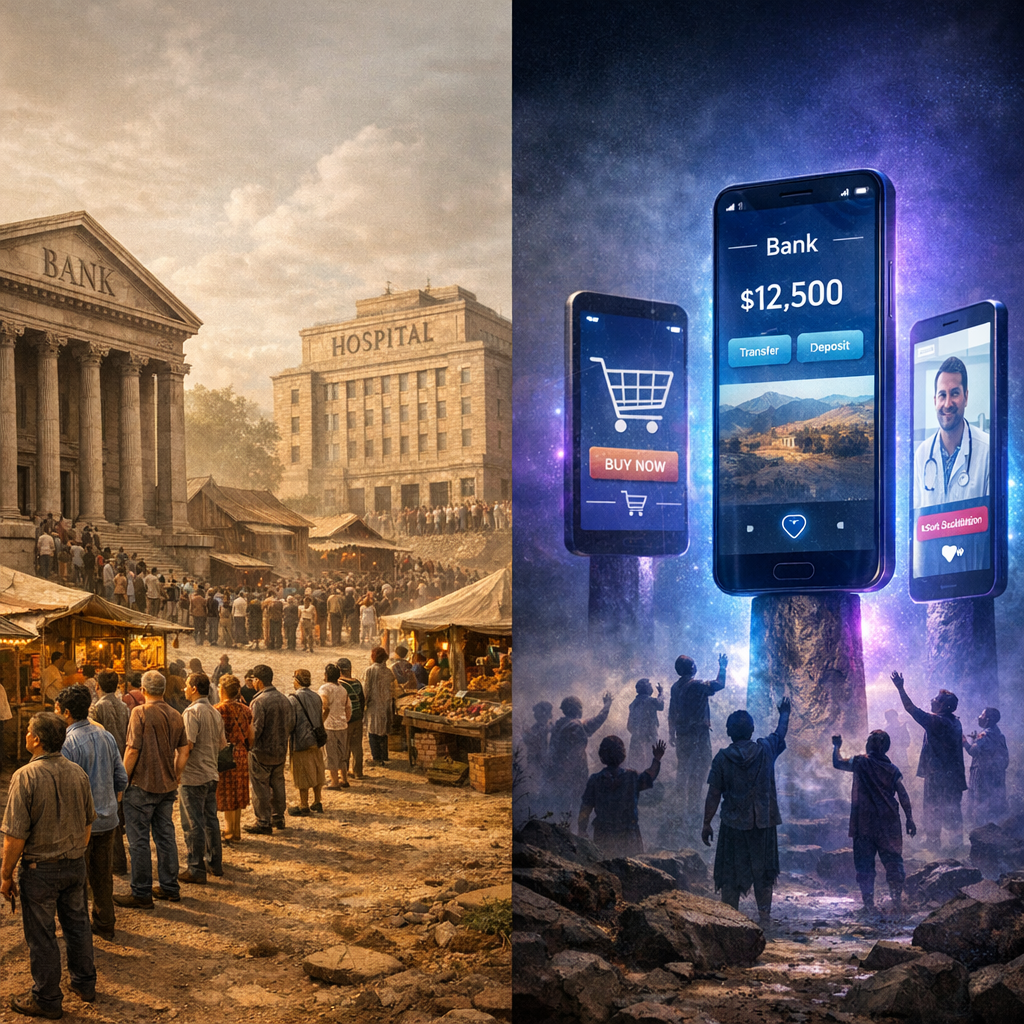
When the tribe chooses its totem: silent sacrifices among banks, shops, and digital hospitals
An anthropologist observes how banks, retailers, and hospitals are reorganizing around new digital totems. There are no heroes or pure winners—only tribes that grow through sacrifices, friction, and uneasy pacts between traditional industry and startups.

The Hook: The emptying office, the app that never sleeps
Friday, 11:47 a.m.
In a neighborhood bank branch, three people wait their turn. The branch manager leafs through a report on office closures; he knows that, statistically, a portion of his own physical network is already an expensive anachronism. Fifteen meters away, a sign promises “personalized attention and trust.”
At the same moment, on the other side of the city, a fintech with no physical offices is registering hundreds of new sign-ups in its app. Between 20–30% of its customers under 30 have never set foot in a traditional branch. Its promise is different: “do everything from your phone in minutes.”
If you look at these two spaces like an anthropologist, you don’t see technologies. You see rituals.
In the bank, the ritual is in-person, slow, laden with symbols: signatures, stamps, bulletproof glass. In the app, the ritual is silent: biometrics, push notifications, a contract accepted with a thumb swipe.
The scene repeats, with variations, in the neighborhood supermarket versus e‑commerce, and in the hospital waiting room versus the video-call consultation. We are not just witnessing “digital transformation”; we are witnessing a redistribution of sacrifices: which tribes accept which losses in exchange for what kind of progress.
This report is not about benefits. It is about what is given up in order to grow.
The Genesis: How we went from cathedrals to app-altars
For decades, the banking, retail, and healthcare sectors built physical cathedrals: branches, stores, hospitals. These were places of regular pilgrimage, with clear rules and visible hierarchies. Value was concentrated in stable infrastructure and control of space.
The irruption of digital startups—fintech, e‑commerce, healthtech—reorganized economic life around less visible totems: the app on the phone, the payment gateway, the medical record in the cloud.
In banking and finance, the comparative narrative is usually presented in simple terms: traditional banks as heavy structures protected by regulation (Basel III, solvency controls), versus agile fintechs like Nubank or dozens of neobanks promising fee‑free services and elegant UX. However, that shift entailed sacrifices: closed branches, transformed jobs, disoriented older customers, and trust transferred from the familiar employee to opaque algorithms.
In retail, the physical store offered variety and socialization; e‑commerce, led by digital‑native players, introduced solitary but convenient shopping, with personalization based on data and consumption patterns. The promise of “fast delivery” is sustained by intensive logistics chains and highly precarious work in some of their links.
In healthcare, telemedicine and apps for prescriptions and medical record management—such as the case of Vitae, with record download numbers in its first three months—appear as patient emancipation: more access, less bureaucracy. But behind this, the sacrifice is the dematerialization of the doctor–patient relationship and the fragmentation of care across multiple platforms.
The underlying pattern is always the same: the technological tribe offers a new form of belonging and efficiency, but demands the abandonment of part of the rituals, physical supports, and human bonds that sustained the previous economic life.
The Invisible Conflict: It’s not “who wins,” but “who pays the invisible price”
On the surface, the traditional‑industry vs. startup comparison looks like a race for efficiency. The real conflict, however, is which social group absorbs which cost.
In each sector, we can read three fronts of invisible tension:
-
Control vs. dependence
- Traditional banking sacrificed speed to maintain total control over the value chain, with high vertical integration and strict regulatory compliance.
- Fintechs sacrifice control in exchange for speed, relying on banking APIs, cloud infrastructure partners, and external ecosystems. Dependence disguised as freedom.
-
Physical presence vs. digital accessibility
- Traditional retail has given up part of its margin to sustain the store as a social and service space.
- E‑commerce startups sacrifice that stable physical presence to offer convenience and personalization, at the cost of making logistics work and community disconnection invisible.
-
Human relationship vs. remote efficiency
- In healthcare, hospitals and clinics sacrifice digital agility to preserve protocols, clinical coordination, and clear legal responsibility.
- Healthtechs sacrifice continuity and relational warmth to multiply access points, relying on patient autonomy and automation.
The question is not who offers “better UX” or “better technology.” The anthropological question is: which part of the social fabric thins out so that UX can feel magical.
Evidence & Insights: Three sectors, six tribes, and their renunciations
1. Banking/Finance: from marble to mobile
a) Business models: the price of trust
Incumbent bank
- Value proposition: Security and institutional trust in safeguarding money and credit.
- Revenue: Various fees, loan interest, investment services.
- Costs: Extensive physical infrastructure, legacy IT systems, compliance teams.
- Growth: Traditionally via geographic expansion and acquisitions; now also through buying fintechs.
- Vertical integration: High, end‑to‑end control of products and risks.
- Regulation: Heavy (Basel III, consumer protection, AML, KYC).
Structural sacrifice: Slowness in launching new products and digital friction to protect solvency, stability, and compliance. The banking tribe sacrifices agility to sustain systemic trust.
Fintech startup (e.g., neobanks like Nubank)
- Value proposition: Simple financial services, no fees, in a clear app.
- Revenue: Transaction fees, credit products, freemium or premium subscription models.
- Costs: Lower physical structure; heavy investment in development, data, and user acquisition.
- Growth: Fast platform‑based scaling, partnerships with banks and issuers, agile international expansion.
- Vertical integration: Lower; built on banking partners and infrastructure providers.
- Regulation: Lighter at the start, but increasing as volume and complexity grow.
Structural sacrifice: Less direct control over critical infrastructure, exposure to unexpected regulatory changes, and dependence on partners. The fintech tribe sacrifices structural security to gain speed and perceived closeness to the customer.
b) Technology and architecture: the cost of modernizing a temple
Traditional banking
- Architecture: Monolithic legacy systems, hard to modify without risk.
- Data: Classic Business Intelligence: periodic reports, limited personalization.
- Release speed: Quarterly or semi‑annual; many approval cycles.
- Cybersecurity and compliance: Very robust but rigid; slow changes to avoid compromising integrity.
- Openness: Restricted APIs; openness driven by regulation, not by culture.
- Scaling: Limited by architecture and by the weight of the physical network.
Technological sacrifice: Banks sacrifice flexibility and experimentation to avoid massive failures and penalties. The temple cannot close “for experimental maintenance.”
Fintech
- Architecture: Cloud‑based microservices; each component independent and updatable.
- Data: Use of data lakes, AI/ML algorithms for scoring, fraud prevention, and personalization.
- Release speed: Weekly or daily, using DevOps and CI/CD.
- Cybersecurity: More flexible and innovative, under pressure to mature controls.
- Openness: Open APIs, third‑party integration as a design principle (API‑first).
- Scaling: Designed for rapid regional or global growth.
Technological sacrifice: Less time to consolidate controls, risk of accumulating “compliance debt.” The altar is new; the solidity of its columns is still being tested.
c) User experience: giving up the human gesture
Traditional banking
- Journey: Branch‑centric; digital is added on, not designed from scratch.
- UI: Complex apps full of internal terminology.
- Support: Strong human presence, but with wait times and paperwork.
- Experience: Moderate to low digital NPS; high abandonment in online processes.
- Iteration: Slow; few simultaneous tests, tightly controlled changes.
UX sacrifice: The bank gives up a fluid experience to avoid breaking coherence with inherited processes and to avoid multiplying operational risk.
Fintech
- Journey: Mobile‑first and omnichannel from day one.
- UI: Colloquial language, minimalist screens.
- Support: Chatbots, self‑service, human support as last escalation.
- Experience: High NPS, low abandonment.
- Iteration: Product features and flows under continuous A/B testing.
UX sacrifice: The fintech sacrifices relationship depth: less opportunity to build personal ties, greater ease for the customer to switch providers with one tap.
2. Retail/Commerce: from the lit aisle to the invisible cart
a) Business models: from ritual visit to atomized purchase
Traditional retail
- Value proposition: Variety of offerings, in‑store experience, ability to see and touch the product.
- Revenue: Direct sales, promotions, margins negotiated with suppliers.
- Costs: High: rents, store staff, logistics to physical points.
- Growth: New store openings, category diversification, franchises.
- Vertical integration: From sourcing to point of sale, with some control over the chain.
- Regulation: Retail trade, labor rules, consumer protection.
Structural sacrifice: Margin and financial flexibility to maintain a space that also serves a social function: a place for meeting, physical comparison, and routine.
E‑commerce / marketplace startup
- Value proposition: Convenience, 24/7 availability, data‑driven personalization.
- Revenue: Online direct sales, marketplace commissions, loyalty subscriptions.
- Costs: Digital operations, logistics centers, performance marketing.
- Growth: Platform‑driven, expanding categories and geographies with less brick‑and‑mortar investment.
- Vertical integration: Typically lower; they leverage logistics operators and third‑party sellers.
- Regulation: Similar consumer protection, but less exposure to rules for local physical commerce.
Structural sacrifice: Less control over delivery experience and final quality, dependency on third parties for key stages.
b) Technology and architecture: the infinite shelf has a price
Traditional retail
- Architecture: ERP and legacy POS systems, hard to connect to new channels.
- Data: Focused on inventory and sales history; limited personalization.
- Speed of change: Slow; changes require staff training and hardware updates.
- Cybersecurity: Focused on POS and payment data protection.
- Openness: Restricted APIs to integrate with suppliers, but no platform mindset.
- Scaling: Tied to new openings and logistical improvements.
Technological sacrifice: Coherence between warehouse, store, and checkout is prioritized over rapid experimentation with new digital models.
Digital retail startups
- Architecture: Cloud, microservices, modular e‑commerce (decoupled cart, catalog, payments).
- Data: Advanced analytics for recommendations, dynamic pricing, customer segmentation.
- Speed of change: High; constant iteration in product pages, checkout, promotions.
- Cybersecurity: Focus on payments and online fraud protection.
- Openness: Integration with multiple payment, logistics, and marketing platforms.
- Scaling: Easy to replicate in new digital geographies.
Technological sacrifice: They grow at the cost of integration complexity and dependence on global infrastructures (payment gateways, major clouds), accepting a certain “outsourced fragility.”
c) User experience: from talking to the clerk to the suggesting algorithm
Traditional retail
- Journey: Centered on the physical visit; online is usually a later add‑on.
- UI: Static websites, poorly filterable catalogs.
- Support: Face‑to‑face, phone; variable resolution time but with human interaction.
- Experience: For some users, richer due to physical interaction; for others, inefficient.
- Iteration: Seasonal or campaign‑based changes; little continuous experimentation.
UX sacrifice: The store forgoes digital hyper‑personalization to uphold a role as community experience. The customer pays with time, not with data.
E‑commerce / startups
- Journey: Designed from the start for quick, low‑friction purchasing.
- UI: Filters, comparison tools, user reviews.
- Support: Chats, FAQs, bots; human support reserved for serious issues.
- Experience: High conversion if the customer knows what they want; cold if they need contextual advice.
- Iteration: Permanent A/B testing on banners, offers, checkout flows.
UX sacrifice: The customer gains convenience but loses co‑present social interaction and the chance to discover through relationships with store staff.
3. Healthcare: from the crowded corridor to on‑screen consultation
a) Business models: expanded access, fragmented continuity
Traditional system/hospital
- Value proposition: Comprehensive care, from emergencies to chronic management.
- Revenue: Public funding, insurance, co‑pays; complex fee‑for‑service models.
- Costs: Hospital infrastructure, highly qualified staff, equipment.
- Growth: New specialties, center expansion, agreements with insurers.
- Vertical integration: High; diagnosis, treatment, and follow‑up concentrated.
- Regulation: Strict regarding clinical data protection, quality protocols, and patient safety.
Structural sacrifice: Limited margin to invest in brilliant digital experiences; clinical capacity and medical standards are prioritized.
Healthtech startup / health apps (e.g., a Vitae‑type app)
- Value proposition: Rapid access to specific services: teleconsultation, e‑prescriptions, medicine purchases, record access.
- Revenue: Subscriptions, pay‑per‑use, B2B agreements with insurers or pharmacies.
- Costs: Software development, user acquisition, agreements with professionals and providers.
- Growth: Digital geographic scaling, alliances with health systems, record download rates in a few months.
- Vertical integration: Typically partial; they depend on external networks of clinics, labs, and pharmacies.
- Regulation: Must comply with privacy and medical standards, but with frameworks still evolving in some countries.
Structural sacrifice: They take on the risk of being “in between”: neither a full hospital nor a mere tech tool. Patient journey fragmentation is the price of accessibility.
b) Technology and architecture: the medical record as digital totem
Traditional healthcare
- Architecture: Integrated but rigid hospital systems, often on‑premise.
- Data: Electronic health records, but limited sharing between institutions.
- Speed of change: Slow; any update affects life‑or‑death processes.
- Cybersecurity: Very high, under strict regulation.
- Openness: Limited integrations, little culture of open APIs.
- Scaling: Limited by physical capacity and public or insurer budgets.
Technological sacrifice: Fast experimentation is sacrificed in favor of stability and clinical safety.
Healthtech
- Architecture: Cloud, microservices, mobile apps connected to lightweight backends.
- Data: Collect habits, symptoms, basic histories; starting to use AI for recommendations and triage.
- Speed of change: High; frequent new versions, fast rollout of new features.
- Cybersecurity: Maturing; tension between maximum usability and robust protocols.
- Openness: APIs to integrate with pharmacies, insurers, devices.
- Scaling: Rapid in user numbers; slower when deep clinical integration is required.
Technological sacrifice: Healthtechs give up data homogeneity and unified protocols in order to grow in layers, connecting unevenly to existing systems.
c) User experience: clinical intimacy vs. digital convenience
Traditional system
- Journey: Centered on in‑person visits; digitalization usually layered on top of already complex processes (appointments, referrals, tests).
- UI: Functional but unfriendly patient portals.
- Support: Phone, front desks, direct interaction with healthcare staff.
- Experience: High friction (wait times, queues), but a strong sense of being “attended to” by real people.
- Iteration: Gradual changes, heavy institutional constraints.
UX sacrifice: Systems sacrifice smoothness to maintain clinical rigor and internal coordination.
Healthtech / patient apps
- Journey: Fast registration, teleconsultation bookings, online prescription and medication purchases.
- UI: Clean interface focused on a few key tasks.
- Support: Mix of bots, FAQs, on‑demand professionals.
- Experience: High sense of patient control; less time lost physically.
- Iteration: Adjusted according to usage metrics and user feedback.
UX sacrifice: Care is fragmented: one professional here, another there, multiple apps. Some continuity and prolonged clinical observation is lost.
The Winners vs. Losers Scorecard: who wins speed, who bears fragility
At the tribal level, there are no absolute winners; there are groups that carry different fragilities.
| Key dimension | Traditional banks | Fintech / Financial startups | Traditional retail | E‑commerce / Retail startups | Traditional healthcare | Healthtech / Health apps |
|---|---|---|---|---|---|---|
| Regulatory control | High but costly | Low at first, growing with scale | Medium | Variable, depending on country | Very high | High, still consolidating |
| Innovation speed | Low | High | Low | High | Low | High |
| Structural stability | High | Medium | Medium‑high | Medium | High | Medium |
| Perceived digital experience | Medium‑low | High | Medium | High | Medium‑low | High |
| Dependence on third parties | Lower (vertical integration) | High (APIs, banks, cloud) | Medium | High (logistics, payments) | Medium | High (clinics, pharmacies, clouds) |
| Depth of human relationship | High in branch/office | Low‑medium (remote channels) | High in store | Low | High (in‑person consultation) | Medium‑low (remote interaction) |
Each cell reflects a sacrifice: high speed sacrifices stability; high control sacrifices agility; human experience sacrifices efficiency; digital experience sacrifices relationship.
The Timeline of Sacrifices: how rituals change in three waves
| Approx. historical wave | Banking / Finance | Retail / Commerce | Healthcare |
|---|---|---|---|
| 1st wave (analogue) | Physical financial cathedrals | Store as social plaza | Hospital as total center of healthcare life |
| 2nd wave (digitalizing) | Online banking layered on legacy systems | E‑commerce as a parallel channel | Electronic records, basic patient portals |
| 3rd wave (digital‑native) | 100% mobile neobanks (e.g., Nubank) | Global marketplaces and quick‑commerce | Prescription apps, mass telemedicine (e.g., Vitae) |
In each transition, certain groups lose centrality: branch employees, store clerks, healthcare admin staff. Others gain symbolic power: developers, product designers, data specialists.
The Strategic Shift: uncomfortable decisions that truly change the tribe
From a strategic anthropology perspective, recommendations are not checklists of “best practices,” but conscious pacts about what to sacrifice.
A. For incumbents: what they must be willing to lose
-
Let go of the myth of total control
Opening APIs and platforms means accepting interdependence with startups and third parties. The sacrifice is symbolic: admitting that value is no longer generated only inside the walls, but in the ecosystem. -
Accept partial cannibalization of the physical channel
Banks, retailers, and hospitals must treat their physical assets as high value‑added hubs (complex advice, premium experience, critical cases), not as default channels. This means closing or repurposing spaces, with labor and social impact. -
Abandon “UX as decoration”
Bring UX teams into the decision‑making core, even if this clashes with traditional org charts. It implies ceding power from product or IT areas to hybrid profiles. -
Sacrifice homogeneity to gain learning
Instead of multi‑year mega‑projects for total modernization, pursue modular core modernization. Accept a temporarily uneven architecture (new coexisting with old) in exchange for learning and risk reduction. -
Expose experience metrics internally, even if it stings
Make NPS, abandonment rates, and resolution times visible by business unit. Political cost is high: areas that “have always done it this way” face new scrutiny.
B. For startups: what they must stop believing to survive alongside giants
-
Give up the myth of frictionless hyper‑growth
In banking and healthcare, sustainable competition means embracing evolving regulatory frameworks from the outset, not treating them as a “when we’re big” issue. The sacrifice: speed and the “purity” of the minimal viable product. -
Accept roles as invisible infrastructure
Not every startup will be customer‑facing. Many will find advantage in being the “engine under the hood” of banks, retailers, or health systems. The sacrifice is ego: yielding brand visibility in exchange for recurring B2B revenue. -
Sacrifice extreme simplicity to handle real‑world cases
Regulatory and operational realities force exceptions, special flows, and human support. The perfect UX becomes slightly more complex, but more honest and viable. -
Abandon experiment‑without‑memory culture
Move from constant iteration without record to governed change processes, especially in critical sectors. The price is minimal internal bureaucracy, needed to avoid repeating mistakes. -
Let go of “incumbent = dinosaur”
See incumbents as potential partners, not just obsolete rivals. This enables revenue‑sharing, co‑development, and shared distribution channels. The sacrifice is sharing margin and part of the disruption narrative.
The Big Picture: what tribe we want to be when every business is a digital ritual
In banking, retail, and healthcare, it is no longer just products or technologies that compete. Rituals of belonging compete.
- The banking customer chooses between loyalty to the familiar branch and to an app that responds in seconds.
- The shopper chooses between a stroll to the local shop and an anonymous late‑night order.
- The patient oscillates between the known waiting room and the video call from the sofa.
Each choice empowers one organizational tribe and weakens another. If digital transformation has something of inevitability, sacrifices never are: someone chooses, consciously or not, who loses power, which ties are cut, which rituals are forgotten.
The banks, shops, and hospitals that survive will not be those with “the best technology,” but those that explicitly negotiate these sacrifices with their community: employees, customers, regulators, territories. The startups that endure will be those that accept that maturing means adopting brakes, control rituals, and collective responsibilities.
Anthropology reminds us that every innovation is, in reality, a rewriting of everyday rites. The question is not which sector will win, but what kind of society will emerge from this recombination of apps, branches, stores, and waiting rooms.
Perhaps the next wave of meaningful innovation will not come from a new business model, but from a more honest pact about what we are willing to lose while we go on calling whatever comes next “progress.”
References
- Comparative analysis of traditional industry vs. startup ecosystem in banking/finance, retail/commerce and healthcare (context provided).
- Cincodias.elpais.com – "Las fintech y el sector bancario: una relación de largo recorrido" (2023).
- Ecosistemastartup.com – Case Nubank and cost efficiency in fintech.
- Hypernovalabs.com – Development of health applications and case of a Vitae‑type app with record download numbers.
- International financial regulations: Basel III and consumer protection frameworks in banking.
- General data protection and healthcare regulations applicable to medical records and telemedicine services.
Related Articles

Who Stole the Value? A Forensic Audit of Giants, Startups, and the Customer Left Out of the Deal
Treating today’s innovation economy as a crime scene, this essay investigates what quietly disappears when incumbents and startups reshape finance, health, retail, mobility, education, and climate tech. Beyond pitch decks and marble lobbies, who actually captures the value—and at what human cost?

The Year We Misread the Checkbox: How a Single UX Choice Rewired Giants and Startups
Writing from 2050, a radical futurist looks back on 2024 and argues that the true battle between traditional industries and startups in banking, retail, health, and mobility never took place in boardrooms or pitch decks, but inside a single, tiny UX artifact: the checkbox. By following that microscopic element, this manifesto rewrites the history of incumbents vs. startups as a struggle over who controls consent, data, and time.

The scene of the silent crime: where has courage been lost between giants and startups?
A monk‑analyst steps onto the “crime scene” of the digital economy—financial services, retail, healthcare, mobility, education, and manufacturing—to investigate a silent disappearance: the deeper value that customers, workers, and communities expected from the transformation between traditional industry and the startup ecosystem.