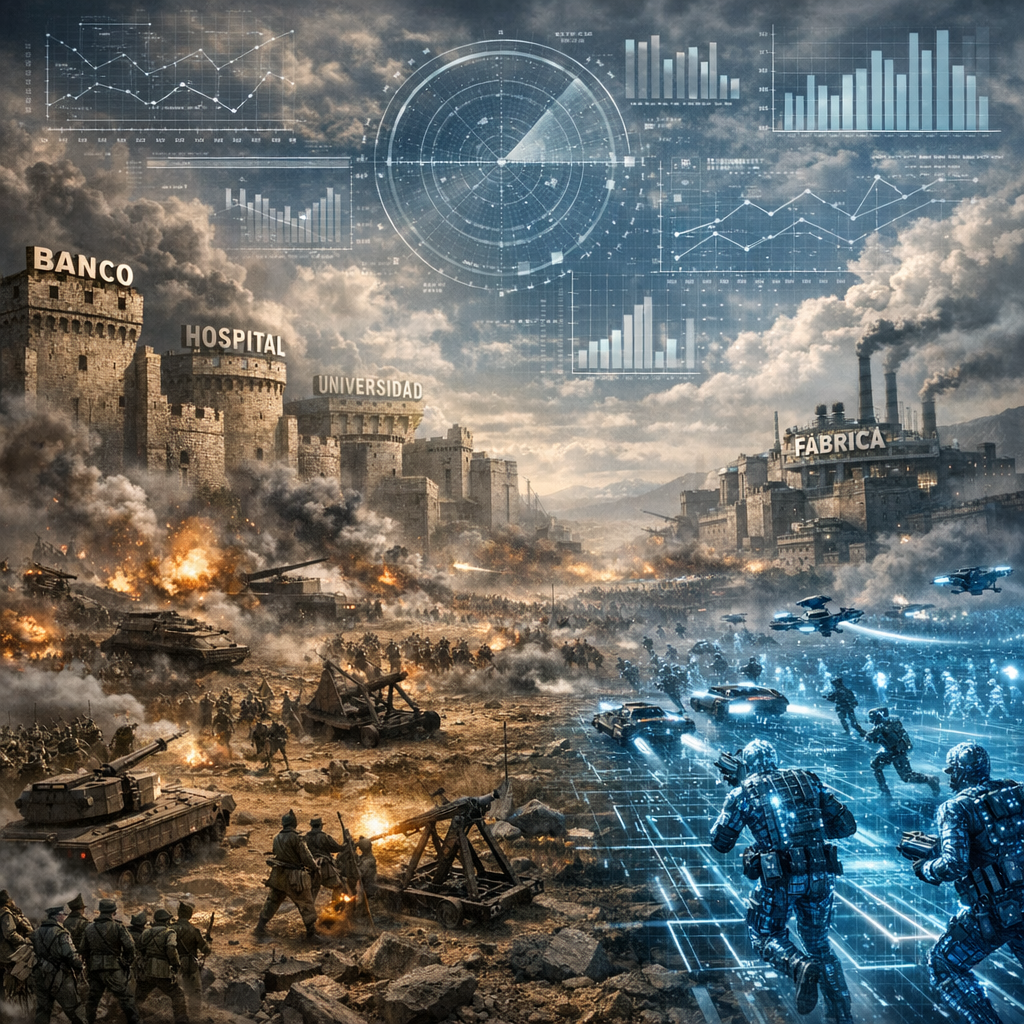
When progress demands casualties: traditional industry and startups through the lens of Verdun
A war historian compares traditional industry and the startup ecosystem to rival armies on multiple fronts: finance, healthcare, retail, mobility, education, and manufacturing. There are no untarnished heroes—only trade‑offs, sacrifices, and tactical decisions reminiscent of Verdun, Stalingrad, or the French Revolution.

The Hook: a financial “general” facing his digital Verdun
The CEO of a major Latin American bank looks at a dashboard of indicators as if it were a trench map.
On the left, a stable front: marble‑clad branches, regulatory solvency, decades of accumulated trust. On the right, a front that’s bleeding young customers to an app that didn’t exist five years ago.
He’s not celebrating stability. He’s counting casualties:
- Loss of margin due to competitive pressure from fintechs.
- Loss of talent, defecting to startups.
- Loss of regulator patience, as they demand more controls in the middle of a digital race.
His dilemma isn’t “how to win.” It’s: what to sacrifice to stay in the war?
The same dilemma repeats in a hospital, a retail chain, a transport fleet, a university and a factory. As a war historian, I’ve seen it before: at Verdun, where France decided to hold out at any cost; at Stalingrad, where German speed crashed into winter and attrition; in the French Revolution, where the ancien régime underestimated the price of not changing.
In the clash between traditional industry and startups, there are no simply “modern” and “obsolete” armies. There are different doctrines, each with its strengths… and, above all, with inescapable sacrifices.
The genesis of the conflict: two armies, two doctrines
What we’ll call “traditional industry” and “startup ecosystem”
In this campaign, we’ll call traditional industry those established companies operating in consolidated and heavily regulated sectors, with:
- Hierarchical, bureaucratic structures.
- Standardized processes focused on stability and sustained profitability.
- An emphasis on optimizing what already exists rather than taking big disruptive bets.
The startup ecosystem will be the set of emerging companies designed—following Steve Blank—as temporary organizations seeking a repeatable and scalable business model under extreme uncertainty, with:
- Lightweight structures, small teams and distributed decision‑making power.
- Venture capital demanding accelerated growth.
- A culture of experimentation, traction metrics and “validated learning.”
Structural differences: choosing a type of war
As in military history, the difference is not just who has more soldiers, but what kind of war each side chooses.
| Dimension | Traditional industry (War of position) | Startups (War of maneuver) |
|---|---|---|
| Governance | Committees, boards, multiple approvals | Founders and small boards, fast decisions |
| Access to capital | Bank credit, debt markets, regulated issuances | Venture capital willing to tolerate losses for growth |
| Time horizon | Decades, emphasis on stability and dividends | Years, focused on reaching product‑market fit and scaling |
| Risk tolerance | Low: avoid visible failures and regulatory sanctions | High: frequent failures accepted as long as there is learning |
| Culture | Conservative, procedural, control‑oriented | Innovative, experimental, user‑detail‑oriented |
| Iteration speed | Slow: long change cycles, multi‑year projects | Fast: short cycles, continuous releases |
Traditional industry chooses the fortress: high walls, predictable rules, reserves of capital. It sacrifices flexibility to protect positions.
Startups choose blitzkrieg: speed, surprise, occupation of unprotected niches. They sacrifice safety and reserves to move before the rival.
The financial front: Stalingrad in banking and fintech
a) Sector context
The Latin American financial sector recalls the Eastern Front in World War II: highly regulated, with a few large banks controlling most of the ground, but with large “unbanked” populations equivalent to unoccupied territory.
Banking system maturity is high, but financial inclusion is incomplete. The arrival of fintechs opens a new front: digital payments, alternative lending, mobile wallets.
b) Business models: fees vs. disintermediation
-
Traditional industry:
- Revenue from interest (lending) and fees (services).
- Heavy cost structure: physical branches, large headcount, legacy systems.
- Channels: branches, call centers, online banking often conceived as a “digital version of paper.”
- Critical dependence on regulation to operate, which acts as a defensive moat.
-
Fintech startups:
- Value propositions focused on simplicity, lower fees and access for the unbanked.
- Monetization via subscriptions (premium accounts), marketplace models (P2P lending), payment “take rate” and sometimes freemium.
- Lower dependence on physical assets; intellectual capital and data are their main arsenal.
Competitive advantage:
- Banks: reputation, access to liquidity, regulatory licenses.
- Fintechs: much lower acquisition and service cost per customer, products designed natively for mobile.
c) Technology: legacy vs. cloud‑native
Banks operate like armies with equipment from several different wars layered together:
- Core legacy systems with complex, costly integrations.
- Limited automation and labor‑intensive back‑office processes.
- Partial AI/ML implementations, often confined to credit scoring or fraud detection.
Fintechs design their “artillery” in the cloud:
- Cloud‑native architectures, microservices, open APIs, data lakes.
- Continuous deployment, weekly or daily iterations.
- Native integration of advanced analytics, automation and, increasingly, generative AI in front and back office.
The trade‑off is clear: banks have resilience and robustness, but at the cost of slowness and internal friction; fintechs have flexibility and speed, sacrificing redundancies and safety buffers.
d) User experience: physical lines vs. onboarding in minutes
-
Banks:
- Long forms, slow approval times, legacy UX.
- Incomplete omnichannel experience: jumping from the app to the branch.
- Brand associated with trust and stability, but also with “administrative pain.”
-
Fintechs:
- Fast, mobile‑first, self‑service digital onboarding.
- Personalization using transactional data.
- Agile support, though sometimes limited in complex situations.
Banks sacrifice acquiring younger clients and lower‑frequency users; fintechs sacrifice by bearing the perception of risk and a lack of history.
e) Regulation and risk
Financial regulation is a double‑edged sword.
- For banks, it protects the perimeter but forces them to devote much of their energy to compliance.
- For fintechs, the “sandbox” opens gaps in defenses but exposes them to significant operational and reputational risks when something fails.
f) Representative patterns
- Universal banks with full portfolios and regional presence.
- P2P lending platforms, payment gateways and digital wallets capturing underserved segments.
The health front: slow hospital artillery vs. telemedicine guerrillas
a) Sector context
The Latin American health system looks like a fragmented front: public and private systems, small clinics and large hospitals, insurers, all tied together by complex bureaucracies. Intense regulation, high fixed costs, heavy dependence on specialized staff.
b) Business models
-
Traditional institutions:
- Income through insurance, co‑pays, direct fee‑for‑service.
- High costs in physical infrastructure, equipment, staff and on‑call coverage.
- Channels: in‑person appointments, referrals, insurance networks.
-
Health startups (healthtech):
- General telemedicine, online specialties, mental health, remote monitoring.
- Subscription models for chronic patients, freemium in wellness apps.
- Marketplaces connecting independent doctors with patients.
Advantages:
- Traditional: capacity for complex care, surgery, emergency, access to insurance reimbursements.
- Startups: access and convenience; more personalized and cheaper services per visit.
c) Technology
-
Traditional:
- Incomplete or fragmented electronic health records.
- Poor integration between lab, imaging and pharmacy systems.
- Limited use of data for prevention; focus on managing the acute episode.
-
Startups:
- Cloud platforms for video calls, medical chat, e‑prescriptions.
- AI for triage and personalized reminders.
- Interoperability via APIs with insurers or public systems when possible.
Hospitals that cling to tradition sacrifice by keeping slow, costly processes; startups sacrifice the ability to treat complex cases: their artillery is light.
d) User experience
-
In hospitals:
- Long waits, duplicate paperwork, rigid schedules.
- Feeling of clinical safety, but administrative frustration.
-
In healthtech:
- Fast remote access, flexible hours, UX focus.
- Trust barriers for serious cases.
Startups capture mild and moderate consultations; hospitals retain the critical, but lose ground on the “front line” of patient relationships.
e) Regulation and risk
- Regulation protects patient safety but slows innovation adoption.
- Startups must manage data privacy risks, medical compliance and professional liability.
f) Generic cases
- General teleconsultation and mental health platforms.
- Remote monitoring devices reporting to a digital dashboard.
The retail front: old commercial empires under e‑commerce siege
a) Sector context
Latin American retail resembles a system of commercial city‑states: large chains dominate urban centers with physical stores and malls, while e‑commerce opens alternative sea routes.
b) Business models
-
Traditional retail:
- In‑store sales with tight margins.
- High fixed costs: rent, in‑store inventory, sales staff.
- Channels: physical stores, catalogues, e‑commerce as a complement.
-
Retail / e‑commerce startups:
- Marketplaces, dropshipping, direct‑to‑consumer models.
- Monetization through commissions, on‑site ads, logistics subscriptions.
- Less exposure to owned inventory, higher dependence on logistics partners.
Advantages:
- Traditional: physical experience, trust, ability to try products.
- Startups: broad catalogues, easily comparable prices, convenience.
c) Technology
-
Traditional:
- ERPs and inventory systems often fragmented.
- Weak integration between physical and digital channels.
-
Startups:
- Platforms optimized for conversion, behavioral analytics.
- Recommendation algorithms, marketing automation.
The trade‑off: classic retailers retain physical control and proximity, but sacrifice agility in personalization; startups gain flexibility while sacrificing direct control of the logistics experience.
d) User experience
-
Physical store:
- Human assistance, product trial, immediate delivery.
- Limited local stock, store hours, customer travel.
-
Startup e‑commerce:
- Intuitive UX/UI, price comparison, reviews, personalization.
- Risks in delivery times and returns.
e) Regulation and risk
- Less strict regulation than in finance or health.
- Risks in consumer protection, data and logistics (failed deliveries, fraud).
f) Patterns
- Regional marketplaces aggregating small sellers.
- Price comparison and coupon apps eroding traditional margins.
The mobility front: heavy cavalry vs. platform swarms
a) Sector context
Urban transport resembles heavy cavalry armies facing swarms of light infantry. Traditional bus, taxi and fleet companies compete with ridesharing and micromobility apps.
b) Business models
-
Traditional companies:
- Regulated fares, concessions, taxi licenses.
- Asset‑based models (owned or concessioned vehicles).
-
Mobility startups:
- Platforms connecting independent drivers and users.
- Monetization via per‑trip commissions, dynamic pricing.
- Expansion into other services (deliveries, urban logistics).
Advantages:
- Traditional: access to infrastructure, regulatory protection, territorial knowledge.
- Startups: flexible supply, fast demand adjustment, app‑centric experience.
c) Technology
-
Traditional:
- Often limited fleet management systems.
- Low integration of real‑time data.
-
Startups:
- Apps with geolocation, matching algorithms and dynamic pricing.
- Data lakes of mobility patterns.
Traditional players sacrifice by accepting inefficiencies in occupancy and idle time; startups sacrifice by operating on the edge of regulatory and social controversy.
d) User experience
-
Traditional transport:
- Physical stops, fixed schedules, cash payments.
- Perceived safety on regulated routes, but discomfort and waiting.
-
Platforms:
- On‑demand requests, route traceability, digital payments.
- Variability in service quality and perceived safety.
e) Regulation and risk
- Local governments debate how to balance competition, labor safety and congestion.
- Startups often operate in regulatory “grey zones,” taking on the risk of sanctions or abrupt rule changes.
f) Patterns
- Regional ride‑hailing apps.
- Micromobility platforms with shared scooters or bikes.
The education front: university‑fortresses vs. edtech squads
a) Sector context
Higher education and professional training resemble a system of medieval fortresses: universities, institutes and schools with centuries of legitimacy, surrounded by a growing perimeter of edtech platforms.
b) Business models
-
Traditional education:
- Tuition, periodic fees, public or mixed funding.
- High fixed costs: campus, infrastructure, academic staff.
-
Edtech startups:
- Online courses, bootcamps, micro‑credentials.
- Subscription, pay‑per‑course, and in some cases income share agreements.
Advantages:
- Traditional: recognized degrees, alumni networks, research.
- Edtech: speed in updating content, lower cost per student, geographic accessibility.
c) Technology
-
Traditional:
- Basic learning management systems (LMS).
- Low personalization, synchronous classes moved almost unchanged into digital.
-
Startups:
- Cloud platforms with learning analytics.
- AI for tutoring, instant feedback and personalized paths.
The university’s sacrifice: preserving rituals and status at the expense of agility; edtech’s sacrifice: lacking full legitimacy with some employers and regulators.
d) User experience
-
Physical classroom:
- Rich human interaction, powerful social networks.
- Rigid schedules and curricula, commuting.
-
Startup digital classroom:
- Flexible pace, updated content, learner‑centric UX.
- Higher dropout if engagement fails, less positive social pressure.
e) Regulation and risk
- Accreditation and regulatory frameworks are slow to accept new forms of certification.
- Edtech risks in academic quality, data protection and unkept job‑placement promises.
f) Patterns
- Massive course platforms, intensive bootcamps, digital vocational academies.
The manufacturing/logistics front: production lines vs. digital just‑in‑time chains
a) Sector context
Latin American manufacturing and logistics are the equivalent of supply fronts in war: essential but often technologically lagging.
b) Business models
-
Traditional manufacturing/logistics:
- Scale production, long‑term contracts, tight margins.
- High costs in facilities, machinery, fleets.
-
Industrial/logistics startups:
- Supply chain visibility platforms.
- On‑demand storage and transport services.
- Marketplace models connecting idle capacity with spot demand.
Advantages:
- Traditional: installed capacity, long‑standing relationships with large customers.
- Startups: flexibility for demand peaks and underserved niches.
c) Technology
-
Traditional:
- Warehouse management systems and ERPs often lacking real‑time integration.
- Limited advanced automation, restrained AI adoption.
-
Startups:
- Cloud platforms with real‑time tracking.
- Algorithms for route, load and storage optimization.
Trade‑off: classic manufacturers and operators prioritize stability and secure contracts, sacrificing the ability to react quickly; startups embrace volatility in exchange for near real‑time network reconfiguration.
d) User experience (B2B customer)
-
Traditional:
- Slow quoting processes, rigid contracts, low transparency.
-
Startups:
- Self‑service portals, real‑time tracking, dashboards.
e) Regulation and risk
- Labor, transport and foreign trade frameworks influence system rigidity.
- Startups face compliance, third‑party management and cybersecurity risks.
f) Patterns
- Fleet management platforms.
- Freight and warehousing marketplaces.
Cross‑front situation report: common patterns and sacrifices
From the financial trench to the factory, clear patterns repeat.
Shared patterns in business models
- Startups capture “orphan territories”: the unbanked, patients without access to specialists, merchants without online channels, travelers without flexible options, adult learners, small businesses without efficient logistics.
- They do so with lightweight, tech‑intensive models and decreasing marginal costs.
Traditional industry, in exchange for scale, sacrifices the ability to serve small or short‑term unprofitable niches.
Technological patterns
- Traditional: legacy systems, limited integration, partial automation.
- Startups: cloud, APIs, microservices, AI applied end‑to‑end.
Traditional industry pays technology debt like an army having to supply weapons from multiple eras; startups pay with fragility: when capital runs out or adoption doesn’t come, the house of cards collapses quickly.
UX as the battlefield
Across all fronts, user experience is where positions are truly won and lost:
- Startups reduce friction, simplify processes, personalize.
- Incumbents lean on trust and coverage, but tolerate frictions that erode loyalty.
The recurring sacrifice board
| Dimension | Traditional industry: What does it sacrifice? | Startups: What do they sacrifice? |
|---|---|---|
| Agility | Speed and experimentation | Process stability and predictability |
| Radical innovation | Visible disruptive bets | Continuous focus on immediate profitability |
| Regulatory compliance | Flexibility in service design | Pace of expansion in regulated markets |
| Margin per customer | Part of the margin in exchange for coverage and redundancy | Short‑term margin to finance growth |
| Reputation | Young and dynamic image | Perception of absolute safety and permanence |
| Talent | Low churn but weaker appeal for “tech” profiles | Talent continuity under high‑pressure conditions |
No side “wins” without wounds. Only different areas where scars concentrate.
Competitive maneuvers and scenarios: from total war to coalitions
Historically, few conflicts end with one side’s total annihilation; most lead to armistices, alliances and uneasy equilibria. The same is happening between incumbents and startups.
Current relationship modes
-
Direct competition:
- Fintechs offering accounts and loans to the same segments as banks.
- Mobility platforms competing with traditional taxis.
-
Tactical collaboration:
- Banks integrating fintech solutions via APIs.
- Hospitals using telemedicine platforms as a “first filter.”
- Retailers relying on marketplaces to extend their reach.
-
M&A and corporate venture arms:
- Incumbents buying startups to acquire technology and talent.
- Corporate funds investing in early stage to observe trends.
-
Coexistence in differentiated niches:
- Edtech for continuous training, universities for foundational degrees.
- Logistics startups for last mile, traditional operators for long‑haul.
5–10 year scenarios
-
Consolidation via acquisitions
- Many startups lack ammunition (capital) for a long war.
- Incumbents with cash and regulatory access buy technologies and teams.
- Startup sacrifice: part of their independence and culture. Incumbent sacrifice: accepting painful internal change.
-
Hybrid platforms
- Ecosystems where a bank, hospital or retailer orchestrates a network of specialized startups.
- The incumbent becomes a “platform of platforms,” sacrificing front‑end prominence in exchange for remaining the core of trust and compliance.
-
Technological commoditization and brand wars
- Technologies such as digital payments, medical video calls, LMS, logistics optimization become standard.
- Differentiation shifts to brand, community, proprietary data and integrated experience.
- Startups without a defensible edge beyond technology get trapped in price wars.
-
Partial reconfiguration of the value chain
- Some high‑friction, low‑complexity segments (simple payments, basic consultations, short courses, ad‑hoc urban transport, spot freight) are almost completely reorganized around digital platforms.
- Traditional structures retreat to segments intensive in capital, regulation or technical complexity.
Strategic maneuver: what to sacrifice now to stay on the field
For traditional industry: choosing which fortress to abandon
Established companies cannot win this war by multiplying committees. They need maneuvers equivalent to tactical retreats to regroup.
-
Business model
- Sacrifice some current margins to experiment with subscription, freemium or marketplace models in controlled segments.
- Accept cannibalizing part of the traditional business with digital subsidiaries or brands.
-
Technology architecture
- Accept the political and economic cost of dismantling or encapsulating legacy systems.
- Gradually migrate to modular architectures and internal APIs, even if it means “breaking” comfortable processes.
-
Experience design
- Shift the center of gravity from internal process to customer journey.
- Accept that aesthetics of security and formality can reduce flow, and adjust communication without losing the core.
-
Governance and culture
- Create semi‑autonomous units to experiment, with rules different from the “main body.”
- Accept higher churn of young talent as a manageable cost instead of forcing unrealistic retention.
For startups: learning to sustain long campaigns
Startups have been trained for quick skirmishes. To survive the winter, they need a doctrine of prolonged war.
-
Defensible advantages
- Sacrifice some feature‑building speed to create lasting assets:
- Proprietary data with cumulative value.
- Active user communities.
- Critical integrations that make switching providers costly.
- Patents or specialized know‑how when it makes sense.
- Sacrifice some feature‑building speed to create lasting assets:
-
Regulation management
- Accept dedicating senior talent to compliance from early stages.
- Engage in regulatory conversations, even if they steal hours from development.
-
Scaling without losing UX
- Standardize support and quality processes, even if that limits the ad‑hoc creativity of early stages.
- Invest in operational reliability, sacrificing some short‑term exponential growth “magic.”
-
Finance and resilience
- Reduce exclusive dependence on venture capital: explore more robust early revenues, even if it flattens the growth curve.
Long‑term view: from the myth of “clean disruption” to war of attrition
Popular narratives paint this contest as a sequence of neat coups: a startup appears, “disrupts” a sector, the giants fall. Military history teaches something else:
- Empires don’t fall from a single assault but from cumulative exhaustion, strategic mistakes and bad sacrifice choices.
- Victorious revolutions are not free: they burn generations and political capital before stabilizing.
Across the sectors we’ve examined, the most likely future is not a map populated only by startups or only by giants. It’s a hybrid ecosystem where:
- Incumbents that survive will be those willing to give up part of their fortress to gain mobility.
- Startups that endure will be those that swap a cult of disruption for the discipline of patient management.
As at Verdun, the question is not who fires faster, but who can remain standing after years of attrition.
Today’s economic war will reward less the hero who takes the hill once and more the general who can decide, each year, which position to abandon—painfully—so as not to lose the entire campaign.
References
- Steve Blank. Definition of a startup as a temporary organization designed to search for a repeatable and scalable business model. (Summary based on es.wikipedia.org)
- Comparisons of differences between startups and traditional companies in risk approach, scalability and structure. (Based on hubbog.com and ticnegocios.camaravalencia.com)
- Context on financial inclusion, fintech emergence and strict regulation in the Latin American financial sector. (Based on the summary provided in the research context)
- Description of the Latin American health ecosystem, intense regulation and the emergence of telemedicine and healthtech. (Based on the research context summary)
- Transformation of retail in Latin America, growth of e‑commerce and appearance of marketplaces and dropshipping. (Based on the research context)
- General description of mobility startups, ridesharing and platform economies. (Based on the research context)
Executive summary (10 bullets)
- Traditional industry and startups are not “old vs. new” but different war doctrines: defensive fortress vs. rapid maneuver.
- In finance, health, retail, mobility, education and manufacturing, startups occupy underserved segments that incumbents sacrifice to protect margins and processes.
- Incumbents pay the price of technological and organizational debt, gaining resilience but losing agility and front‑end experience quality.
- Startups pay with financial, operational and regulatory fragility in exchange for iteration speed and lower marginal costs.
- Regulation acts as a defensive moat for traditional industry and a minefield for startups: it protects and constrains at the same time.
- User experience is the real battlefield: startups reduce friction and personalize; incumbents defend trust and breadth of service.
- Competitive patterns are evolving toward direct competition, tactical alliances, M&A and niche coexistence, rather than outright replacement.
- 5–10 year scenarios include consolidation via acquisitions, emergence of hybrid platforms and technological commoditization shifting focus to brand, community and data.
- Surviving traditional players will need to sacrifice margins, legacy and rigidity to gain mobility; enduring startups will have to sacrifice some anarchy to embrace regulation and process.
- The future belongs not to the “most disruptive” actor, but to the one who can manage what to sacrifice and when in a prolonged war of attrition, sector by sector.
Related Articles

Who Stole the Value? A Forensic Audit of Giants, Startups, and the Customer Left Out of the Deal
Treating today’s innovation economy as a crime scene, this essay investigates what quietly disappears when incumbents and startups reshape finance, health, retail, mobility, education, and climate tech. Beyond pitch decks and marble lobbies, who actually captures the value—and at what human cost?

The Year We Misread the Checkbox: How a Single UX Choice Rewired Giants and Startups
Writing from 2050, a radical futurist looks back on 2024 and argues that the true battle between traditional industries and startups in banking, retail, health, and mobility never took place in boardrooms or pitch decks, but inside a single, tiny UX artifact: the checkbox. By following that microscopic element, this manifesto rewrites the history of incumbents vs. startups as a struggle over who controls consent, data, and time.

The scene of the silent crime: where has courage been lost between giants and startups?
A monk‑analyst steps onto the “crime scene” of the digital economy—financial services, retail, healthcare, mobility, education, and manufacturing—to investigate a silent disappearance: the deeper value that customers, workers, and communities expected from the transformation between traditional industry and the startup ecosystem.