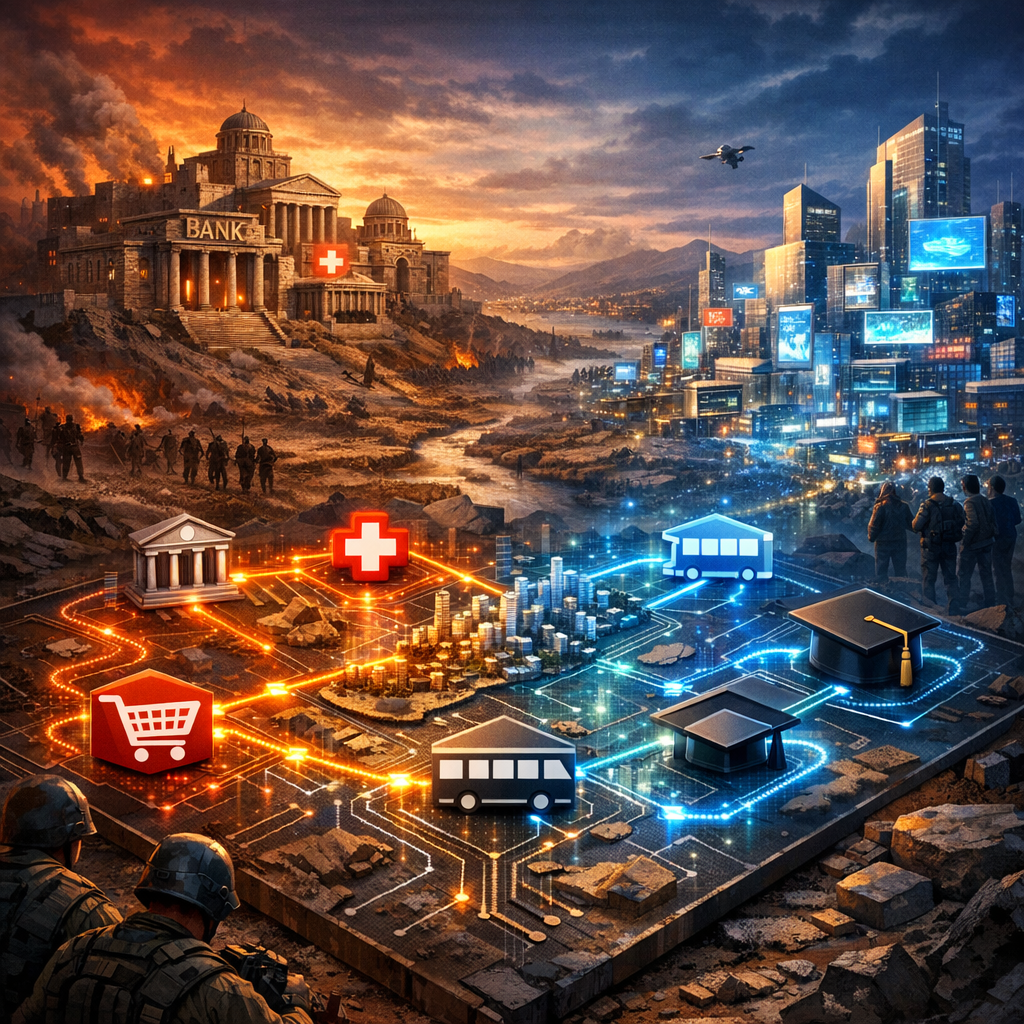
Orders from the Next Front: Letters to a 2030 Strategist Watching Giants and Startups Wear Themselves Out
Written as a series of urgent letters from a war historian to a professional in 2030, this analysis advances an uncomfortable thesis: the real battle between traditional industry and startups is not about who wins the present, but about who survives the war of attrition in business models, technology, and user experience.

1. The Hook — Letter from the 2030 Trenches
Strategist of 2030,
This comes from a war historian who’s spent too many nights comparing balance sheets to battles, and funding rounds to badly planned campaigns.
You’re sitting on an innovation committee looking at two maps: on the left, the traditional industry of financial services, healthcare, retail, mobility, and education; on the right, the startup ecosystem that promised to remake everything between 2015 and 2025. Both sides are still there. No one has won. Many have bled.
Your CEO has just asked you: “Should we behave like a startup or defend our position as an incumbent?” It’s the kind of question that sounds like 1914: heads of state convinced the war will be short and glorious.
I’m writing to warn you: you’re entering a war of attrition, not a lightning battle. The playbooks you’ve read about “slow giants vs. agile startups” are the equivalent of propaganda pamphlets before the first charge. With data in hand, from finance to education, what’s unfolding is not an epic of heroic disruptors; it’s a series of static fronts where technology and user experience are used to move meters, not continents.
Keep these three axes close: business models, technology, and user experience. They are your artillery, logistics, and troop morale. Mismanaged, they turn digital transformation into Verdun.
2. The Genesis — Letter on How These Campaigns Were Unleashed
Strategist,
No war begins the day the cannons fire. It starts years earlier, with railroads, treaties, and doctrines being designed. The same has happened between traditional industries and startups.
Between 2000 and 2020, the sectors you care about followed fairly clear patterns:
- Financial services: Banks with branches as fortresses, legacy core systems, and models based on interest and fees. Fintechs emerged with platform models, data as an asset, and cloud-native architectures.
- Healthcare: Hospitals tied to costly physical infrastructure and insurers, with obsolete technology and low automation. Healthtechs appeared with subscriptions, telemedicine, and AI to personalize services.
- Retail: Physical stores dominated by product margins and CAPEX in stores; e‑commerce startups pushing marketplaces, advanced personalization, and subscription services.
- Mobility: Traditional operators with fares, heavy fleets, and legacy systems; new entrants relying on mobile apps, cloud-native platforms, and data to optimize routes and capacity.
- Education: Universities funded by tuition and donations, with slow tech adoption; edtechs betting on subscriptions, freemium models, and AI-personalized online courses.
The comparative research you have on the table confirms it: incumbents prioritized stability, hierarchy, and risk control; startups prioritized innovation, speed, and experimentation. Recent studies show that startups, having less to lose, allowed themselves bolder bets and, in many cases, more innovation than their traditional counterparts.
But here lies the strategic trap: both sides assumed that the winner would be whoever advanced fastest. Historians know it’s usually whoever can hold out longest with fewer resources. Your task in 2030 is not to imitate the “cool” side, but to understand the logic of attrition on each front.
3. The Invisible Conflict — Letter on the War Almost No One Sees
Strategist,
Most analyses compare features: who offers mobile-first onboarding, who has AI, who charges subscriptions. That’s reporting regiment movements, not understanding the war.
The invisible conflict is this: incumbents and startups are, without realizing it, optimizing against different objectives.
- Incumbents behave like empires that want to preserve borders, not conquer new territory: they protect regulation, brands, customer bases, and perceived quality.
- Startups behave like revolutionary forces: they prioritize rapid impact on weak points in the system, fund their offensive with venture capital expecting accelerated returns, and accept high casualties (startup mortality) as part of the game.
From your chair in 2030, the mistake you cannot make is to think the battlefield is symmetrical. It is not.
- In financial services, fintechs have redesigned specific segments (payments, P2P lending, robo‑advisory), but keep hitting the wall of regulation and capital requirements that protect banks.
- In healthcare, telemedicine and wearables have widened the front, but the ability of hospitals and insurers to absorb innovation—or to block it—still defines the map.
- In retail, e‑commerce and subscription models have reshaped habits, but physical logistics and the cost of serving the last mile still decide who survives.
- In mobility, on‑demand platforms have changed expectations, but physical infrastructure (roads, airports, regulators) remains the terrain that cannot be ignored.
- In education, edtech democratizes access, but accreditation and institutional prestige remain the system’s “high command.”
What almost nobody wants to admit: the real war is not startup vs. incumbent; it’s regulated, physically intensive systems vs. digital layers trying to sit on top without absorbing all their costs and risks.
Your advantage in 2030 will be to see this as a conflict of sustainability models, not marketing. Every new technology, every brilliant UX, is just a different way of redistributing who carries the cost of effort, uncertainty, and failure.
4. Evidence & Insights — Letter with the Sector War Reports
Strategist,
Let’s review your fronts. I won’t give you feature lists; I’ll give you structures, like someone analyzing supply lines.
4.1 Financial Services: The Entrenched Front
Incumbents
- Business model: interest, fees, charges. High costs from physical branches and regulatory compliance. Strong vertical integration from accounts to investments.
- Technology: legacy core systems; limited automation; interoperability challenges; cybersecurity is critical but complex to update.
- UX: predominantly physical channels, slow processes, low personalization.
Startups (fintech)
- Business model: platforms, subscriptions, data monetization; clusters of specialized products (payments, P2P, robo‑advisors).
- Technology: cloud-native, APIs, microservices, end‑to‑end automation, AI/ML for scoring and fraud prevention.
- UX: mobile-first, fast onboarding, digital support, strong focus on NPS and retention.
4.2 Healthcare: The Most Complex Logistics Campaign
Incumbents (hospitals, insurers)
- Business model: fee‑for‑service, contracts with insurers, very high dependence on physical infrastructure and heavy regulation.
- Technology: outdated systems, low automation; cybersecurity is critical but often insufficient.
- UX: in‑person care, long waits, little personalization.
Startups (healthtech)
- Business model: subscriptions, freemium, data‑driven digital services.
- Technology: data‑driven, AI, telemedicine and remote monitoring platforms.
- UX: user‑centred design, mobile apps for ubiquitous access.
4.3 Retail and E‑commerce: The Consumer Behavior Front
Incumbents (brick‑and‑mortar retail)
- Business model: in‑store sales, product margins, high CAPEX in locations.
- Technology: limited digitalization, inventory management not always integrated.
- UX: in‑person service; friction in wait times, opening hours, and availability.
Startups (e‑commerce, D2C)
- Business model: marketplaces, subscriptions, data‑driven personalization.
- Technology: e‑commerce platforms, microservices, advanced analytics.
- UX: seamless experience, digital support, personalized recommenders.
4.4 Mobility/Transport: The Capacity War
Incumbents (transport operators)
- Business model: fares, passes, institutional contracts; high operating and asset costs.
- Technology: legacy systems, scarce automation, limited use of real‑time data.
- UX: in‑person service, waiting times, rigid schedules.
Startups (mobility platforms)
- Business model: platforms, pay‑per‑use, models based on efficient matching.
- Technology: cloud-native, apps, real‑time data to optimize routes.
- UX: self‑service, digital support, experience centred on immediate convenience.
4.5 Education/Edtech: The War for Legitimacy
Incumbents (universities)
- Business model: tuition, donations, subsidies; high cost structure.
- Technology: slow adoption, fragmented LMS.
- UX: in‑person classes, little personalization in learning.
Startups (edtech)
- Business model: subscription, freemium, online course sales.
- Technology: data‑driven, AI for content personalization.
- UX: easy access, intuitive design, flexible formats.
4.6 Cross‑Sector Comparative Table
First table for you, like a General Staff map:
Table 1 — Comparative Matrix by Sector and Axis (2030 Recap)
| Sector | Axis | Traditional industry (2020s) | Startups / new entrants (2020s) |
|---|---|---|---|
| Financial services | Business model | Interest, fees, high dependence on regulation and branches | Platforms, subscription, data monetization |
| Technology | Legacy core systems, low interoperability, limited automation | Cloud-native, APIs, microservices, AI/ML, end‑to‑end automation | |
| UX | Physical channels, high friction, low personalization | Mobile-first, fast onboarding, digital support, high NPS | |
| Healthcare | Business model | Fee‑for‑service, insurance, costly infrastructure | Subscriptions, freemium, personalized digital services |
| Technology | Obsolete systems, low automation, reactive cybersecurity | Telemedicine platforms, diagnostic AI, data‑driven approach | |
| UX | In‑person care, long waits, little transparency | Remote access, apps, patient‑centric experience | |
| Retail & e‑commerce | Business model | Physical sales, product margins, CAPEX in locations | Marketplaces, subscriptions, data‑as‑asset |
| Technology | Isolated inventory systems, partial digitalization | E‑commerce platforms, microservices, advanced analytics | |
| UX | In‑store purchase with friction, limited opening hours | Smooth omnichannel experience, personalized recommendations | |
| Mobility/transport | Business model | Fares and passes, institutional contracts, asset‑intensive | On‑demand platforms, pay‑per‑use, usage‑based models |
| Technology | Legacy planning systems, scarce use of real‑time data | Cloud-native, mobile apps, routing and allocation algorithms | |
| UX | Waiting times, in‑person service, low flexibility | Self‑service, real‑time tracking, high convenience | |
| Education/Edtech | Business model | Tuition, donations, accreditation as core value | Subscription, freemium, modular course sales |
| Technology | Fragmented LMS, low integration with other platforms | Data‑driven platforms, AI for content recommendation | |
| UX | Large classes, standardized exams, low personalization | Flexible learning, intuitive UX, personalized pathways |
This table captures already documented patterns: incumbents prioritizing stability and risk management; startups showing greater innovation, sustained by demanding funding and high mortality. Your challenge is not to romanticize either side.
5. The Strategic Shift — Tactical Orders from a Tired Historian
Strategist,
Every long war demands new maneuvers. What I’m proposing is not to pick a side, but to redesign tactics.
5.1 Second Table: Structural Advantage Scorecard
Table 2 — “Winners vs. Losers” by Attribute (Really, Trade‑offs)
| Key attribute | Typical incumbent advantage | Typical startup advantage | Underlying trade‑off |
|---|---|---|---|
| Capital and liquidity | Stable financial base, access to cheap debt | Dependence on venture capital | Stability vs. growth pressure |
| Brand and trust | Established reputation, perceived reliability | Emerging brand, less reputational baggage | Institutional trust vs. perceived closeness |
| Speed of change | Slow due to governance and regulation | Fast due to lean structures | Robustness vs. agility |
| Technology | Solid but rigid legacy systems | Flexible cloud-native architecture | Operational continuity vs. ease of experimentation |
| User experience | Broad coverage but with friction | Polished UX in specific segments | Mass reach vs. hyperfocus on niches |
| Regulation | Close relationship with regulators | Ability to operate in regulatory grey areas | Protection vs. room to experiment |
| Talent | Ability to attract stable senior profiles | Attractive to innovative, high‑risk profiles | Deep expertise vs. experimental creativity |
Your role in 2030 is to use this table not to define an ideal profile, but to compose asymmetric combinations.
5.2 Orders for a Traditional Company in Each Sector
Think like a general who knows he won’t win by copying the guerrilla.
Financial services
- Declare the dogma “more branches = more control” obsolete. Redesign the model towards platforms where third parties can integrate via APIs.
- Keep your strength in regulatory compliance, but turn it into a product: offer regulatory infrastructure as a service to fintechs.
- In UX, end the war of attrition in branches: migrate low‑complexity interactions to well‑designed digital channels, reserving human contact for high‑impact decisions.
Healthcare
- Don’t try to replicate every healthtech feature. Instead, integrate a constellation of startups around your clinical infrastructure.
- Use your regulatory weight and access to clinical data to define interoperability standards that startups must adopt to work with you.
- Redesign the patient journey so that in‑person visits are the exception, not the rule, starting with low‑risk conditions.
Retail
- Accept that the physical store is no longer the main front: it’s a node in a hybrid network.
- Use your logistics advantage to offer “fulfilment as a service” to digitally native brands.
- In UX, turn the store into an experience center, not just a transaction point: experiences, pickups, seamless returns.
Mobility
- Use your control of physical assets to negotiate from strength with platforms, but offer open interfaces so they can integrate with your services.
- Implement real‑time data systems in your own operations; don’t surrender the entire algorithmic terrain.
- Redesign pass products so they behave like dynamic subscriptions, not rigid contracts.
Education
- Accept that accreditation is your “hard currency.” Use that legitimacy to certify content developed in partnership with edtechs.
- Invest in platforms that bring your obsolete LMSs together under a decent UX layer.
- Experiment with hybrid pathways where online modules provide flexibility at lower cost, while preserving high‑value in‑person experiences.
5.3 Orders for Startups That Want to Survive More Than One Campaign
You also advise entrepreneurs. Give them these hard instructions:
Financial services (fintech)
- Don’t underestimate regulatory cost; consider early alliances with banks to share compliance infrastructure.
- Build business models that don’t rely solely on ever‑larger funding rounds: clear subscriptions, transparent fees, B2B deals.
Healthcare (healthtech)
- Accept that access to patients and clinical data is mediated by incumbents. Design from the start to integrate into their workflows, not to ignore them.
- Work with evidence‑based models and in dialogue with regulators; improvisation here kills.
Retail/e‑commerce
- Recognize that logistics is the equivalent of heavy artillery: expensive and slow to deploy. Use third‑party networks or alliances with large retailers where possible.
- Don’t base your whole proposition on discounts or convenience; build brand identity and community.
Mobility
- Assume each city has its own “campaign rulebook”: adapt business model and experience to local contexts.
- Design modular technology that can integrate with public transport systems; cooperation can be more profitable than confrontation.
Education (edtech)
- Understand that legitimacy doesn’t come from UX alone: seek agreements with institutions to co‑certify programs.
- Build metrics of real learning impact; without evidence of outcomes, you’ll be seen as expensive entertainment.
5.4 Competitive Dynamics and Collaboration: Hybrid Fronts
Between 2020 and 2030 you’ve seen collaboration patterns consolidate that you should treat as formal tactics:
- Corporate venture capital: incumbents finance startups to explore technologies without committing the whole army.
- Corporate accelerators: spaces where political risk of experimentation is reduced.
- Selective acquisitions: buying specific capabilities (e.g., UX, AI, data) to graft them onto existing structures.
- White‑label and APIs: startups providing invisible capabilities that incumbents bundle under their own brand.
Archetypal cases to keep in mind:
- a) Startups displacing incumbents: hyper‑specialized niches where incumbents cannot operate economically (e.g., digital micro‑loans in underserved segments, global educational services outside formal accreditation).
- b) Incumbents adapting and winning using startup capabilities: banks integrating fintechs as experience layers, hospitals incorporating telemedicine platforms, retailers using external marketplaces but monopolizing logistics.
- c) Hybrid ecosystems: mobility platforms where public and private operators coexist; educational environments where universities and edtechs share students and data.
Your standing order as strategist in 2030: make the terms of these alliances explicit. In every asymmetric collaboration, ask: who controls the relationship with the end user? Who sets the standards? Who bears regulatory risk?
6. The Big Picture — Final Letter Before Nightfall
Strategist,
Historians know that long wars tend to erase the initial ideological differences. In the end, all sides look more alike than they’d like to admit. I see the same in 2030 between traditional industry and startups.
Banks have learned to launch digital products almost at fintech speed, at the cost of complex technology stacks. Fintechs have had to adopt compliance processes so heavy that they no longer differ much from banks. Hospitals and healthtechs share data infrastructures. Physical retailers look like marketplaces if you peek into their back office. Mobility platforms are subject to regulations as strict as the taxis they criticized. Universities and edtechs have become an intertwined system where no one controls the entire educational narrative.
What’s really at stake, in the end, is not who “wins” the disruption, but who survives the organizational and economic fatigue of sustaining coherent business models, technology architectures, and user experiences in a regulated, physically constrained environment.
Your five final orders, distilled as post‑war strategic directives:
- Don’t copy the enemy; copy their learning logic. Incumbent or startup, your lasting advantage comes from how you absorb evidence—from customers, from technology, from regulation—and turn it into new tactics.
- Redesign your business model as an alliance system, not a fortress. Frontal confrontation burns resources; selective cooperation expands your reach without multiplying fixed costs.
- Treat technology as logistics, not propaganda. Cloud, AI, microservices, telemedicine, e‑commerce platforms: they’re supply lines. Judge them by their impact on cost, resilience, and maneuverability, not their shine.
- Orchestrate user experience as if it were troop morale. In finance, healthcare, retail, mobility, and education, the perception of ease, safety, and personalization will sustain or sink your reputation. Don’t fully outsource it to partners.
- Choose consciously where to accept friction. Tough regulation, slow processes for critical decisions, clinical validation, rigorous educational assessment: not everything should be “frictionless.” Sometimes, friction is your defense against collapse.
If history teaches us anything, it’s that wars end when contenders understand that total victory is impossible and learn to negotiate a functional peace. In your 2030 world, that peace will be called hybrid ecosystems: value chains where traditional industry and startups coexist, watch each other, and—uneasily—need each other.
Your job is not to win the war; it is to design a system that doesn’t collapse under its own weight.
Signed,
A war historian who sees only strategic campaigns where others see “innovation.”
7. References
- Hubbog. “Estrategias empresariales: tradicional vs startup. Diferencias en estructuras y capacidad de innovación.”
- Iceebook. “Startups vs empresas tradicionales: quién lidera la innovación y el valor a largo plazo.”
- Xataka. “La trampa del gigantismo: por qué las startups pueden ser más innovadoras que las grandes empresas.”
- Monografias.com. “Metodología de la investigación: tipos, etapas y aplicaciones.”
- RealidadEconomica.es. “Cómo las startups están redefiniendo los modelos de negocio en el sector financiero.”
- Economiaeinversion.com. “Modelos de negocio para empresas de tecnología emergente: ejemplos y análisis.”
- Synthetic sector observations on banking/fintech, healthcare/healthtech, retail/e‑commerce, mobility and education/edtech based on comparison between physical infrastructure and regulation in incumbents versus technological agility and UX focus in startups (research context provided in the brief).
Related Articles

Who Stole the Value? A Forensic Audit of Giants, Startups, and the Customer Left Out of the Deal
Treating today’s innovation economy as a crime scene, this essay investigates what quietly disappears when incumbents and startups reshape finance, health, retail, mobility, education, and climate tech. Beyond pitch decks and marble lobbies, who actually captures the value—and at what human cost?

The Year We Misread the Checkbox: How a Single UX Choice Rewired Giants and Startups
Writing from 2050, a radical futurist looks back on 2024 and argues that the true battle between traditional industries and startups in banking, retail, health, and mobility never took place in boardrooms or pitch decks, but inside a single, tiny UX artifact: the checkbox. By following that microscopic element, this manifesto rewrites the history of incumbents vs. startups as a struggle over who controls consent, data, and time.

The scene of the silent crime: where has courage been lost between giants and startups?
A monk‑analyst steps onto the “crime scene” of the digital economy—financial services, retail, healthcare, mobility, education, and manufacturing—to investigate a silent disappearance: the deeper value that customers, workers, and communities expected from the transformation between traditional industry and the startup ecosystem.