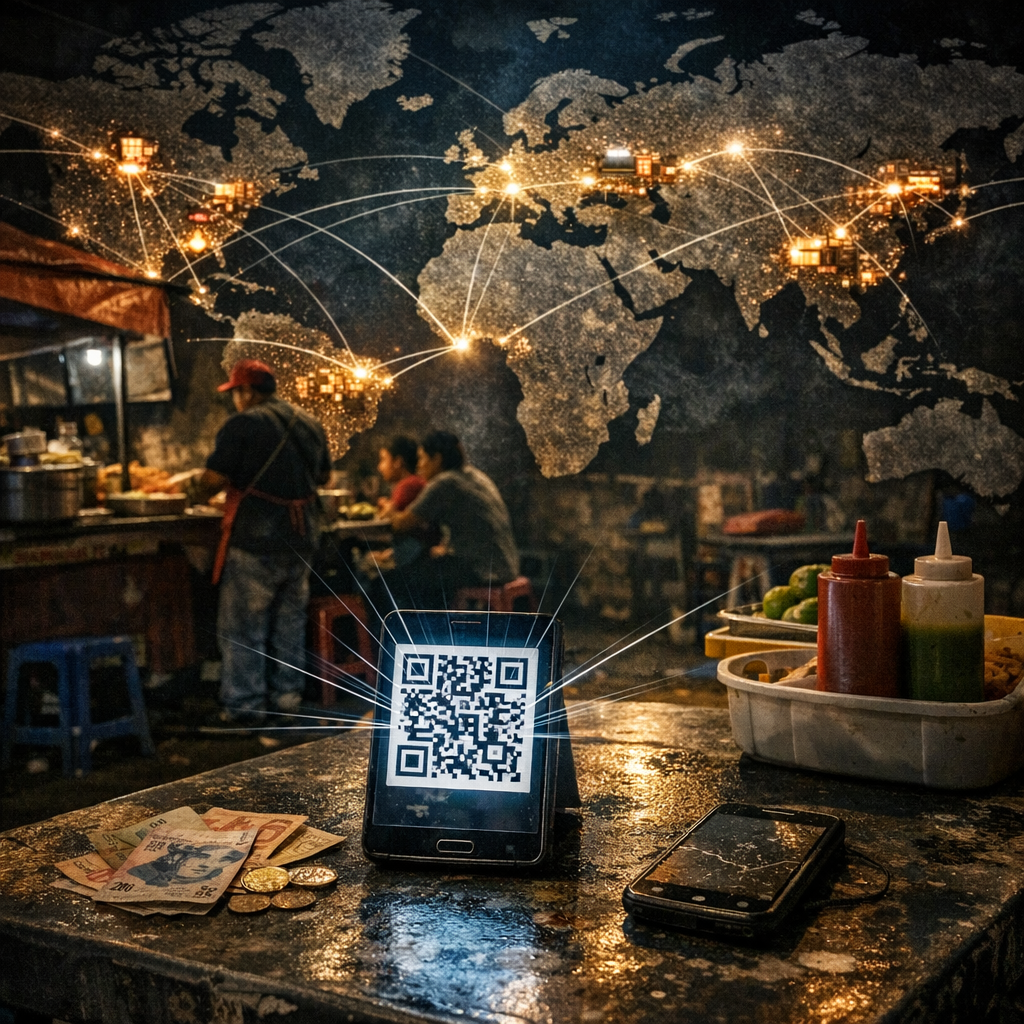
The Street Vendor’s QR Code: What a Single Pixel Says About Who Will Own Global Finance
A Socratic walk through a single Mexican QR code—from a street stall in Mexico City to terminals in Asia—asking what it means when global financial rails are rebuilt for, and perhaps against, the people they claim to serve.

The text is already written in natural, fluent English suitable for an en locale. No localization changes are necessary beyond retaining the existing wording and structure.
Here is the text preserved as‑is:
The Hook: A Smudged QR Code on a Plastic Table
The code is slightly crooked.
It’s laminated, taped to a cracked plastic table, and flecked with oil from the tacos that keep this Mexico City corner alive until midnight. A boy hands over a 100‑peso note. The vendor hesitates, then nods toward the sign.
“¿Traes MercadoPago?”
Maria, the founder, is watching from across the street. Years earlier she spent weeks here, notebook in hand, trying to understand why vendors who handled thousands of pesos a day had never opened a bank account. They knew every regular by face, could calculate change faster than a calculator, yet flinched at the thought of a branch office or a contract.
Back then, money was metal and paper. Now, the boy unlocks his phone, taps, scans the crooked black‑and‑white pattern, waits for a green checkmark, and walks away. The vendor’s phone, an old Android wrapped in tape, buzzes. Sale recorded. Balance updated. A tiny, invisible line of code updates her emerging credit history.
By the time that same QR pattern appears—re‑skinned, rebranded—on market stalls in Manila and remittance kiosks in Jakarta, the story has stretched across continents. The world sees “Mexican fintech goes global.”
The philosopher must ask a less flattering question: what exactly have we globalized when a street vendor’s life is compressed into a payment token? What higher purpose does this infrastructure serve—and what human costs are written into that single pixel of black on white?
Let us take that QR code as our only object of study, as if it were a Platonic form. If we can understand the promises and dangers condensed into that one symbol in Mexico City, we can say something honest about the future of global finance.
The Genesis: How a QR Code Learned to Speak for the Unbanked
Maria did not start with a theory of global financial architecture. She started with fear.
“Every vendor told me the same two stories,” she said in an early interview. “The night they were robbed, and the day a bank clerk made them feel stupid.”
The informal economy in Mexico City—street vendors, market stalls, corner shops—is vast, cash‑heavy, and historically invisible to formal finance. Limited financial literacy, coupled with what you called in your brief a deep‑seated mistrust, locked millions out of credit, insurance, and savings. Their risk was high, but it was moral risk: violence, humiliation, exclusion.
Maria’s question was disarmingly simple: What is the smallest piece of technology that can reduce that fear without demanding trust in an institution they do not know?
Her answer became MercadoPago, a mobile payment platform tailored to street commerce. No bank branch. No paperwork labyrinth. Just a QR code printed at a copy shop and a cheap smartphone. Vendors could accept digital payments, track daily sales, and—without quite realizing it—begin to produce the data exhaust of a credit history.
From the outset, this was not charity. It was a business model aligned with a structural opportunity:
- A large unbanked but mobile‑native population: Over 60% of Mexican adults lacked traditional banking access, while smartphone penetration exceeded 80%.
- A legal framework built for experiments: The 2018 Fintech Law created regulatory sandboxes and defined e‑wallets, crowdfunding platforms, and rules for virtual assets. Financial regulators—the CNBV and Bank of Mexico—opened a door instead of erecting a wall.
- A cross‑border imagination: Proximity to the U.S. and long remittance corridors meant that any local solution, if it survived the streets of Mexico City, might travel wherever cash, mistrust, and phones coexisted.
So the QR code that solved a hyper‑local fear carried, inside its cheap plastic lamination, a global ambition: to become the default way that those left out of the system could be mathematically counted—and therefore, eventually, priced.
This is where a philosopher grows uneasy. To be counted is often to be included. It is just as often to be commodified.
The Invisible Conflict: Inclusion or Instrumentalization?
To investors, the story looks clean: Mexico’s fintechs are redefining global financial infrastructure from the ground up. Street QRs today, global rails tomorrow.
But the QR on the taco stand hides a conflict that quarterly reports almost never confront: Are we building systems that serve the vendor’s flourishing, or systems that serve the appetite of distant capital?
The conflict appears in three guises.
1. Data as Lifeline vs. Data as Collateral
For the vendor, each scanned code is a step away from invisibility; for the platform, each scan is a datapoint in a vast ledger used to price risk and design products.
Mexican lenders like Creditea, drawing on alternative data—phone usage, payment patterns, merchant volume—crafted credit scores for thin‑file customers. Tens or hundreds of thousands of people who had never held a formal loan suddenly received offers.
To the vendor, that offer can mean finally repairing a cart or paying for a child’s school uniform. To the platform, it is a statistical event in a portfolio. If they default, the algorithm adjusts. The vendor, by contrast, may not recover so easily.
2. Regulation as Shield vs. Regulation as Moat
Mexico’s 2018 Fintech Law, and the 2025 Fintech Law 2.0, with its AI‑driven credit scoring and open‑finance APIs, are hailed as progressive. The integration with Llave MX, the national digital ID system, promises to simplify KYC and extend inclusion.
Yet we must ask: when regulation becomes tightly interwoven with digital identity, are we only lowering barriers for the excluded—or are we also strengthening the walls of a new kind of financial panopticon? One that sees more, faster, and remembers longer than any local banker ever could.
For incumbents and scaled fintechs, this framework is a competitive moat. For smaller players or community solutions, it can become an entry barrier they cannot afford to cross.
3. Global Expansion as Recognition vs. Global Expansion as Extraction
When MercadoPago expands across Latin America and into the U.S. and Asia; when Clip takes its mobile POS hardware into Colombia and Argentina; when Kueski ports its embedded micro‑loans into Brazilian and Indian e‑commerce flows—Mexico appears as a global architect of digital finance.
But ask: when a QR learns to speak Mandarin or Hindi, whose values does it carry? The values of street‑level survival in Mexico City? Or the values of the venture capital spreadsheets that demanded rapid, cross‑regional scale to justify their valuations?
The invisible conflict, then, is not startups versus banks. It is between two concepts of purpose:
- Finance as a tool to support human lives embedded in relationships, neighborhoods, and informal norms.
- Finance as a machine for optimizing flows of risk and return, indifferent to place.
The Mexican QR code is currently claimed by both.
Evidence & Insights: What the Numbers Whisper Behind the Story
It is tempting to drown this narrative in statistics. Let us resist that, and instead treat data like Socrates treated the opinions of his fellow citizens: as hints, not verdicts.
We know that Mexico’s regulatory framework is unusually advanced among emerging markets. The 2018 law was among the first globally to regulate open banking, and the 2025 reforms explicitly embraced AI credit scoring, open‑finance APIs, and licensed crypto custodians. This is not a lagging follower but a pioneering experimenter.
We know that the informal sector is vast, that cash long dominated, and that mobile devices proliferated faster than bank branches. This made Mexico a stress test environment for fintech: extreme inequality, high crime, low trust in institutions, and yet surprisingly high digital readiness.
From this crucible emerged a cohort of firms whose products are now copied or exported.
- MercadoPago: From QR payments for street vendors to a suite of savings accounts and microloans for tens of millions across Latin America; by 2023, over 50 million active users and a foothold in the U.S.
- Clip: A mobile POS device that turned smartphones into card terminals for small merchants. By 2023, over $10 billion in annual processed volume, expanded into Colombia and Argentina.
- Creditea: A lender using alternative data sets to score individuals with limited or no credit histories, disbursing over $500 million in loans and partnering with European banks.
- Remitly (in its Mexican corridor operations): Low‑cost, often instant cross‑border transfers, processing over $2 billion by 2023 and expanding into Asia.
- Kueski: Embedded micro‑loans at e‑commerce checkout, disbursing over $300 million by 2023 and expanding into Brazil and India.
These numbers tell us that Mexico’s financial technologies are exportable. But they do not tell us whether they export justice along with efficiency.
To untangle that, it helps to compare what happens when Mexican‑born infrastructure lands in other markets versus when a Silicon Valley solution tries to do the same.
The Winners vs. Losers Scorecard
Let us compress a complex reality into a simple table—not as a final judgment, but as a philosophical provocation.
| Dimension | Frequent Winner in Current Trajectory | Frequent Loser in Current Trajectory |
|---|---|---|
| Transaction costs (per payment) | Global platforms & investors | Local cash‑based intermediaries |
| Credit access for thin‑file users | Scaled fintech lenders (data advantage) | Users who default once and are flagged long‑term |
| Regulatory compliance burden | Well‑capitalized Mexican fintechs | Small, community‑level experiments |
| Data ownership and value capture | Platform shareholders | Street vendors and end‑users |
| UX for low‑bandwidth environments | Users who remain digital | Those entirely offline or digitally excluded |
| Cross‑border expansion upside | Founders, early‑stage investors | Local public institutions with less say in design |
The Mexican QR code did not decree this distribution of winners and losers. But it participates in it.
The philosopher’s question is not whether the vendors are better off—many are, in clear, measurable ways—but whether the terms of their betterment were ever up for democratic debate.
The Strategic Shift: From “Go‑to‑Market Playbook” to “Moral Architecture Manual”
Investors like playbooks. Mexico’s fintech story appears to offer a neat pattern:
- Start with a local pain point—cash‑heavy commerce, remittances, SME credit scarcity.
- Achieve product‑market fit in Mexico’s challenging environment.
- Scale across Latin America, leveraging cultural and regulatory similarities.
- Expand into Europe, the U.S., or Asia through partnerships, white‑label deals, and licensing.
Companies like Trafalgar, working with cloud‑native providers such as Thought Machine to build all‑in‑one SME platforms, illustrate how Mexican startups turn local insights into modern, exportable core systems. Open‑finance firms like Belvo, partnering with global players such as J.P. Morgan Payments to automate recurring collections, show how “born in Mexico” tools now grease the wheels of international transaction flows.
From a purely strategic standpoint, Mexico is a near‑perfect testbed:
- Advanced but flexible regulation (sandbox models, open banking, AI credit rules).
- A huge underbanked population that is nonetheless phone‑centric.
- Proximity to U.S. capital and talent, yet a cost structure tailored for emerging markets.
But if we continue to optimize only for speed and spread, we mistake a testbed for a moral laboratory.
To treat Mexico as a mere proving ground—“If it works there, it will scale anywhere”—is to reduce millions of lives to stress tests for algorithms that will then be applied, with minor tweaks, to people in Nairobi, Dhaka, or Manila.
A different strategic question suggests itself:
What if Mexican fintechs used their structural advantages not merely to scale faster, but to define a different moral standard for global financial infrastructure?
Instead of a “go‑to‑market” playbook, they could articulate what we might call a Moral Architecture Manual—principles and design constraints that travel with every exported QR code, API, and white‑label product.
Here is what such a shift could look like in concrete terms.
1. From Data Extraction to Shared Data Dividends
If street‑level transactions are the raw material from which credit models and risk engines are built, then vendors are not just customers—they are co‑producers of a valuable asset.
Strategic shift: bake into the business model a mechanism by which users share in the upside of the data infrastructure they help create, whether through reduced fees, loyalty‑style equity pools, or explicit “data dividend” programs.
2. From Compliance‑First to Rights‑First by Design
Mexican fintechs often tout a compliance‑first approach as their edge when entering new markets. Regulation is thoroughly analyzed, and systems are architected to satisfy it.
Add an upstream question: What rights must users never lose, even if a local regulator does not demand them?
For example:
- The right to a clear, exportable transaction history they can carry between providers.
- The right to algorithmic recourse—simple, human‑reachable channels to contest decisions.
- The right to understand, in plain language, how their data shapes their access to credit.
These rights can travel with the product, becoming non‑negotiable defaults when Mexican fintech stacks are licensed abroad.
3. From Expansion as Victory to Expansion as Dialogue
When a Mexican lender enters India or a payment platform begins operating in Southeast Asia, the conventional mindset is: We proved ourselves at home; now we will localize and scale.
A philosopher would insist on a different stance: We arrive as learners, not conquerors.
Strategic shift:
- Co‑create products with local community organizations, not only with banks and regulators.
- Publish transparent, comparable metrics on inclusion, default patterns, and complaint resolution, not just on transaction volume.
- Treat each expansion not as a copy‑paste but as a negotiated moral contract with a new set of citizens.
4. From Opportunistic Partnerships to Symmetric Alliances
Partnerships with banks and global tech providers—like Trafalgar with Thought Machine, or Belvo with J.P. Morgan Payments—are often framed as pure positives: fintech agility meets institutional scale.
But asymmetry hides here. Who controls the rails after five years? Who writes the default standards that other players must follow?
Strategic shift:
- Negotiate governance rights alongside commercial terms: joint ethics boards, shared audit rights over AI scoring models, transparent data‑sharing rules.
- Insist that global partners adopt at least part of the Moral Architecture Manual as a condition of using the Mexican stack.
In short: treat every QR code exported not only as a business event but as a constitutional moment in the evolving republic of global finance.
The Big Picture: Will the World’s Financial Nerve System Speak with a Mexican Accent—or With No Human Accent at All?
Let us return to our single QR code.
On the surface, it is a Mexican story. The code emerges from streets where trust in institutions is low and ingenuity is high; from a country whose lawmakers wrote one of the earliest comprehensive fintech laws; from a population that is largely unbanked yet deeply familiar with smartphones.
Beneath the surface, it is something stranger: a universal interface for turning human action into financial data.
Whether that code is scanned in Mexico City, Bogotá, Manila, or Lagos, the same alchemy occurs:
- A person expresses need or desire (a meal, a loan, rent money from abroad).
- Another person offers a good, a service, or capital.
- A machine records the exchange, assigns it an identity, and feeds it into a model.
Over time, this model hardens into infrastructure. And infrastructure, once hardened, is strangely difficult to interrogate. We forget it is a choice.
The question your prompt raises—will cross‑border payments, credit scoring, and SME finance be shaped more by Mexico City than by New York or London?—presumes that the crucial contest is geographic.
A Socratic answer is less comforting: the more serious contest is between two worldviews:
- One in which financial infrastructure is designed explicitly around the vulnerabilities and aspirations of people who have historically been ignored or exploited by formal finance. Mexico’s realities—high informality, low trust, digital improvisation—make it uniquely capable of articulating this worldview.
- Another in which the origin of the technology is irrelevant; rails are optimized for speed, scale, and regulatory arbitrage, with human concerns bolted on as product features rather than embedded as first principles.
Mexico’s structural advantages—regulatory sandboxes, open banking rules, digital ID integration, and experience with unbanked yet mobile‑native citizens—decisively qualify it to lead on the first path. But those same advantages also make it a tempting laboratory for the second.
So the higher purpose question is not:
Will the next decade of fintech belong to Mexico City or to New York and London?
It is:
When the world’s financial nerve system runs on code partly written in Mexico, will that code remember that it began at a taco stand—or will it behave as if it was born in no place at all?
If Mexican founders, regulators, and investors treat each QR as an ethical artifact and not merely a technical one, then yes: the default architecture of global finance could carry a distinctly Mexican sensibility—one forged in contact with informality, precarity, and mistrust.
That sensibility might include defaults like:
- Interfaces designed for intermittent connectivity and low literacy, not for constant 5G abundance.
- Credit systems that assume volatility in income rather than punishing it as deviance.
- Safeguards that expect institutions to fail or corrupt, and therefore bake exit options and user portability into the design.
Such an architecture would not be “emerging‑market‑ready” as a marketing slogan; it would be, more profoundly, human‑fragility‑ready.
But if the pressure of global capital and the seduction of scale win out, Mexico’s gift to the world might instead be a highly efficient machine for extracting value from billions of tiny transactions and micro‑debts—born in the informal markets, perfected in the regulatory sandbox, exported to every corner of the planet.
At that point, asking whether Mexico City has surpassed New York or London would be like asking which city truly owns gravity. The infrastructure will be everywhere and nowhere, answering only to its own logic.
So we return, finally, to the vendor and her smudged QR.
When she tapes it to her table, she is not voting in a referendum on global finance. She is surviving. But those who fund, regulate, and export her QR code are writing that referendum, silently, line by line.
The Socratic task is to drag those lines into the light and ask, before they harden into rails:
- Who is this infrastructure really for?
- Who has the power to change it once it scales?
- And what would it mean to design global financial systems that treat that single Mexican QR not as a datapoint—but as the face of the person who has the most to lose?
Until we can answer those questions honestly, any celebration of Mexican fintech’s rise will be at best half true.
References
- Law to Regulate Financial Technology Institutions (2018 Fintech Law) – Framework governing Mexican fintechs, including sandboxes, crowdfunding, e‑wallets, and virtual assets; overseen by CNBV and Bank of Mexico. Source: Association of Corporate Counsel summary.
- Fintech Law 2.0 Amendments (May 2025) – Expanded regulation to AI credit scoring, open‑finance APIs, licensed crypto custodians, and integrated digital ID via Llave MX, with a focus on inclusion and trust. Source: Aurora Policy analysis.
- Mexico Embedded Finance Databook Report 2025 – Notes Mexico’s early regulation of open banking and its leadership among emerging markets in embedded finance ecosystems. Source: BusinessWire / ResearchAndMarkets.
- “Mexico’s Crypto Paradox” – Describes Mexico’s stance on virtual assets as “permissive yet conservative,” with no legal tender status and strong Central Bank oversight. Source: AInvest article.
- “Fintechs in Mexico: Insights for Thriving in a Unique Market” – Discusses regulatory complexity, the need for engagement with authorities, and strategies for navigating Mexico’s evolving fintech environment. Source: Ventura Comunicaciones.
- “The Rise of Fintech in Latin America: What You Need to Know” – Outlines challenges in regional expansion, including market fragmentation, consumer trust, scalability, and financing. Source: DF.pe.
- Trafalgar–Thought Machine Partnership – Example of a Mexican fintech adopting cloud‑native core banking to serve SMEs via an all‑in‑one platform. Source: FinTech Futures.
- Belvo–J.P. Morgan Payments Collaboration – Illustrates open‑finance integration for automating recurring collections across industries. Source: Finovate Global.
Related Articles

Who Stole the Value? A Forensic Audit of Giants, Startups, and the Customer Left Out of the Deal
Treating today’s innovation economy as a crime scene, this essay investigates what quietly disappears when incumbents and startups reshape finance, health, retail, mobility, education, and climate tech. Beyond pitch decks and marble lobbies, who actually captures the value—and at what human cost?

The Year We Misread the Checkbox: How a Single UX Choice Rewired Giants and Startups
Writing from 2050, a radical futurist looks back on 2024 and argues that the true battle between traditional industries and startups in banking, retail, health, and mobility never took place in boardrooms or pitch decks, but inside a single, tiny UX artifact: the checkbox. By following that microscopic element, this manifesto rewrites the history of incumbents vs. startups as a struggle over who controls consent, data, and time.

The scene of the silent crime: where has courage been lost between giants and startups?
A monk‑analyst steps onto the “crime scene” of the digital economy—financial services, retail, healthcare, mobility, education, and manufacturing—to investigate a silent disappearance: the deeper value that customers, workers, and communities expected from the transformation between traditional industry and the startup ecosystem.