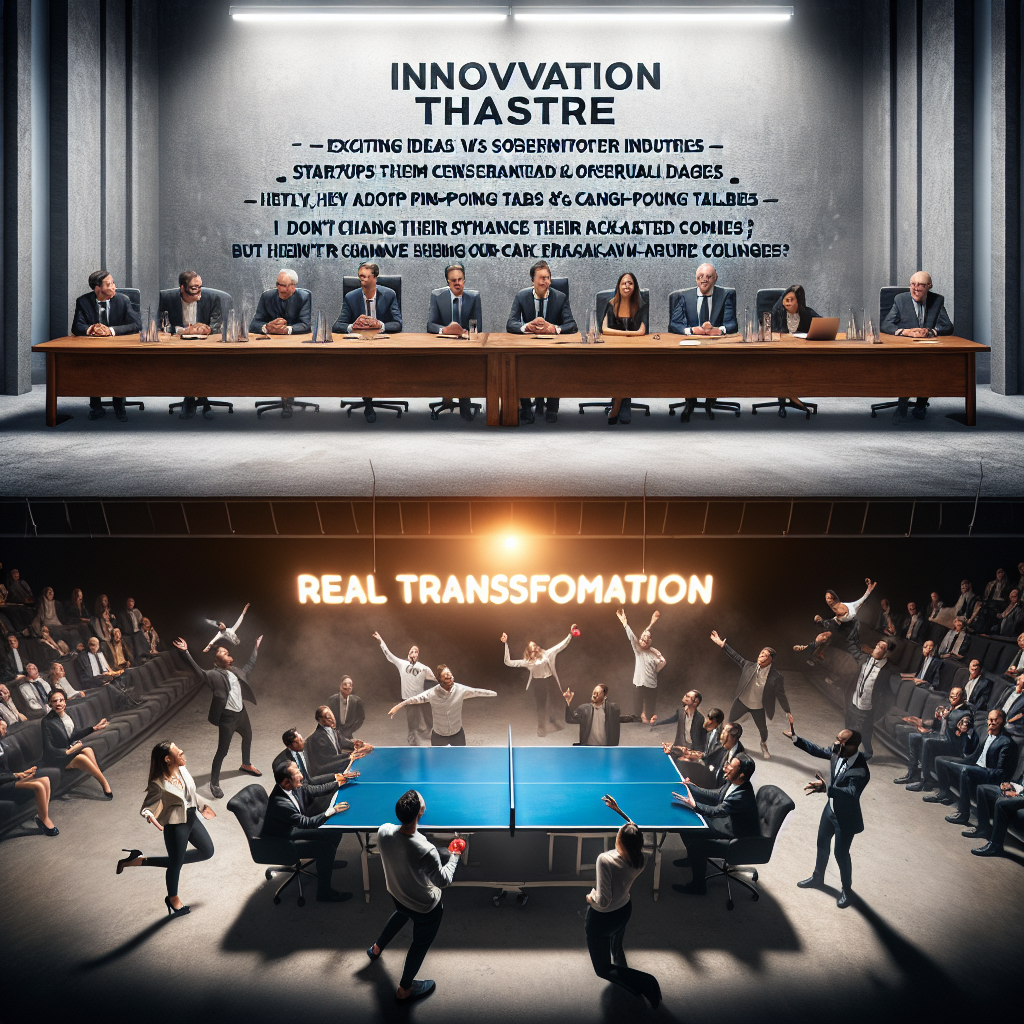
Innovation Theater vs. Real Transformation: How Regulated Industries Imitate Startups Without Changing Their Core
A critical, research-grounded analysis of how banks, hospitals, and utilities often simulate startup-style innovation through labs, apps, and slick UX while leaving their business models, technology stacks, and user experience cultures largely untouched—and why that distinction matters for competitiveness, regulation, and market evolution.

Abstract
Across highly regulated sectors, corporate leaders increasingly showcase innovation labs, digital channels, and startup-style branding as evidence of transformation. Yet much of this activity remains “innovation theater”: visible signals of change that leave underlying incentives, technology architecture, and user experience culture largely intact. This white paper develops a three-layer framework—business model, technology, and user experience (UX)—to distinguish theater from substantive innovation. Using banking vs. fintech, healthcare vs. healthtech, and energy vs. cleantech as core comparisons, it analyzes how incumbents simulate startup traits while preserving legacy business logic and risk structures. It also explores how regulation shapes both incumbents’ cautious approaches and startups’ modular, compliance-aware strategies, including tools such as regulatory sandboxes [1][2]. Drawing on documented patterns of organizational behavior, regulatory impact on innovation, and cross-industry collaborations [1][3][4], the paper identifies recurring drivers of superficial change, hidden strengths and weaknesses on both sides, and pragmatic pathways from theater to real transformation. The analysis offers actionable guidance for operators, investors, and policymakers on how to interpret digital signals, benchmark transformation claims, and design environments that reward genuine innovation rather than its performance.
Background
Walk into a large bank’s “digital garage,” a hospital’s “experience center,” or a utility’s “innovation hub” and you will see exposed brick, beanbags, walls plastered with sticky notes, and a cluster of agile coaches facilitating stand-ups. On the surface, these spaces echo early-stage startups. Yet the teams working there often discover that real decisions are still made in distant committees, releases are constrained by decade-old vendor contracts, and incentives reward risk avoidance over experimentation. This gap between theatrical signals and structural reality is increasingly visible across regulated industries.
The term innovation theater captures these activities that look like innovation but rarely change how value is created or delivered. Typical manifestations include hackathons that never ship, pilots that cannot scale because of compliance bottlenecks, and redesigned apps that mask paper-based back offices. The research literature on regulatory impact shows that compliance can both slow and stimulate innovation, depending on how organizations internalize constraints [1]. In many incumbents, compliance functions become defensive gatekeepers rather than design partners, reinforcing theater: it is safer to build a lab than to rethink the core.
Startups, by contrast, often emerge explicitly to challenge incumbents’ inertia. They build greenfield technology stacks, experiment with new revenue models, and design end-to-end user journeys unconstrained by legacy processes. However, in highly regulated sectors such as finance, healthcare, and energy, startups face their own obstacles: complex rulebooks, high capital requirements, and multi-stakeholder governance. Research highlights how successful startups adopt strategies such as early incorporation of regulatory expertise, systematic regulatory intelligence, and active engagement with regulators [2]. Regulatory sandboxes, such as those established by the UK’s Financial Conduct Authority for fintech firms, provide supervised environments to test innovations with real users [1].
Despite this, public and media narratives often compare incumbents and startups at the level of surface features—“who has the better app?”—rather than at the level of business incentives, architecture, and culture. This paper argues that without separating these layers, analysts misinterpret both the pace of change and where true competitive threats lie. A bank may appear “digital” yet still rely on overnight batch processes for decisions; a hospital might offer teleconsultations while offloading paperwork to patients; a utility can promote green dashboards while maintaining opaque billing. The goal here is to equip readers with a practical framework to see through the theater, understand the structural drivers in each sector, and identify the levers of genuine transformation.
Methods
This white paper synthesizes secondary research and conceptual analysis rather than primary empirical fieldwork. The core evidence base consists of:
First, published analyses of how regulation influences innovation behavior, with specific attention to highly regulated sectors. Sources describe both the constraints and innovation-enabling aspects of regulatory frameworks, including the role of compliance functions and the emergence of tools like regulatory sandboxes that allow supervised experimentation [1]. Academic and practitioner work on startup strategies for dealing with regulation—such as early regulatory expertise, systematic intelligence gathering, and proactive engagement with regulators—provides a grounding for understanding startup behavior in constrained markets [2].
Second, documented case studies of collaborative innovation between incumbents and startups in other sectors, such as consumer goods, automotive, and healthcare. Examples include P&G’s Connect + Develop open innovation program, Unilever’s Foundry, BMW’s Startup Garage, and the IBM–Memorial Sloan Kettering partnership [3][4]. While these are not in our three focal sectors, they illustrate generalizable patterns in how incumbents and startups can combine complementary capabilities and where collaboration succeeds or devolves into theater.
Third, research on organizational psychology and culture, particularly regarding hierarchical rigidity, siloed communication, and the absence of psychological safety as barriers to genuine innovation [5]. These insights inform the analysis of UX culture and decision rights.
These streams are integrated using the three-layer framework (business model, technology, UX) developed in the introduction. For each sector, we construct realistic composite scenarios (e.g., opening a bank account, scheduling a medical visit, managing household energy use) that reflect commonly documented practices and friction points. The analysis remains conceptual but is anchored to the empirical patterns described in the research context, with explicit use of in-text citations that map to a references section.
Key Findings
A Three-Layer Lens on Innovation Theater
Across banking, healthcare, and energy, a consistent pattern emerges: incumbents selectively adopt startup aesthetics and front-stage features while preserving back-stage structures. This is most visible when we parse change across the three layers.
At the business model layer, incumbents’ revenue logic and incentive systems remain deeply tied to existing regulatory and capital structures. Banks continue to prioritize interest spreads and fee income; hospitals optimize for reimbursable procedures; utilities focus on allowed returns on infrastructure. Innovation initiatives are often measured on public relations impact or pilot count rather than actual shifts in margins, risk, or allocation of capital. Startups, by contrast, design around narrower problem spaces (e.g., instant payments, chronic disease management, residential demand response) and adopt revenue models that align with user outcomes or usage patterns. Yet research on regulatory impact shows that both must internalize complex rules, and startups that succeed typically incorporate regulatory intelligence early [1][2].
At the technology layer, incumbents layer APIs and digital channels on top of monolithic systems. The result is what might be called “API-wrapped legacy”: sleek front ends tied to slow cores, with nightly batch jobs and manual reconciliation hidden under interfaces marketed as real time. Startups generally build modular, cloud-native stacks with continuous deployment and data pipelines optimized for experimentation. However, as they integrate with incumbent infrastructure or regulated networks, they too encounter lock-in and latency.
The UX layer reveals the starkest divide between theater and transformation. Incumbents increasingly invest in design systems, user research labs, and mobile applications. Yet cultural barriers—hierarchy, siloed communication, and fear of failure—often prevent redesigning core journeys such as onboarding, dispute resolution, and billing [5]. Instead, users navigate polished screens that still encode the organization’s internal silos. Startups tend to treat friction as an opportunity: they redesign journeys around instant decisions, proactive communication, and transparency. Where regulation requires steps, they often build automation and guidance rather than offloading complexity to the user.
Sector 1: Banking vs. Fintech
In retail banking, innovation theater often shows up in digital account opening and mobile servicing. A traditional bank may advertise “open an account in minutes” via a modern app, but behind the experience sits a patchwork of legacy core banking systems, manual KYC checks, and overnight batch processing. The business model remains anchored in cross-selling, overdraft fees, and interest spreads, with internal incentives tied to balance growth and product penetration rather than customer lifetime satisfaction.
Fintech players serving the same need—say, a mobile current account—typically pursue narrower revenue models: interchange fees on card spending, subscriptions for premium features, or lending margins on small overdrafts. They are less tolerant of churn because their entire economics depend on engagement. This drives a focus on reducing onboarding friction and making fees explicit. Regulatory frameworks still apply, but successful fintechs build compliance into their product design rather than bolting it on later [2].
Technologically, banks’ mainframe cores and tightly coupled architectures mean that even minor product changes can require months of coordination. Innovation labs often build “digital shells” on top: mobile apps that call middleware, which then triggers manual or semi-automated processes. The appearance is agile, but deployment cycles remain tied to the slowest components. This is textbook innovation theater: visible change without altering the bottleneck. Fintechs, by contrast, are more likely to use microservices, API-first integration, and automated testing to deploy frequently. Yet as fintechs grow and face deeper integration with payment networks and regulatory reporting requirements, their own systems can accrete complexity.
UX culture is where the illusion becomes personal. Consider a user disputing a card transaction. At a traditional bank, the app may offer a “dispute” button, but tapping it might trigger a process that requires calling a call center, filling PDF forms, and waiting weeks. The interface masks a process optimized around internal risk controls, not user clarity. A fintech, in contrast, might allow instant card freezing, categorize the merchant clearly, and initiate a provisional credit while automatically generating required documentation. Both operate under similar card network rules, but the startup uses UX and automation to shoulder administrative burden.
Empirically, regulatory initiatives like the UK FCA’s sandbox (launched mid-2010s) have enabled fintechs to test new models—such as alternative credit scoring or instant payments—with live users, under supervision [1]. Banks also participate in such sandboxes but often confine experiments to peripheral products. The result is a widening gap between perceived and actual agility.
Sector 2: Healthcare vs. Healthtech
Healthcare’s innovation theater is shaped by complex reimbursement structures and risk-averse cultures. A hospital may launch a branded patient app with features like appointment viewing or limited messaging. Yet the underlying business model still revolves around fee-for-service reimbursement, where revenue is tied to the volume of billable encounters rather than continuous outcomes. Administrative processes are optimized to ensure codable documentation, not patient comprehension.
Healthtech startups tackling similar problems—appointment scheduling, chronic disease management, or teleconsultations—often adopt subscription models (e.g., per-member-per-month for employers), outcomes-based contracts, or B2B2C arrangements that align their revenues with reduced hospitalizations or improved adherence. Because they are not locked into billing codes in the same way, they can design experiences around longer-term engagement. Nevertheless, they must still navigate privacy regulations and reimbursement rules. Research highlights how successful healthtech firms build regulatory expertise early and maintain systematic monitoring of rule changes [2].
Technologically, hospitals rely on large EHR/EMR systems that are essential for compliance but notorious for poor usability and limited interoperability. Vendor lock-in is pervasive: integrations can be expensive and slow, discouraging experimentation. A hospital’s new app may, in reality, be a thin wrapper around the existing portal, mirroring its constraints. Healthtech platforms generally start with API-enabled architectures, remote monitoring devices, and data pipelines that can ingest and analyze data from multiple sources. This modularity allows them to iterate on features such as automated triage, reminders, or risk scoring without waiting for a monolithic release cycle.
UX culture in traditional healthcare is constrained not only by regulation but also by deeply ingrained professional norms and siloed communication [5]. Clinicians and administrative staff may not be involved in app design, and there can be little psychological safety to question “how we’ve always done it.” The result: a hospital app that still requires patients to call for appointments, complete paper intake forms, and navigate disconnected billing portals. Healthtech startups, by contrast, frequently treat every administrative hurdle as a design target. A patient booking through a telehealth platform can select an appointment slot, complete medical history forms online, consent digitally, and receive automated reminders and follow-ups. Where regulation demands explicit consent or disclosure, the startup integrates it into the flow with clear explanations.
The collaboration between IBM and Memorial Sloan Kettering around cognitive computing for oncology illustrates how genuine innovation emerges when technology and clinical expertise align [4]. Rather than building an app on the side, the partnership rethought diagnostic decision support, integrating AI into clinical workflows. However, such deep integration remains the exception; many providers default to innovation theater—apps and portals that leave core processes untouched.
Sector 3: Energy vs. Cleantech
In energy, particularly electricity distribution, the business model of regulated utilities is built on cost-of-service regulation: utilities earn allowed returns on infrastructure investments and are incentivized primarily to maintain reliability and meet regulatory standards. Customer engagement has historically been minimal, and innovation often centers on grid reliability rather than user-centric services. When utilities launch “digital” initiatives—smart meter portals, carbon footprint dashboards—the impact on their revenue logic is marginal.
Cleantech startups, meanwhile, experiment with models such as virtual power plants aggregating rooftop solar and batteries, SaaS platforms selling optimization tools to utilities, or consumer-facing apps that share savings from load shifting. These models depend on granular, real-time data and active user participation. They align business incentives with energy efficiency or flexibility rather than sheer volume. Regulatory frameworks still set the boundaries, but startups that succeed tend to design modular products that can be adapted to differing tariff structures and rules [2].
On the technology front, utilities operate legacy SCADA systems and monolithic operational platforms designed for one-way power flows and conservative change management. Integrating new data streams or control signals often requires major capital projects and vendor negotiations. This encourages theatrical front ends: consumer portals that display delayed consumption data (e.g., 24–48 hours lag) and generic tips. Cleantech firms build IoT-based, cloud-backed architectures that pull data from smart meters, sensors, and EV chargers in near real time. They deploy analytics and automation to orchestrate loads, predict peaks, and nudge users.
UX culture in utilities has traditionally been transactional: send a bill, respond to outages. When they create apps, the primary aim may be deflecting calls rather than empowering users. A household might see a colorful dashboard of monthly consumption but receive little actionable guidance. Pricing structures remain opaque, with complex tariffs buried in PDFs. Cleantech startups, conversely, often center their UX on real-time feedback and automation. An app might notify the user that energy prices are high now but will be lower in two hours, offer a one-tap deferral of EV charging, and show projected savings.
Utilities do undertake genuine transformation, especially where regulation rewards efficiency or flexibility. Yet the prevalence of “green” and “digital” branding without underlying shifts in investment decisions or grid operations is high. The difference between theater and transformation often hinges on whether the same metrics that drive capital allocation (e.g., regulated asset base growth) are updated to reward user-centric outcomes and decarbonization.
Cross-Sector Patterns
Across banking, healthcare, and energy, several patterns recur.
First, incumbents frequently simulate startup behavior at the surface—labs, accelerators, branded apps—while leaving business model incentives unchanged. Innovation teams are asked to produce pilots, proofs of concept, and media coverage, but they often lack power to challenge fee structures, reimbursement logic, or tariff design. This leads to what might be called “innovation enclaves”: pockets of modern UX and agile rituals embedded in organizations whose core metrics still reward volume over value.
Second, there is a structural reliance on technology compromises. Many incumbents operate what is effectively a facade architecture: modern interfaces on top of batch-based, siloed systems. Users experience this as inexplicable delays and inconsistencies. Research on regulatory impact underscores that compliance demands can justify conservative architectures [1], but they do not require poor UX. Startups sometimes underestimate these constraints and promise instant transformation, only to discover the friction of integrating with entrenched systems.
Third, startups can naively assume that regulation is merely a hurdle to be “disrupted.” Evidence suggests that those who succeed in regulated sectors adopt four strategies: integrating regulatory expertise into founding teams, establishing systematic regulatory intelligence, engaging regulators strategically, and designing modular product architectures to accommodate rule changes [2]. Those who ignore these practices often struggle when pilots confront real-world oversight.
Finally, UX culture emerges as a cross-cutting determinant of whether innovation is theater or real. Genuine UX culture is not about nicer screens; it is about who has decision rights, how experimentation is evaluated, how user feedback informs roadmaps, and how failure is treated. In many incumbents, hierarchical rigidity, siloed communication, and lack of psychological safety push innovation into symbolic activities that do not threaten existing power structures [5]. Startups are not immune—investor pressure can create its own rigidity—but they are more likely, especially early on, to align culture with continuous learning.
The table below illustrates, at a high level, recurring contrasts between theater and transformation across the three layers.
| Layer | Theater (Typical Incumbent Pattern) | Transformation (Often Startup-Led, Sometimes Incumbent) |
|---|---|---|
| Business Model | Innovation KPIs decoupled from core P&L; revenue logic unchanged | New revenue/risk-sharing models; metrics tied to outcomes or experience |
| Technology | Modern front ends on legacy cores; slow, vendor-driven change | Modular, API-first architectures; continuous deployment and experimentation |
| UX Culture | Design teams with limited authority; risk-averse governance | Cross-functional product teams with decision rights and tolerance for failure |
Comparative Analysis
Business Model Trade-offs Across Sectors
In banking, incumbents enjoy stable, diversified revenue streams and regulatory protection. Their tolerance for churn is higher because customers face switching costs and regulatory processes. This supports a form of innovation theater: they can invest in highly visible digital channels to reassure regulators and customers that they are modernizing, without substantially changing margin structures. Fintechs, constrained by narrower margins and customer acquisition costs, must make their innovations pay off quickly. This pushes them toward user-centric models but also exposes them to fragile unit economics if growth stalls.
Healthcare incumbents operate within reimbursement regimes that tightly prescribe what is billable. This can make radical business model innovation risky: deviating from reimbursable pathways may threaten financial viability. As a result, many digital initiatives focus on supporting existing visit-based models. Healthtech startups, especially those selling to employers or directly to consumers, are freer to experiment with subscription and outcomes-based contracts. However, they often struggle to integrate their models into the broader care ecosystem, particularly where insurers and regulators determine what is recognized as “care.”
In energy, utilities’ regulated returns stabilize their revenues but also disincentivize risk. Investments in innovative customer programs must compete with traditional infrastructure projects that regulators are accustomed to approving. Cleantech startups face a mirror-image problem: their business models often rely on regulatory changes that value flexibility, distributed resources, or emissions reductions. The trade-off is clear: incumbents trade agility for stability; startups trade stability for growth potential. Theater often arises when incumbents mimic startup branding without accepting startup-like exposure to performance-based revenue.
Technology Architecture and Vendor Dependency
From a technology perspective, banks, hospitals, and utilities share deep dependencies on a small set of core vendors whose systems undergird compliance and operations. Changing these systems is expensive and risky, encouraging incrementalism. Innovation labs often build “around” these cores, resulting in a two-speed architecture. This duality allows theatrics—front ends can change rapidly—but true transformation requires decoupling data and logic from legacy monoliths.
Startups, starting on a greenfield basis, avoid these sunk costs. Their architectures are typically designed for modularity and integration from day one. However, they become dependent on cloud providers, third-party APIs, and regulatory interfaces. Their advantage lies in being able to recompose capabilities quickly; their vulnerability lies in integration risk as they scale. When startups partner with incumbents, the collision of architectures often reveals whether the incumbent’s digital story is theater—if core processes cannot expose APIs or accept event-driven integration, innovation remains at the edges.
UX Culture, Trust, and Risk
UX culture drives different trade-offs in each sector. In banking, incumbents benefit from trust and brand recognition. This can justify more friction—extensive KYC, multiple confirmations—under the banner of security. Startups must prove they are both easy and safe, often over-investing in transparency and support. Theater occurs when banks simplify only the visual design while leaving users to navigate legacy processes, whereas transformation occurs when security and compliance are redesigned to be both robust and minimally intrusive.
In healthcare, the stakes of error are high, and professional norms prioritize clinical autonomy. UX decisions are often subordinate to provider convenience and documentation requirements. Healthtech startups are freer to optimize for patient experience, but they may underestimate the importance of clinician trust and workflow fit. A beautifully designed app that does not integrate with a physician’s EHR or billing workflow risks irrelevance. Collaboration, as seen in the IBM–Memorial Sloan Kettering partnership, can overcome this by embedding technology within clinical decision-making [4].
Energy users historically have had little interaction with utilities; trust was implicit. As climate concerns grow, trust now encompasses not only reliability but also fairness and transparency about pricing and environmental impact. Utilities’ UX culture is catching up from a low base, making them prone to treat UX as a communication exercise rather than a behavioral and systems design problem. Cleantech startups start with a UX-first posture but must earn trust for automation (e.g., remotely controlling devices). Missteps can quickly erode confidence.
The cross-sector pattern is that incumbents often have trust but poor UX, while startups have better UX but fragile trust and economics. Innovation theater arises when incumbents attempt to “buy” UX via labs and agencies without shifting internal decision rights and risk frameworks.
The following table summarizes some of these comparative dynamics.
| Dimension | Banking vs. Fintech | Healthcare vs. Healthtech | Energy vs. Cleantech |
|---|---|---|---|
| Revenue Logic | Incumbent: spreads & fees; Startup: narrow, usage-based | Incumbent: fee-for-service; Startup: subscriptions/outcomes | Incumbent: regulated returns; Startup: flexibility & savings |
| Core Systems | Incumbent: mainframes; Startup: microservices | Incumbent: EHR monoliths; Startup: API platforms | Incumbent: SCADA/OMS; Startup: IoT/cloud |
| UX Baseline | Incumbent: trust, friction; Startup: convenience, clarity | Incumbent: compliance-first; Startup: engagement-first | Incumbent: minimal interaction; Startup: proactive feedback |
Case Studies
Case 1: A Bank’s “Digital Branch” vs. an API-First Fintech
A mid-sized retail bank launches a “digital branch of the future,” featuring tablet-equipped staff and a revamped mobile app. Marketing highlights instant account opening and paperless processes. Internally, however, account creation still depends on a core banking system that runs batch jobs overnight. Regulatory KYC checks are handled by a separate compliance unit using manual workflows. As a result, “instant” accounts are provisionally opened, with full functionality only available after back-office approval. When edge cases arise, users are asked to visit a physical branch, undermining the digital promise.
A fintech competitor offers a mobile-only account with real-time identity verification, using third-party providers integrated via APIs. Its business model relies on card interchange and premium subscriptions, so any onboarding drop-off directly impacts revenue. The fintech’s architecture allows automated risk scoring and immediate account activation within minutes, subject to ongoing monitoring. Compliance is embedded into the product team, which works closely with legal to interpret regulations pragmatically [2]. User feedback loops are tight; friction points are continuously tested and refined.
The contrast illustrates theater vs. transformation. The bank has adopted digital styling and surface capabilities but kept risk decisions, incentives, and system dependencies unchanged. Its innovation lab lacks authority over core processes. The fintech’s entire stack—business model, technology, UX—is aligned around a specific value proposition, with regulation treated as a design constraint, not a justification for delay.
Case 2: Hospital Branded App vs. Integrated Telehealth Platform
A regional hospital group invests in a new branded patient app. The app allows patients to view upcoming appointments and lab results and send secure messages. However, scheduling still requires calling a central line during office hours. New patients must fill paper forms in the waiting room, which staff later re-enter into the EHR. Billing is managed through a separate portal with different credentials. The hospital’s revenue continues to derive from billable visits and procedures; the app is viewed primarily as a loyalty and communication channel.
In parallel, an independent telehealth startup partners with employers to provide virtual primary care. Its app supports online scheduling, digital intake forms, teleconsultations, e-prescriptions, and ongoing chat-based follow-up. Revenue is subscription-based: employers pay per covered member, incentivizing the startup to reduce unnecessary ER visits and improve chronic disease management. The technology is built on interoperable APIs that integrate with multiple pharmacies and, where possible, provider EHRs. UX decisions are made by cross-functional teams with clear metrics around response times, resolution rates, and patient satisfaction.
Here, the hospital’s initiative is more communicative than transformational. Patients still bear the administrative burden; internal processes related to scheduling, intake, and billing remain unchanged. The startup, by contrast, has re-engineered the care journey within its scope, turning typical friction points into engagement opportunities.
Case 3: Utility Green Dashboard vs. Smart Demand Response Service
A large electric utility rolls out a “green customer portal” featuring charts of monthly energy usage and estimated carbon footprint. Marketing materials emphasize sustainability and digital convenience. However, data is updated once daily, and pricing information is limited to aggregate monthly bills. The utility’s regulated business model remains focused on infrastructure investment and reliability metrics. The portal is managed by the communications team and is loosely connected to operational systems.
A cleantech startup offers a residential demand response service. Customers connect their smart thermostats, EV chargers, and appliances via an app. The startup monitors real-time grid signals and automatically shifts loads to lower-demand periods, sharing savings with users. It sells aggregated flexibility to the utility or wholesale market. Its technology stack ingests high-frequency data from devices and grid APIs, using algorithms to optimize comfort, cost, and grid stability. UX emphasizes clarity: users see immediate feedback on savings and can override automation at any time.
In this case, the utility’s innovation is largely theater—an informational layer on top of unchanged operations and incentives. The startup’s service, while still constrained by regulatory rules on grid participation, constitutes genuine innovation: it creates a new asset class (flexibility), aligns incentives around efficiency, and uses UX and automation to drive behavior change.
Limitations
This analysis is conceptual and based on secondary research rather than primary field studies. While it draws on documented patterns of regulatory impact, collaborative innovation, and organizational culture [1][2][3][4][5], it does not provide sector-wide quantitative metrics on the prevalence of innovation theater versus genuine transformation. The scenarios described are realistic composites, not detailed ethnographies of specific organizations, which limits the granularity of operational insights.
Another limitation is sectoral and geographic scope. The paper focuses on banking, healthcare, and energy as representative highly regulated industries, primarily from the perspective of mature markets where regulatory frameworks and incumbent structures are relatively stable. Emerging markets, where leapfrogging is more common and regulatory regimes are evolving rapidly, may exhibit different dynamics. Similarly, specific subsegments—such as investment banking, specialized clinics, or distributed energy resource aggregators—could display more diversity than captured here.
Moreover, regulation itself is treated in a relatively static way, even though regulators increasingly experiment with new tools like sandboxes and outcome-based rules [1]. The interplay between policy evolution and corporate strategy could warrant a separate, more detailed analysis. Finally, this paper emphasizes the contrast between incumbents and startups; hybrid organizations, platform ecosystems, and public–private partnerships are only briefly touched upon despite their growing importance in the innovation landscape.
Implications
For traditional operators, the key implication is that styling cannot substitute for structural change. Innovation labs, digital front ends, and startup partnerships become genuine levers only when connected to shifts in business model metrics, technology architecture, and UX decision rights. Leaders should explicitly tie innovation KPIs to P&L impact, regulatory outcomes, and customer experience improvements rather than purely volumetric indicators like number of pilots.
Investors—both in incumbents and startups—should scrutinize where innovation initiatives sit relative to core revenue engines. In incumbents, signals of real transformation include reallocation of capital toward new models, decoupling from legacy cores, and governance changes that embed product thinking at the executive level. In startups, evidence of sustainable innovation includes early regulatory engagement, modular architectures designed for compliance evolution, and user behavior data that supports realistic unit economics [2]. Overemphasis on surface UX without examining underlying cost structures and data flows risks mispricing both opportunity and risk.
Policymakers and regulators, recognizing their dual role as constraint-setters and innovation enablers, can design frameworks that reduce the payoff of theater. Regulatory sandboxes and open dialogue programs have shown promise in allowing startups to experiment safely [1]. Similar mechanisms can be extended to incumbents, with conditions that require experiments to address core processes rather than only peripheral offerings. Encouraging transparency around system performance, data usage, and user outcomes can help distinguish substantive innovation from marketing.
Ultimately, the three-layer lens suggests that meaningful progress requires alignment: business models that reward desired outcomes (e.g., financial health, patient wellness, energy efficiency), technology that enables adaptable, interoperable services, and UX cultures that treat users as partners rather than obstacles. Cross-sector collaboration—when done with strategic alignment and open innovation principles [3][4]—can accelerate this alignment, provided that both parties resist the temptation to stop at symbolic gestures.
Conclusion
The juxtaposition of startups and traditional players in banking, healthcare, and energy often focuses on visible artifacts: apps, labs, and branding. This paper argues that the real divide lies deeper—in business model incentives, technology architecture, and UX culture. Innovation theater flourishes when organizations imitate startup aesthetics while leaving these foundations untouched. Genuine innovation, by contrast, reconfigures how revenue is earned, how systems are built, and how decisions about user journeys are made.
For practitioners seeking a practical diagnostic, a few questions can help distinguish theater from transformation in any sector:
Do innovation initiatives meaningfully affect core revenue streams, risk-sharing structures, or capital allocation priorities—or are they budgeted at the margins? Are new technologies primarily used to wrap legacy systems, or is there a deliberate program to decouple, modularize, and expose capabilities via APIs? In UX, who ultimately decides what friction is acceptable: compliance alone, or cross-functional teams with clear outcome metrics and psychological safety to challenge norms [5]?
If the answers point to isolated labs, decorative dashboards, and UX that merely conceals old processes, the organization is likely engaged in innovation theater. If, instead, experiments alter incentives, simplify systems, and redistribute decision rights toward those closest to users, then genuine transformation may be underway. Recognizing this distinction is essential not only for competitive strategy but also for building regulated markets that reward real progress rather than its performance.
References
[1] Deloitte Insights – “The Future of Regulation: Regulating Emerging Technology” – https://www.deloitte.com/us/en/insights/industry/government-public-sector-services/future-of-regulation/regulating-emerging-technology.html
[2] Journal of Innovation & Sustainable Entrepreneurship – “Regulatory Intelligence and Startup Strategies in Highly Regulated Markets” – https://jisem-journal.com/index.php/journal/article/download/7189/3322/11980
[3] Innovacre Blog – “Harnessing Open Innovation: Collaborating with Startups for Creative Solutions” – https://blogs.innovacre.com/blog-harnessing-open-innovation-collaborating-with-startups-for-creative-solutions-169679
[4] Braden Kelley – “Case Studies: Successful Innovations Driven by Collaboration” – https://bradenkelley.com/2021/12/case-studies-successful-innovations-driven-by-collaboration
[5] Empower Laws – “Regulatory Impact on Business Innovation” – https://empowerlaws.com/regulatory-impact-on-business-innovation/
Related Articles

Who Stole the Value? A Forensic Audit of Giants, Startups, and the Customer Left Out of the Deal
Treating today’s innovation economy as a crime scene, this essay investigates what quietly disappears when incumbents and startups reshape finance, health, retail, mobility, education, and climate tech. Beyond pitch decks and marble lobbies, who actually captures the value—and at what human cost?

The Year We Misread the Checkbox: How a Single UX Choice Rewired Giants and Startups
Writing from 2050, a radical futurist looks back on 2024 and argues that the true battle between traditional industries and startups in banking, retail, health, and mobility never took place in boardrooms or pitch decks, but inside a single, tiny UX artifact: the checkbox. By following that microscopic element, this manifesto rewrites the history of incumbents vs. startups as a struggle over who controls consent, data, and time.

The scene of the silent crime: where has courage been lost between giants and startups?
A monk‑analyst steps onto the “crime scene” of the digital economy—financial services, retail, healthcare, mobility, education, and manufacturing—to investigate a silent disappearance: the deeper value that customers, workers, and communities expected from the transformation between traditional industry and the startup ecosystem.