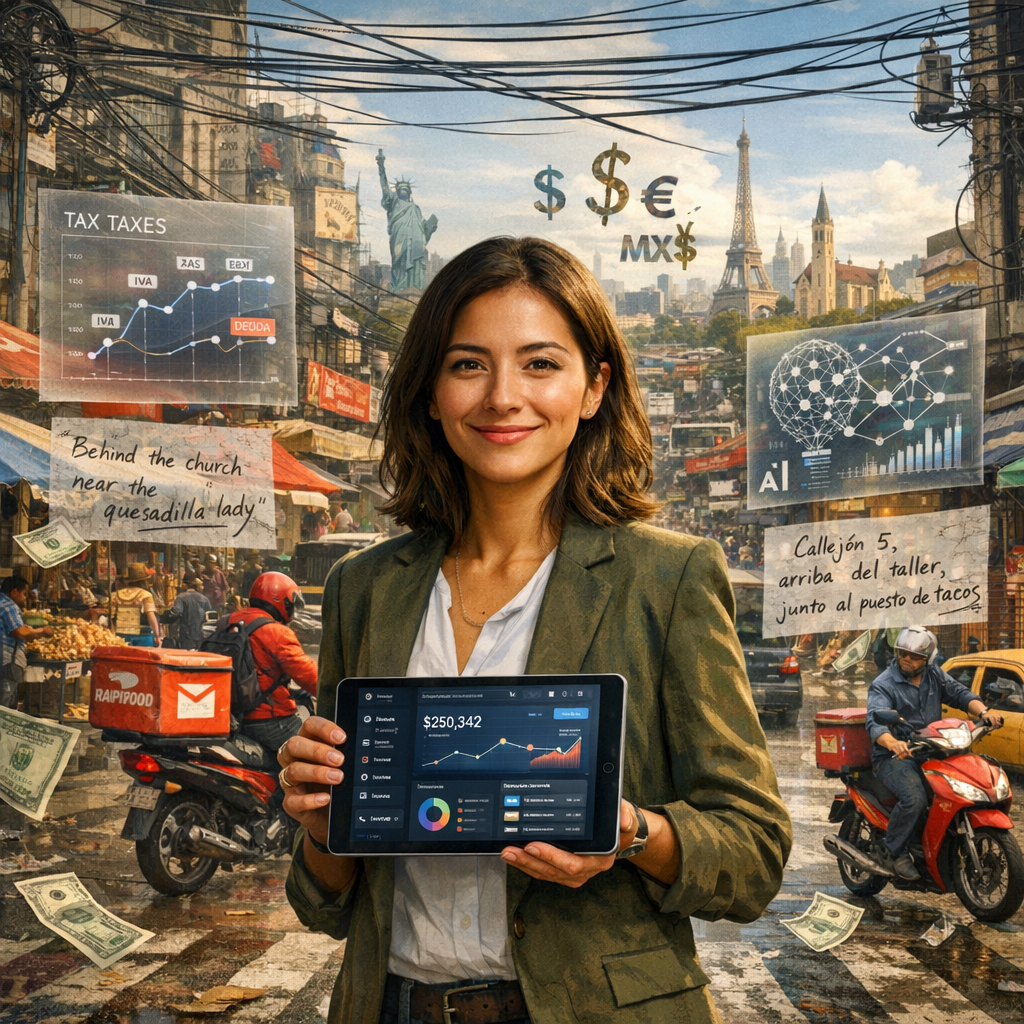
Hard Mode Mexico: A Day in the Life of a Startup That Accidentally Trains for the Olympics
Follow one founder’s chaotic Tuesday in Mexico City to see how informality, low trust, cash-based transactions, and logistical mayhem can accidentally turn Mexican startups into world-class product machines—built on “hard mode” that makes the US and Europe feel like tutorial levels.

The Hook: Tuesday, 7:42 a.m., and the App Just Met Reality
By 7:42 a.m., Sofía’s startup has already technically died twice.
First death: a government portal that’s been “under maintenance” since the Peña Nieto administration.
Second death: a courier who insists an address doesn’t exist because “where it says number 53, it’s actually the blue house next to Don Chuy’s little store.”
On paper, Sofía is the CEO of a shiny Mexican fintech–logistics–SaaS chimera headquartered in Mexico City. In practice, she’s a professional chaos negotiator.
Her app promises three things:
- Open a bank account in minutes without documents.
- Deliver goods to people who technically don’t “have” an address.
- Make taxes make sense in a country where half the economy doesn’t want to talk about taxes.
That’s her sales deck: “Financial inclusion for the underbanked, logistics for the unaddressed, SaaS for the unaccounted.” It sounds visionary until you watch her actual Tuesday and realize this is less “innovation lab” and more “survival reality show.”
By 7:43 a.m., she gets a message from a US investor asking, “What’s your moat?”
Her moat is simple: Mexico.
Not the tourism‑board Mexico of beaches and mezcal tastings—the one where 55% of the workforce is informal, half the population is unbanked, and only about a third of adults use digital payments. The one where bureaucratic mazes, low trust in institutions, cash‑only mentalities, and last‑mile chaos are the default difficulty setting.
Everyone else calls that a handicap.
Sofía calls it her free, very painful accelerator program.
The Genesis: How Sofía Ended Up Coding for the Informal Apocalypse
Sofía didn’t wake up one day and decide, “I want to build products for the statistical abyss.” Like most founders, she started with a polite lie: “We’re building a simple neobank for SMEs.”
Then she met Mexico.
Her first pilot was with a hardware store in Ecatepec. She showed up with a sleek digital onboarding flow.
The owner, Don Jorge, showed up with:
- No recent bank statements,
- No formal tax records,
- A notebook with sales written in pencil,
- And a healthy distrust of anything involving passwords.
“Bank account? No thanks. Last time they froze my cousin’s money because he typed his PIN wrong three times,” he told her.
That was Sofía’s real genesis moment: realizing she wasn’t building around informality, she was building inside it.
She looked around the system and saw the same pattern everywhere:
- Informality as operating system: About 55% of workers function outside the formal system. No clear payslips. No credit history. Just vibes, cash, and maybe WhatsApp receipts.
- Cash as religion: Only about 31.7% of adults used digital payments as of 2018. Everyone else is in a committed relationship with paper money.
- Low trust as policy: People trust their cousin, the shopkeeper, and the lady who runs the tanda more than any institution with a logo.
- Logistics as performance art: Delivery in Mexico isn’t “last mile,” it’s “last improvisation.” Addresses are more like poems than coordinates.
Investors saw “constraints.” Sofía saw a training montage.
If she could build something that survived this, taking it to Chile, Colombia, Brazil, or even the US and Europe would feel like switching from boxing in a parking lot to sparring in a padded gym where everyone follows the rules.
The Invisible Conflict: The World Thinks It’s a Bug, Sofía Knows It’s the Feature
From the outside, everyone insists Mexico is playing with a handicap. Sofía knows the real twist: the handicap is secretly a high‑performance gym.
Her Tuesday is a walking argument against the comfortable startup myth that you need:
- Pristine regulation
- Reliable infrastructure
- Compliant users
In Mexico, you get:
- Regulation like Jenga
- Infrastructure with commitment issues
- Users who treat every app like it might be a scam
And yet, this friction is exactly what forges her product edge.
The invisible conflict isn’t between Mexican startups and “bad conditions.”
It’s between two worldviews:
-
Silicon Valley on Easy Mode
Build for people with credit cards, consistent addresses, and blind trust in digital terms and conditions. -
Sofía on Hard Mode
Build for people with no credit history, fluid addresses, low trust, and a spiritual connection to cash.
The irony: when Sofía expands abroad, the very things investors once saw as her liabilities turn into competitive superpowers.
- She’s built risk models that work with almost no data.
- She’s built logistics that survive in places where Google Maps cries.
- She’s built SaaS that can juggle multiple currencies and tax regimes before breakfast.
Everyone else is training with dumbbells.
She’s been dodging live traffic.
Evidence & Insights: A Tuesday of Accidental Superpowers
Let’s walk through Sofía’s Tuesday as a guided tour of how Mexican “hard mode” constraints turn into world‑class product muscle.
1. 8:15 a.m. – Kiosks, Not Branches: Fintech in the Real World
Sofía starts her day reviewing numbers from a pilot inspired by Aviva, the Mexican fintech operating over 70 physical kiosks for the unbanked.
Her team borrowed a page from that playbook:
- Use AI and natural language processing to onboard users with almost no formal documents.
- Replace long forms with conversational flows.
- Place sign‑up points where people actually are—markets, metro stations, busy plazas.
Why kiosks? Because nearly half of Mexicans are still unbanked and don’t exactly trust abstract “digital clouds.” You show up physically, talk to them, onboard them in minutes, and let AI quietly handle the bureaucratic part.
From the outside, this looks like overkill for a banking app.
From Sofía’s dashboard, it looks like:
- Lower acquisition costs (you meet people where they already congregate)
- Faster onboarding (no document ping‑pong)
- Immediate trust (there’s a human + a screen, not just an app logo)
When she later tests this flow in other Latin American countries with similar underbanked populations, it just works. Then she takes the same product to the US to target immigrant communities who hate paperwork and guess what—her so‑called “emerging market hack” beats the pants off traditional onboarding UX.
Because once you’ve handled no documents, a country that at least has some documentation is basically a spa.
2. 10:27 a.m. – The Taxi That Cannot Find Reality: Logistics as Sport
Next, a Nowports‑style headache.
Sofía’s logistics module was built in the shadow of companies like Nowports, which digitize shipping, customs, and freight in a region where documentation can feel like interpretive dance.
At 10:27 a.m., her operations team pings her:
“New customer. Address reads: ‘Colonia Centro, behind the church, near the lady who sells quesadillas.’ System error.”
The US engineer on the call asks: “Why don’t we just enforce standardized addresses?”
Because Mexico does not care about your standards.
So Sofía’s product leans into the chaos:
- Drivers can pin live locations via WhatsApp or the app.
- The system parses informal address fragments (“in front of the Oxxo,” “between such‑and‑such streets”) and cross‑references landmarks.
- Delivery routes are weighted not just by distance but by predictable chaos: traffic patterns, blocked streets, unrepaired potholes.
This is absurdly hard to build.
But then she pilots the same engine in dense US cities and European towns:
- Suddenly, almost all addresses are formal.
- Traffic is annoying, but not “what if this road just doesn’t exist today?” annoying.
- Customs documentation is still confusing, but compared to Latin American freight bureaucracy, it’s a guided meditation.
Her engine, forged in the logistical equivalent of a mosh pit, feels overqualified.
Meanwhile, someone in San Francisco is still trying to fix their app because an apartment has “Apt. 3” instead of “#3.”
3. 1:03 p.m. – The Cash Drawer vs. The Cloud: Building for People Who Hate Cards
Lunchtime. Sofía goes to meet another client: a small chain of mom‑and‑pop stores that joined her platform.
They operate almost entirely in cash.
The store owner taps her phone with suspicion.
“So you’re saying the money goes inside the phone? And doesn’t get stolen on the way?”
Trust gap, party of eight.
Here’s the irony: this deep distrust forces Sofía to build better systems.
- She designs UIs that show exactly where the money is: on‑device, in transit, in account.
- She sends clear SMS and WhatsApp confirmations for every step.
- She builds a ledger so transparent that even your grandma could audit it.
Mexico’s cash‑first reality, with only a third of adults using digital payments, means that every digital transaction must fight suspicion. So the UX becomes explicit, redundant, almost ritualistic.
Later, when Sofía offers the same flow in the US or Europe, where people already sling cards and Apple Pay without a second thought, users experience it as over‑communicative, ultra‑reassuring fintech.
What felt like survival UX in Mexico becomes premium UX abroad.
4. 3:45 p.m. – SaaS in the Multiplex: Multi‑Currency, Multi‑Tax Madness
Afternoon: SaaS hell.
Sofía’s startup also offers tools similar to platforms like Lounn, which connect SMEs to financing with AI‑driven credit evaluation in a region where banks tend to look at small business applications and quietly close the window.
Her typical SME customer:
- Sells in pesos.
- Buys supplies sometimes in dollars.
- Pays different taxes depending on whether operations are “formal” this quarter.
- Has two realities: the one on the government’s books and the one in the real‑world notebook.
Her SaaS product has to:
- Handle multi‑currency, because even the local supplier occasionally invoices in USD.
- Track multiple tax regimes and edge cases.
- Score creditworthiness off alternative data, because there are no perfect statements.
While many US or European SaaS tools panic when you mention “multiple VAT conditions and informal cash flows,” Sofía’s system yawns.
She built for messy.
Messy is her hometown.
Later, when she sells into Spain or a US state with one or two clean tax regimes, she just flips a few switches. The engine originally designed to survive Mexico’s spaghetti code of tax and semi‑formal behavior now runs in a straight hallway.
Her “handicap” becomes her export‑grade superpower.
The Winners vs. Losers Scorecard
Here’s how Sofía’s world compares to the international “standard mode.”
| Category | Easy‑Mode Startup (US/EU) | Hard‑Mode Mexican Startup (Sofía) |
|---|---|---|
| User Documentation | Full KYC, payslips, credit history | Verbal data, WhatsApp bills, gossip as signal |
| Payment Behavior | Card‑first, digital‑friendly | Cash‑first, suspicious of anything invisible |
| Logistics | Standardized addresses, steady roads | Landmarks, improvised addresses, episodic infrastructure |
| Regulation | Annoying, but mostly stable | Complex, shifting, occasionally interpretive |
| Tax & Currency | Single currency, 1–2 tax regimes | Multiple currencies, layered tax logics, informality halos |
| Trust in Institutions | Medium to high | Chronically low |
| Design Constraint | Convenience | Survival |
| Resulting Product | Comfortable for mainstream users | Over‑engineered resilience that travels well |
The punchline: everything that makes life harder for Sofía makes her product more globally adaptable.
The Timeline of “This is a Bug” Turning Into “Wait, This is Our Edge”
| Stage | Sofía’s Initial Reaction | New Understanding |
|---|---|---|
| Discovering informality | “No one has paperwork. We’re doomed.” | “We build credit models on alternative data; everyone else copies later.” |
| Seeing cash dominance | “They don’t want cards. Adoption will be slow.” | “We design ultra‑clear UX; abroad it feels luxurious and safe.” |
| Facing logistics chaos | “Addresses are feelings, not facts.” | “We build navigation that works anywhere; other markets feel trivial.” |
| Wrestling with regulation | “Another procedure changed yesterday.” | “Our compliance engine is so flexible other countries are just checkboxes.” |
The Strategic Shift: From Surviving Mexico to Exploiting the Difficulty Settings
By 5:30 p.m., Sofía is on yet another Zoom with foreign investors.
They ask the same question again: “Okay, but how will this scale in the US and Europe?”
The real question they should ask is: “How will your US and European competitors survive if they have never had to?”
Here’s the uncomfortable strategic truth: Mexican founders like Sofía have been so busy surviving that they sometimes forget to weaponize their scars.
So what does a strategic shift look like?
1. Stop Hiding the Chaos; Market It
Instead of apologizing for building in a “tough environment,” frame it as what it actually is: an extreme training facility.
Pitch deck translation guide:
- “We operate in a challenging regulatory environment” → “Our architecture treats regulation as a variable, not a constant, so new countries are configuration, not surgery.”
- “Users are distrustful of institutions” → “Our UX is built to earn trust from skeptics; convincing already‑trusting users is trivial.”
- “Logistics are messy” → “Our routing intelligence was built for places where addresses are folklore; structured systems are our vacation.”
2. Product Strategy: Build for the Worst, Toggle Down for the Rest
Sofía restructures her product roadmap around a simple rule: design for Mexico as the upper bound of chaos, then give everyone else the simplified version.
- Risk engine: calibrated to work with almost no formal data → in Spain, she just turns off half the hacks.
- Logistics engine: can parse “behind the church” → in Chicago, she just lets Google Maps relax.
- SaaS tax logic: remembers 12 different tax combinations → in Germany, she gives you the one legal way to suffer.
This is not “add complexity for fun.” It’s “embrace the maximum complexity once, then let the rest of the world live on Easy Mode.”
3. Culture: Hire People Who Have Actually Touched the Problem
Sofía stops fetishizing the Silicon Valley hire and starts maximizing the person who has:
- Waited 3 hours in a bank just to be denied.
- Lost a package to an address that “wasn’t on the map.”
- Filed taxes in a system that feels like a riddle.
You can teach frameworks.
You can’t teach the haunted look of someone who has tried to reconcile receipts from a semi‑formal business that kind of exists.
This is where Mexico’s own ecosystem comes in:
- Nearly 1,000 fintech initiatives as of 2024.
- Startups like Konfío securing major investment (like SoftBank’s $100M in 2024) by solving credit for SMEs that banks avoid.
- Platforms like Lounn automating credit evaluation in a cash‑centric reality.
The people building and using these tools are not theorizing hardship—they’re living it.
4. Expansion Playbook: Start With the Other “Hard Modes,” Then Walk Backward
Instead of sprinting straight to New York and London, Sofía maps her expansion like this:
-
Other Latin American markets with similar constraints: Colombia, Peru, maybe Brazil.
The product barely flinches. -
Emerging markets outside the region with cash‑heavy, low‑trust behaviors.
-
Then, once the product has proven it can survive multiple flavors of chaos, she goes to the US and Europe not as a scrappy outsider but as the vendor who already solved the harder version of their problem.
That’s the narrative she’s been missing.
Not “we’re catching up.”
But “we trained at altitude. You didn’t.”
The Big Picture: Mexico as the Unwanted, Unpaid R&D Lab for the World
By 9:17 p.m., Sofía is finally home.
Her app did not crash. Her couriers mostly found their destinations. Her SaaS tax engine only screamed twice.
She scrolls through international tech press on her phone. The usual headlines:
- “Fintech in Emerging Markets Faces Adoption Challenges”
- “Informality Limits Credit Growth”
- “Logistics Hurdles Persist in LatAm”
Everything is framed as a deficit.
No one writes:
“Mexico Accidentally Becomes the World’s Most Brutal Product Bootcamp.”
Yet that’s what her day actually demonstrates.
- Informality forces better credit models and alternative risk scoring.
- Low trust forces transparent, humane UX instead of dark‑pattern choreography.
- Cash dominance forces products to coexist with physical money instead of pretending it doesn’t exist.
- Logistics chaos forces robust routing, redundancy, and human‑in‑the‑loop systems.
When these products step into more orderly markets, they carry something competitors lack:
They have been tested where failure is constant, documentation is optional, and “address” can mean “that tree over there.”
The irony is almost too on the nose:
- The more Mexico resists clean modernization,
- The sharper the tools become for operating in the mess,
- The more those tools make sense in the rest of the world.
Of course, this doesn’t mean the chaos is “good.” People still suffer from exclusion, delays, and mistrust. But when founders like Sofía decide that if they must live inside this dysfunctional training camp, they might as well export the survival gear, something interesting happens:
Mexico stops being the tragic backdrop and becomes the unsung co‑founder.
Tomorrow morning, another investor will ask her how she’ll compete against US and European players.
She won’t say “We’re catching up.”
She’ll say:
“We’ve been shipping in a market where half the economy doesn’t officially exist, people don’t trust institutions, and addresses are urban legends. Tell me again about your ‘challenging’ US expansion.”
And for once, that won’t just be a punchline.
It will be the strategy.
References
- ABAC E‑Formalization Report. “E‑Formalization and Digital Financial Inclusion in APEC Economies,” December 2024. Data on Mexico’s informal workforce and digital transaction rates. https://km.fti.or.th/wp-content/uploads/2024/12/ABAC_E-Formalization_Report.pdf
- Mexico Business News. “Mexican SMEs Struggle with Credit and Digitalization Gaps.” Discussion of how informality limits SME access to credit. https://mexicobusiness.news/entrepreneurs/news/mexican-smes-struggle-credit-and-digitalization-gaps
- Latam Republic. “Cuantico VP Highlights Top Mexican Startups to Watch in 2026.” Profile of Aviva’s AI‑driven digital banking kiosks for the unbanked. https://www.latamrepublic.com/cuantico-vp-highlights-top-mexican-startups-to-watch-in-2026/
- Hispanic Executive. “5 Latino Startups to Watch in 2024.” Overview of Nowports and its role in digitizing international freight and customs. https://hispanicexecutive.com/5-latino-startups-2024/
- Wikipedia (ES). “Lounn.” Description of Lounn as a digital marketplace for SME financing with AI‑based credit evaluation. https://es.wikipedia.org/wiki/Lounn
- Latam List. “10 Mexican Startups to Watch in the New Year.” Includes Konfío and references SoftBank’s $100M investment in 2024. https://latamlist.com/10-mexican-startups-to-watch-in-the-new-year/
- Sinergia Empresarial. “How Mexican Startups Are Leading Latin America’s Tech Revolution,” 2025. Discussion of STEM talent, healthtech and agritech innovation, and government programs like Startup Mexico and the Digital Transformation Fund. https://sinergiaempresarial.mx/2025/10/how-mexican-startups-are-leading-latin-americas-tech-revolution/
- Stats and Market Insights. “Mexico Startup Ecosystem in 2025: A Year of Resilience and Transformation.” Data on infrastructure improvements and $1.5B in e‑commerce and logistics investments in 2024. https://www.statsandmarketinsights.com/blog/42/mexico-startup-ecosystem-in-2025-a-year-of-resilience-and-transformation
- Panorama Advisors. “The Real Challenges Facing Tech Companies Transforming Their Business Models in Mexico.” Insights on logistics bottlenecks and infrastructure fragmentation. https://www.panoramadvisors.com/post/the-real-challenges-facing-tech-companies-transforming-their-business-models-in-mexico
- MSM Times. “Mexico’s Fintech Revolution: A New Era of Financial Innovation,” 2025. Overview of nearly 1,000 fintech initiatives and drivers like smartphone adoption. https://www.msmtimes.com/2025/04/Mexicos-Fintech-Revolution-A-New-Era-of-Financial-Innovation.html
Related Articles

Who Stole the Value? A Forensic Audit of Giants, Startups, and the Customer Left Out of the Deal
Treating today’s innovation economy as a crime scene, this essay investigates what quietly disappears when incumbents and startups reshape finance, health, retail, mobility, education, and climate tech. Beyond pitch decks and marble lobbies, who actually captures the value—and at what human cost?

The Year We Misread the Checkbox: How a Single UX Choice Rewired Giants and Startups
Writing from 2050, a radical futurist looks back on 2024 and argues that the true battle between traditional industries and startups in banking, retail, health, and mobility never took place in boardrooms or pitch decks, but inside a single, tiny UX artifact: the checkbox. By following that microscopic element, this manifesto rewrites the history of incumbents vs. startups as a struggle over who controls consent, data, and time.

The scene of the silent crime: where has courage been lost between giants and startups?
A monk‑analyst steps onto the “crime scene” of the digital economy—financial services, retail, healthcare, mobility, education, and manufacturing—to investigate a silent disappearance: the deeper value that customers, workers, and communities expected from the transformation between traditional industry and the startup ecosystem.