When Excel Bleeds: What Banking, Retail, and Healthcare Only Learn When It’s Already Too Late
A hands-on engineer compares banking, retail, and healthcare from where it really hurts: system failures, broken journeys, and collaborations that only exist in PowerPoint. This isn’t theory; it’s what holds up—or blows up—in production.

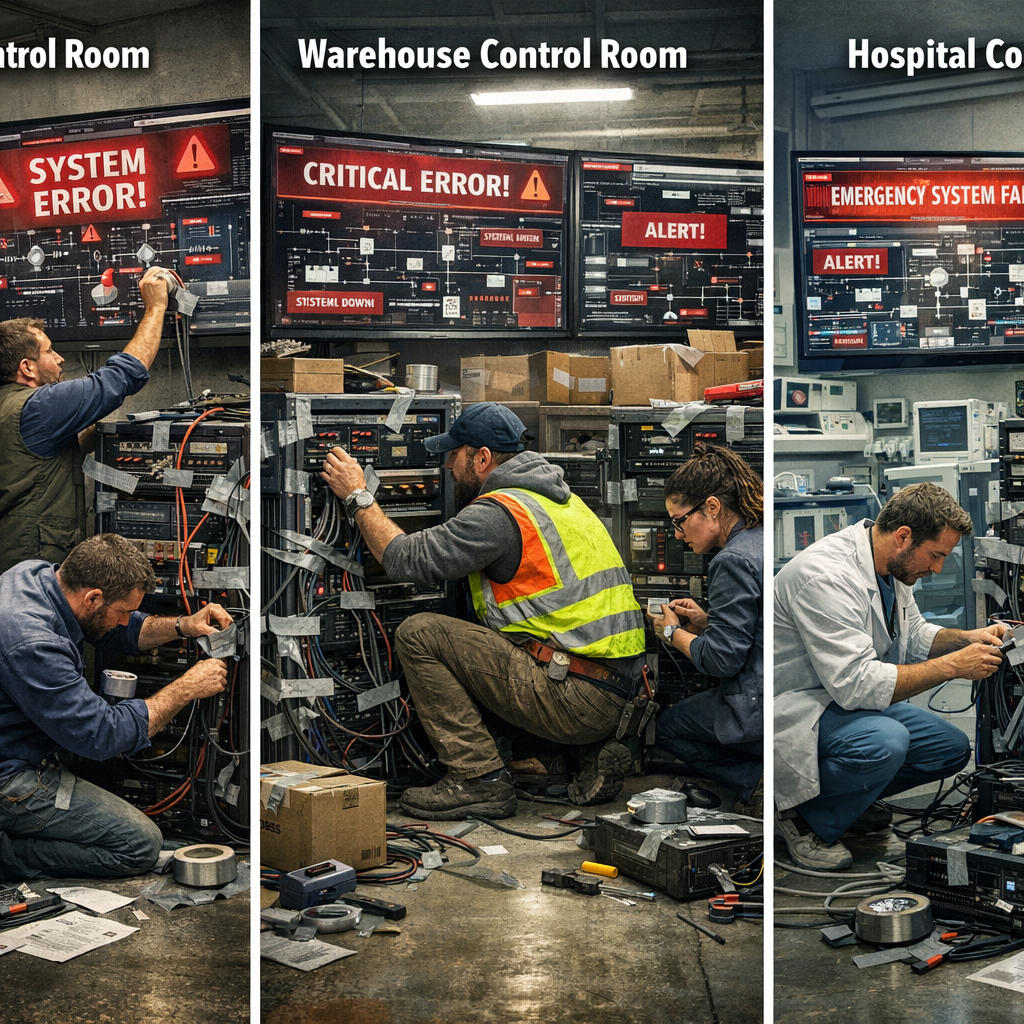
The Hook: Three red screens in the same morning
08:03. Monday.
The core banking system shows critical latency just when thousands of users try to log in to pay their mortgage. The digital onboarding system, half‑built on a 30‑year‑old legacy stack, freezes at KYC verification. Calls to the call center spike. On the dashboard no one is looking at the user; they’re only looking at the SLA.
09:17.
A retailer with 300 physical stores launches its “total omnichannel” campaign. The banner is everywhere, but the actual stock isn’t. The website confirms 24‑hour delivery; the central warehouse knows that SKU hasn’t existed for three days. The picking robot is searching for a phantom product, the marketing promise blows up in negative reviews.
10:42.
In a clinic, the telemedicine platform is “temporarily unavailable.” The healthtech provider applies a patch in production because a shiny new API‑first payments module doesn’t understand that the hospital’s appointment system is basically an Excel file with a pretty interface. Patients without links, doctors waiting in front of a black webcam.
Three sectors, same pattern: the PowerPoint sells perfect integration; reality is digital duct tape.
Here we’re not going to talk about “ecosystems” like they’re some Silicon Valley sunset. We’re going to look, sector by sector, at where things actually break between incumbents and startups, which models can take real hits, and which collaborations only work as long as nobody touches production.
The Genesis: How we ended up with marble castles on COBOL basements
1. Banking/Finance: Regulated to the bone, with fintech breathing down their necks
Traditional banking reached 2020 with almost everything in its favor: licenses, capital, brand, branch network and regulation that makes greenfield entry almost an extreme sport. Even so, in parallel a swarm of fintechs grew that never wanted to be a “full bank”: they focused on slices —payments, onboarding, consumer credit, light investing— using cloud, APIs and journeys designed for thumbs rather than teller windows.
In markets like Italy, the numbers show the paradox. On one side, banks like Banca Finint closed 2023 with a 16% increase in consolidated gross profit (around €26.8 million) and a 17% increase in net profit (€18.9 million). Banca Sistema, for its part, grew its factoring volumes by 26%, exceeding €5.5 billion in acquired receivables. The old model still prints money.
On the other side, the same sector cut more than 60,000 jobs globally in 2023, one of the worst years for layoffs since the financial crisis. Rates, extraordinary deals and cost pressure are pushing digitalization… but with extreme care not to pull the wrong cable in the core.
The typical incumbent response: launch its own “internal neobank,” as Intesa Sanpaolo did with isybank, targeting young customers who no longer set foot in branches. In other words, build a parallel bank to escape legacy… without being able to fully escape it.
2. Retail/Commerce: Between the physical warehouse and the one‑click promise
Classic retail built its edge on square meters, locations, logistics and supplier negotiation. The physical store as the center of the universe. Retail startups —especially e‑commerce and marketplaces— changed the rules: experience centered on web/app, cloud platforms, marketplace models like Mercado Libre that charge commissions, add advertising and sell logistics as a service.
The underlying forces are simple and cruel:
- Manageable regulation, but with more scrutiny on consumer and data protection.
- Margins squeezed by online competition and logistics costs.
- A consumer who no longer forgives friction, but also doesn’t want to pay more for zero friction.
- Barriers to entry that have dropped on the front (anyone can open an online store) and risen in the back (logistics, last mile, returns, 24/7 customer support).
3. Health/Healthtech: Where “move fast” crashes into informed consent
In health care, the competitive context is far less free. Hospitals, clinics, insurers and professionals operate under strict regulation, margins constrained by operating costs and political pressure, and a user/patient who mixes distrust, fear and urgency.
Healthtech startups slip in through the cracks: telemedicine, remote monitoring, interoperable medical records (in theory), AI‑based triage, appointment‑coordination platforms. They offer accessibility and efficiency, but run smack into two hard barriers: scientific validation and patient trust.
Meanwhile, the average hospital still runs on a combination of:
- Old HIS (Hospital Information Systems).
- Modules bought from different vendors that talk to each other only so‑so.
- Processes just as paper‑dependent as 20 years ago, but now with tablets on top.
The Invisible Conflict: It’s not “old vs. new,” it’s “who owns production”
The classic narrative sells this as a war between slow giants and fast startups. In the trenches it doesn’t look like that. What you see is a silent fight over control of the real system:
- Who decides the business logic that runs at 03:00 AM in the payment batch?
- Who can touch the real‑time stock system when Black Friday blows up the site?
- Who has permission to change, without asking for an audience, the flow of an online medical appointment?
In banking, retail and health, incumbents and startups clash less over ideology and more over three very concrete points:
-
Ownership of the data and the critical transaction.
The bank wants the transaction to live in its core. The fintech wants to orchestrate it on its platform. The retailer wants the ticket to be born in its ERP. The marketplace wants to own the checkout. The hospital wants the medical act to reside in its medical record. The healthtech wants to do triage outside and then “sync.” -
Pace of change.
The banking core is designed for annual changes. The fintech app deploys twice a day. The retailer plans collections by season; the e‑commerce startup changes pricing every hour. The hospital thinks in accreditation and budget cycles; the healthtech in sprint cycles. -
Assignment of blame when something breaks.
This is the real battleground. When a payment doesn’t settle, an order is lost, or an appointment isn’t booked, who faces the music? The well‑known logo or the “innovative” app?
While committees talk about “synergies,” the real conflict gets settled in logs, service‑level contracts and who has root access.
Evidence & Insights: Three sectors, three different ways to bleed from the same wound
1. Banking/Finance: Profits on paper, friction in the journey
Let’s put an honest picture on the table.
Table 1. Traditional banks vs. fintechs (real operating model)
| Dimension | Traditional banks | Fintech startups |
|---|---|---|
| Regulation | High, direct, continuous supervision | High but often indirect (license‑dependent), often via bank partner |
| Margins | Tight on commoditized products; comfortable in niches | Volume‑ and fee‑dependent; pressure on unit economics |
| Infrastructure | Legacy core, mainframes, overnight batch | Cloud‑native, microservices, public and private APIs |
| Time‑to‑market | Months/years per critical release | Weeks/days per new app feature |
| Main monetization | Interest, fees, product cross‑selling | Subscriptions, transactional fees, freemium models |
| Onboarding automation | Partial; KYC often manual or semi‑manual | Very high; digital KYC, OCR, biometrics |
| Role of physical channel | Branches as central asset (though in decline) | None; fully digital |
| Personalization capability | Limited by systems and broad segmentation | High; AI models and granular segmentation |
Data such as that from Banca Finint and Banca Sistema show that the traditional model can keep growing in profits and volumes. At the same time, the sector as a whole is cutting 60,000 people. Translated: the business holds, but the structure is starting to crack.
Meanwhile, financial literacy in Italy rose from 10.2 to 10.7 out of 20 between 2020 and 2023. It’s a slight improvement, but still a low level. The user doesn’t fully understand the products, but they do recognize an app that solves things without having to call anyone. That understanding gap is the preferred playing field for many fintechs: simplify the facade without changing the background complexity.
The result is an odd mix: banks still making money, but forced to launch internal neobanks and cut staff; fintechs growing in users but dependent on those same banks’ cores to survive.
2. Retail/Commerce: The pixel promises more than the pallet can deliver
Here friction is usually not in regulation but in physics:
- E‑commerce can sell whatever it wants, but someone has to move boxes.
- The marketplace advertises “24‑hour delivery,” but the logistics operator has its own reality.
Table 2. Traditional retail vs. e‑commerce startups
| Dimension | Traditional retail | E‑commerce / marketplace startups |
|---|---|---|
| Main channel | Physical store, catalog, call center | Web, mobile app, social integrations |
| Revenue model | Margin on product sold | Commissions, ads, logistics services, subscriptions |
| Vertical integration | High: buys, stores, distributes | Variable: many operate as platforms between third parties |
| Tech infrastructure | POS + ERP + bolted‑on e‑commerce | Cloud platform, microservices, third‑party orchestration |
| Stock management | Centralized, designed for physical channel | Dynamic, often drop‑shipping and external sellers |
| UX | Store‑centered; digital as complement | Mobile‑first, recommenders, conversational design |
| Returns | Physical processes, queues, paper | Automatic labels, lockers, home pickup |
Pressure comes from a consumer who, after getting used to efficient platforms, no longer tolerates friction in the traditional store. But many “digital incumbents” have also discovered the physical limit: you can’t promise everything, all the time, at zero cost.
The startups that survived the initial hype are those that quickly realized the war wasn’t just in the app, but in reverse‑logistics engineering, stock‑information quality and the brutal reality of massive returns.
3. Health/Healthtech: Digital helps… until you need to change a clinical protocol
Health care has a couple of boundary conditions that no pitch deck fixes:
- When it fails, someone doesn’t just lose an order; they lose diagnostic time.
- Regulation doesn’t just look at data; it looks at clinical outcomes.
In practice we see:
- Telemedicine platforms that monetize via subscription (clinics, insurers) or per‑consultation fees.
- Device startups that sell hardware + data services (remote monitoring, pattern analysis).
- Software solutions that try to connect heterogeneous systems and turn the medical record into something minimally coherent.
The technology is usually cloud, APIs, specialized modules. The problem is that they land in hospitals where:
- The appointment system is tied to internal billing.
- Any change in flow requires a committee, validation and sometimes external audit.
- Clinical staff are overloaded and not in the mood to “test a new app every quarter.”
The cultural clash is stronger than in banking or retail. Where a bank can spin up a neobank and a retailer a new online channel, a hospital can’t just open a “parallel digital mini‑hospital” without redistributing clinical responsibility. The margin for error is different.
The Strategic Shift: What has to change isn’t the pitch, it’s the system topology
Here’s where I drop the PowerPoint and speak as an engineer: the cross‑sector problem in banking, retail and health isn’t lack of ideas. It’s poor collaboration architecture.
1. Redesign where the “truth” of the business lives
Across all three sectors, incumbents and startups need to stop fighting over who has the best app and start precisely defining:
-
What is the system of record for each critical entity?
Bank account, order, medical act. -
Which system can write, and under what rules?
If the fintech can create an account, who validates KYC? If the marketplace can mark stock, who’s accountable for inventory? If the healthtech can book appointments, who’s accountable if the doctor doesn’t show?
This isn’t philosophy; it’s API design, contracts and data governance.
2. In banking: less “lab neobank,” more pluggable components
Banks that want to stay alive should assume:
-
The legacy core won’t disappear in five years.
Patching it as if it were a microservice won’t work. -
The useful fintechs aren’t the ones that promise to replace the entire bank, but those solving specific pieces: onboarding, alternative scoring, payment UX, financial education.
Practical actions:
- Expose well‑defined internal APIs, with clear responsibility boundaries.
- Accept that certain startups will be specialized fronts on top of the same banking infrastructure.
- Invest in financial literacy not as CSR, but as friction reduction: fewer calls, fewer errors, fewer reprocesses. The Italian figure (10.7 out of 20 in 2023) isn’t just a social indicator; it’s the hidden support bill.
3. In retail: treat logistics as product, not as punishment
For traditional retailers:
- Real omnichannel means the stock system doesn’t lie. Period.
- POS, warehouse and online store systems must talk in real time, not via nightly reconciliations.
For startups:
- Perfect UX with mediocre logistics kills reputation just as fast as for an incumbent.
- Partnering with serious logistics operators and co‑designing the service contract matters more than the loading‑bar animation.
The useful strategy here isn’t “be more digital,” but to identify physical bottlenecks and automate around them: smart picking, returns classification, dynamic routing.
4. In health: respect clinical reality first, then optimize
Healthtech startups tend to apply a generic SaaS playbook to an environment that isn’t generic.
Concrete changes:
- Design products around the real clinical protocol, not forcing the doctor to adapt to the software flow.
- Assume long validation and pilot cycles from day one.
- Work with clinical metrics, not just NPS and retention.
Health incumbents, for their part, must stop seeing technology as “IT” and treat it as part of the care model. Successful collaboration shares risk: clear clinical governance, SLAs that handle failures gracefully, and contingency plans for when the platform goes down.
The Big Picture: The only “ecosystem” that matters is the one that doesn’t break in the user’s worst hour of the day
Banking, retail and health care look like different worlds: hard vs. soft regulation, money vs. physical goods vs. human lives. But from inside the system —where I work, where the support tickets land— they all share something uncomfortable: most conflicts between incumbents and startups don’t come from the technology choices, but from the lack of discipline in deciding who controls what, when and how.
The easy narrative talks about a war of models; what we see in production is a slow convergence toward hybrid architectures where old and new coexist, fight and, with luck, learn not to fall over precisely when the customer, the buyer or the patient can least afford it.
References
- Banca Finint closes fiscal year 2023 with growth, consolidated gross profit +16%, net profit €18.9 million. finanza.repubblica.it, March 26, 2024.
- Banca Sistema increases factoring volumes by 26% in 2023, surpassing €5.5 billion in acquired receivables. finanza.repubblica.it, January 12, 2024.
- Banca d'Italia. “Le competenze finanziarie degli italiani: i risultati della terza indagine campionaria,” 2023. Average financial literacy score 10.7/20, up from 10.2/20 in 2020.
- “Anno nero per i dipendenti delle banche: tagli per oltre 60mila persone.” la Repubblica, December 26, 2023.
- Isybank, digital bank of Intesa Sanpaolo launched in 2023, aimed at young, digital customers. it.wikipedia.org.
- “Industria y startups, clave para el desarrollo empresarial.” ecosistemastartup.com. Analysis of collaboration between traditional industry and startups as a driver of technological upgrade and channel access.
- Study on sports leadership in competitive contexts: the combination of instruction and reinforcement is perceived as the most effective style, especially in youth categories. pepsic.bvsalud.org.
- Study on consumer behavior in competitive contexts: customer satisfaction directly impacts profitability and strategic decisions. repositorio.udesa.edu.ar.
- Concept of competitive equilibrium as a state in which supply and demand are equal and prices reflect the value of goods and services. pt.wikipedia.org.
Related Articles

Who Stole the Value? A Forensic Audit of Giants, Startups, and the Customer Left Out of the Deal
Treating today’s innovation economy as a crime scene, this essay investigates what quietly disappears when incumbents and startups reshape finance, health, retail, mobility, education, and climate tech. Beyond pitch decks and marble lobbies, who actually captures the value—and at what human cost?

The Year We Misread the Checkbox: How a Single UX Choice Rewired Giants and Startups
Writing from 2050, a radical futurist looks back on 2024 and argues that the true battle between traditional industries and startups in banking, retail, health, and mobility never took place in boardrooms or pitch decks, but inside a single, tiny UX artifact: the checkbox. By following that microscopic element, this manifesto rewrites the history of incumbents vs. startups as a struggle over who controls consent, data, and time.

The scene of the silent crime: where has courage been lost between giants and startups?
A monk‑analyst steps onto the “crime scene” of the digital economy—financial services, retail, healthcare, mobility, education, and manufacturing—to investigate a silent disappearance: the deeper value that customers, workers, and communities expected from the transformation between traditional industry and the startup ecosystem.